QUESTION IMAGE
Question
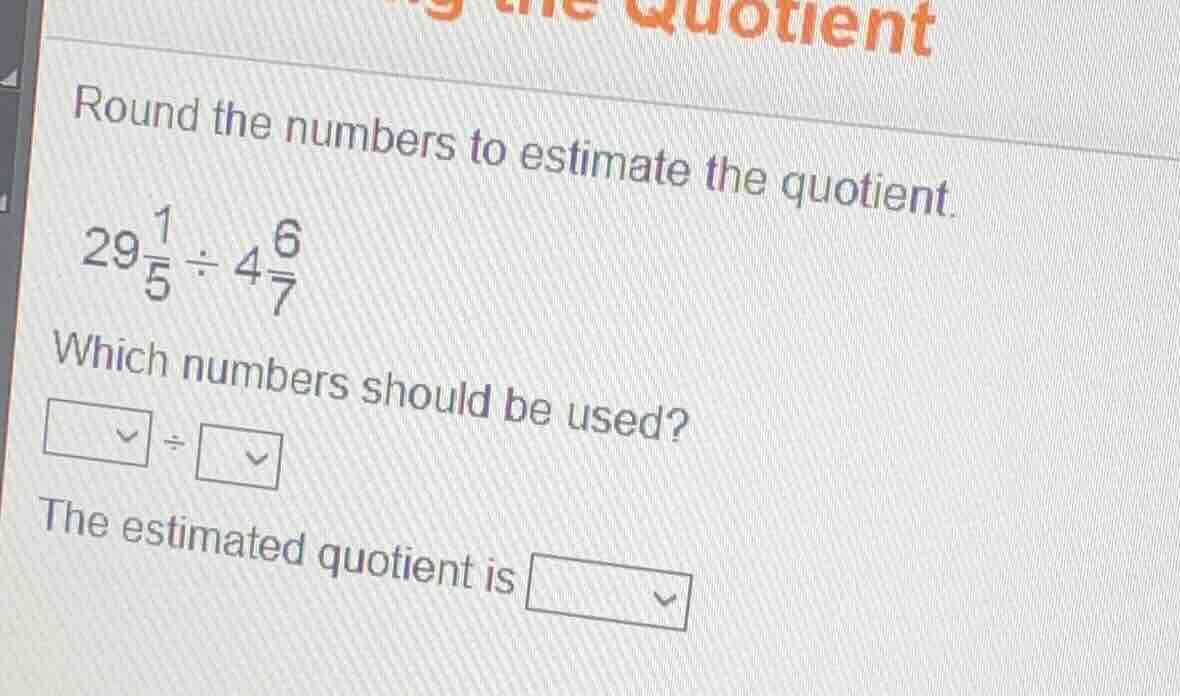
round the numbers to estimate the quotient.
$29\frac{1}{5} \div 4\frac{6}{7}$
which numbers should be used?
$\square \div \square$
the estimated quotient is $\square$
Step1: Round the mixed numbers
First, round \( 29\frac{1}{5} \). Since \( \frac{1}{5}=0.2 \), \( 29\frac{1}{5} \) is close to 29 or 30. But for estimation, \( 29\frac{1}{5} \approx 30 \) (because \( \frac{1}{5} \) is small, but 29 is close to 30, and maybe a better round is to 30? Wait, actually, \( 29\frac{1}{5} = 29.2 \), which is closer to 30? Wait, no, 29.2 is closer to 30? Wait, 29.2 is 0.8 away from 30 and 0.2 away from 29? Wait, no: 29.2 - 29 = 0.2, 30 - 29.2 = 0.8. So actually, \( 29\frac{1}{5} \) is closer to 29. But maybe for estimation, we can round to 30. Then \( 4\frac{6}{7} \): \( \frac{6}{7} \approx 0.857 \), so \( 4\frac{6}{7} \approx 5 \) (since it's close to 5). Wait, but \( 4\frac{6}{7} \) is \( 4 + \frac{6}{7} \approx 4.857 \), which is closer to 5? Wait, 4.857 is 0.143 away from 5 and 0.857 away from 4? No, 4.857 - 4 = 0.857, 5 - 4.857 = 0.143. So yes, closer to 5. Wait, but maybe another approach: round the mixed numbers to the nearest whole number. \( 29\frac{1}{5} \): the fraction part is \( \frac{1}{5}=0.2 \), which is less than 0.5, so we round down? Wait, no, 29.2: when rounding to the nearest whole number, 0.2 is less than 0.5, so 29.2 rounds to 29? But 29.2 is closer to 29. But maybe the problem expects rounding to the nearest ten? No, the numbers are 29 and 4, so maybe round \( 29\frac{1}{5} \) to 30 (since 29 is close to 30) and \( 4\frac{6}{7} \) to 5 (since \( \frac{6}{7} \) is close to 1, so 4 + 1 = 5). Wait, let's check: \( 29\frac{1}{5} \approx 30 \), \( 4\frac{6}{7} \approx 5 \). Then the division would be \( 30 \div 5 \).
Wait, but maybe I made a mistake. Let's re-examine: \( 29\frac{1}{5} = 29.2 \), which is 29 + 0.2, so when estimating, maybe we can round to 30 (since 29.2 is close to 30, or maybe 29? But 29 divided by 5 is 5.8, 30 divided by 5 is 6. Let's see. Wait, the problem is to estimate the quotient, so we need to round each mixed number to a whole number that's easy to divide. So \( 29\frac{1}{5} \approx 30 \) (because 29.2 is close to 30, and 30 is a multiple of 5, which is good for division), and \( 4\frac{6}{7} \approx 5 \) (because \( \frac{6}{7} \) is almost 1, so 4 + 1 = 5). So we use 30 and 5.
Step2: Perform the division
Now, divide the rounded numbers: \( 30 \div 5 = 6 \).
Wait, but let's check again. Maybe \( 29\frac{1}{5} \) is rounded to 29? But 29 divided by 5 is 5.8, which is close to 6. But 30 divided by 5 is exactly 6, which is a cleaner estimate. So the numbers to use are 30 and 5, and the estimated quotient is 6.

Snap & solve any problem in the app
Get step-by-step solutions on Sovi AI
Photo-based solutions with guided steps
Explore more problems and detailed explanations
The numbers to use are \( 30 \div 5 \), and the estimated quotient is \( 6 \).