QUESTION IMAGE
Question
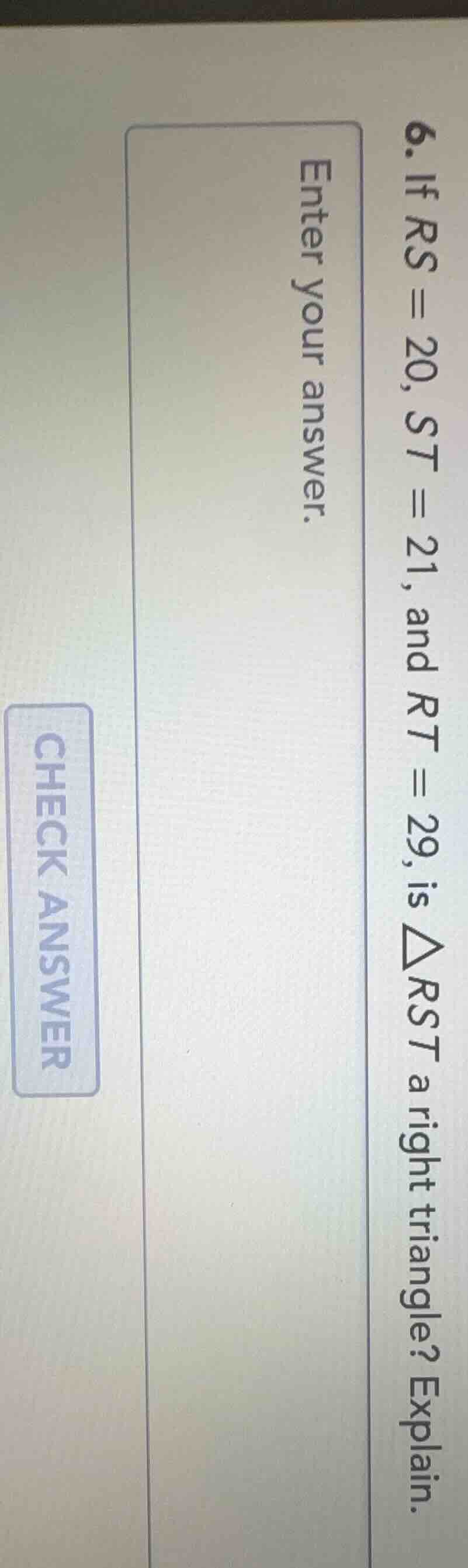
- if rs = 20, st = 21, and rt = 29, is △rst a right triangle? explain. enter your answer. check answer
Step1: Recall Pythagorean theorem
For a triangle with side lengths \(a\), \(b\), and hypotenuse \(c\) (the longest side), the Pythagorean theorem states \(a^{2}+b^{2}=c^{2}\) if it is a right triangle. Here, the sides are \(RS = 20\), \(ST=21\), and \(RT = 29\). The longest side is \(RT = 29\), so we check if \(RS^{2}+ST^{2}=RT^{2}\).
Step2: Calculate \(RS^{2}+ST^{2}\)
Calculate \(RS^{2}\): \(20^{2}=400\). Calculate \(ST^{2}\): \(21^{2} = 441\). Then \(RS^{2}+ST^{2}=400 + 441=841\).
Step3: Calculate \(RT^{2}\)
Calculate \(RT^{2}\): \(29^{2}=841\).
Step4: Compare the two results
Since \(RS^{2}+ST^{2}=841\) and \(RT^{2}=841\), we have \(RS^{2}+ST^{2}=RT^{2}\). By the Pythagorean theorem converse, \(\triangle RST\) is a right triangle.

Snap & solve any problem in the app
Get step-by-step solutions on Sovi AI
Photo-based solutions with guided steps
Explore more problems and detailed explanations
Yes, \(\triangle RST\) is a right triangle. Because \(RS^{2}+ST^{2}=20^{2}+21^{2}=400 + 441 = 841\) and \(RT^{2}=29^{2}=841\), so \(RS^{2}+ST^{2}=RT^{2}\), which satisfies the Pythagorean theorem converse, indicating it is a right triangle.