QUESTION IMAGE
Question
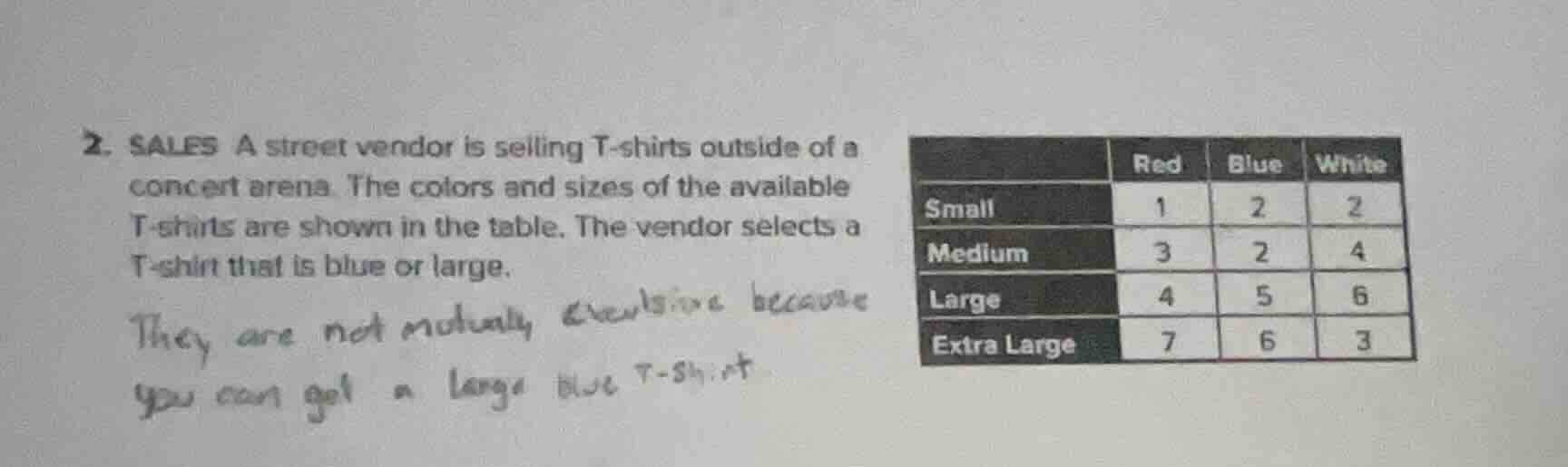
- sales a street vendor is selling t - shirts outside of a concert arena. the colors and sizes of the available t - shirts are shown in the table. the vendor selects a t - shirt that is blue or large. they are not mutually exclusive because you can get a large blue t - shirt
To determine the number of T - shirts that are blue or large, we use the principle of inclusion - exclusion for sets. The formula for \(n(A\cup B)=n(A)+n(B)-n(A\cap B)\), where \(A\) is the set of blue T - shirts and \(B\) is the set of large T - shirts.
Step 1: Find \(n(A)\) (number of blue T - shirts)
We sum up the number of blue T - shirts across all sizes.
For small: \(2\), medium: \(2\), large: \(5\), extra large: \(6\).
So \(n(A)=2 + 2+5 + 6=15\)
Step 2: Find \(n(B)\) (number of large T - shirts)
We sum up the number of large T - shirts across all colors.
For red: \(4\), blue: \(5\), white: \(6\).
So \(n(B)=4 + 5+6 = 15\)
Step 3: Find \(n(A\cap B)\) (number of T - shirts that are both blue and large)
From the table, the number of T - shirts that are blue and large is \(5\). So \(n(A\cap B) = 5\)
Step 4: Calculate \(n(A\cup B)\)
Using the formula \(n(A\cup B)=n(A)+n(B)-n(A\cap B)\)
Substitute \(n(A) = 15\), \(n(B)=15\) and \(n(A\cap B)=5\) into the formula:
\(n(A\cup B)=15 + 15-5=25\)
If the question was about whether the events "selecting a blue T - shirt" and "selecting a large T - shirt" are mutually exclusive, the answer is that they are not mutually exclusive. Because a T - shirt can be both blue and large (as seen from the table, there are 5 T - shirts that are both blue and large), and mutually exclusive events cannot occur at the same time.
If the question was about the number of T - shirts that are blue or large, the answer is \(25\) as calculated above.

Snap & solve any problem in the app
Get step-by-step solutions on Sovi AI
Photo-based solutions with guided steps
Explore more problems and detailed explanations
To determine the number of T - shirts that are blue or large, we use the principle of inclusion - exclusion for sets. The formula for \(n(A\cup B)=n(A)+n(B)-n(A\cap B)\), where \(A\) is the set of blue T - shirts and \(B\) is the set of large T - shirts.
Step 1: Find \(n(A)\) (number of blue T - shirts)
We sum up the number of blue T - shirts across all sizes.
For small: \(2\), medium: \(2\), large: \(5\), extra large: \(6\).
So \(n(A)=2 + 2+5 + 6=15\)
Step 2: Find \(n(B)\) (number of large T - shirts)
We sum up the number of large T - shirts across all colors.
For red: \(4\), blue: \(5\), white: \(6\).
So \(n(B)=4 + 5+6 = 15\)
Step 3: Find \(n(A\cap B)\) (number of T - shirts that are both blue and large)
From the table, the number of T - shirts that are blue and large is \(5\). So \(n(A\cap B) = 5\)
Step 4: Calculate \(n(A\cup B)\)
Using the formula \(n(A\cup B)=n(A)+n(B)-n(A\cap B)\)
Substitute \(n(A) = 15\), \(n(B)=15\) and \(n(A\cap B)=5\) into the formula:
\(n(A\cup B)=15 + 15-5=25\)
If the question was about whether the events "selecting a blue T - shirt" and "selecting a large T - shirt" are mutually exclusive, the answer is that they are not mutually exclusive. Because a T - shirt can be both blue and large (as seen from the table, there are 5 T - shirts that are both blue and large), and mutually exclusive events cannot occur at the same time.
If the question was about the number of T - shirts that are blue or large, the answer is \(25\) as calculated above.