QUESTION IMAGE
Question
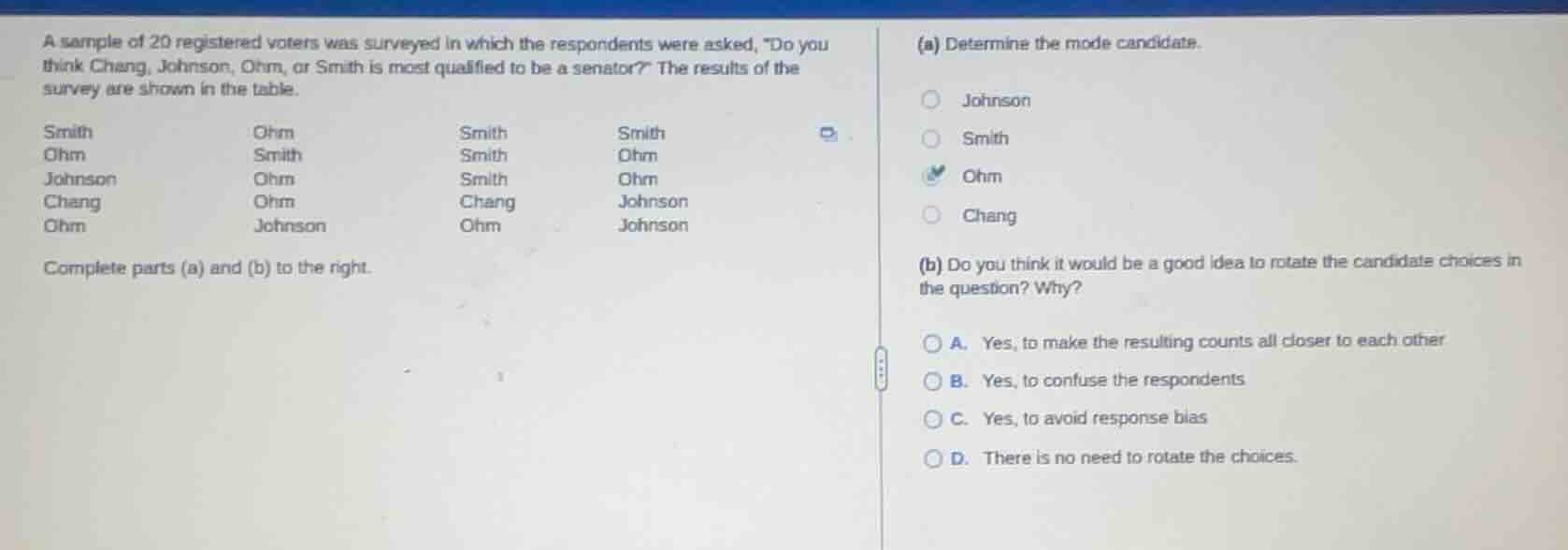
a sample of 20 registered voters was surveyed in which the respondents were asked, \do you think chang, johnson, ohm, or smith is most qualified to be a senator?\ the results of the survey are shown in the table.
smith \tohm \tsmith \tsmith
ohm \tsmith \tsmith \tohm
johnson \tohm \tsmith \tohm
chang \tohm \tchang \tjohnson
ohm \tjohnson \tohm \tjohnson
complete parts (a) and (b) to the right.
(a) determine the mode candidate.
\t○ johnson
\t○ smith
\t○ ohm
\t○ chang
(b) do you think it would be a good idea to rotate the candidate choices in the question? why?
\t○ a. yes, to make the resulting counts all closer to each other
\t○ b. yes, to confuse the respondents
\t○ c. yes, to avoid response bias
\t○ d. there is no need to rotate the choices.
Part (a)
Step 1: Count votes for each candidate
- Smith: Let's count. The entries with Smith are: Smith, Smith, Smith, Smith, Smith, Smith. Wait, let's list all:
First row: Smith, Ohm, Smith, Smith
Second row: Ohm, Smith, Smith, Ohm
Third row: Johnson, Ohm, Smith, Ohm
Fourth row: Chang, Ohm, Chang, Johnson
Fifth row: Ohm, Johnson, Ohm, Johnson
Wait, better to count each:
Smith: Let's go through each name:
- Smith
- Ohm
- Smith
- Smith
- Ohm
- Smith
- Smith
- Ohm
- Johnson
- Ohm
- Smith
- Ohm
- Chang
- Ohm
- Chang
- Johnson
- Ohm
- Johnson
- Ohm
- Johnson
Wait, let's count Smith: positions 1,3,4,6,7,11. So that's 6 times? Wait no, let's do it properly:
List all 20 responses:
- Smith
- Ohm
- Smith
- Smith
- Ohm
- Smith
- Smith
- Ohm
- Johnson
- Ohm
- Smith
- Ohm
- Johnson
- Ohm
- Chang
- Ohm
- Chang
- Johnson
- Ohm
- Johnson
Wait, no, the table is 5 rows, 4 columns? Wait the original table:
First row: Smith, Ohm, Smith, Smith (4)
Second row: Ohm, Smith, Smith, Ohm (4)
Third row: Johnson, Ohm, Smith, Ohm (4)
Fourth row: Chang, Ohm, Chang, Johnson (4)
Fifth row: Ohm, Johnson, Ohm, Johnson (4)
Total 5*4=20.
Now count Smith:
Row 1: 3 (Smith, Ohm, Smith, Smith → positions 1,3,4: 3)
Row 2: 2 (Ohm, Smith, Smith, Ohm → positions 2,3: 2)
Row 3: 1 (Johnson, Ohm, Smith, Ohm → position 3: 1)
Row 4: 0
Row 5: 0
Total Smith: 3+2+1=6
Ohm:
Row 1: 1 (position 2)
Row 2: 2 (positions 1,4)
Row 3: 2 (positions 2,4)
Row 4: 1 (position 2)
Row 5: 2 (positions 1,3)
Total Ohm: 1+2+2+1+2=8
Johnson:
Row 3: 1 (position 1)
Row 4: 1 (position 4)
Row 5: 2 (positions 2,4)
Total Johnson: 1+1+2=4
Chang:
Row 4: 2 (positions 1,3)
Total Chang: 2
So Ohm has 8, Smith 6, Johnson 4, Chang 2. So mode is Ohm (most frequent). So the correct answer for (a) is Ohm.
Part (b)
Response bias can occur when the order of response options influences respondents' choices (e.g., people might be more likely to choose earlier or later options). Rotating the candidate choices helps avoid this bias by ensuring the order doesn't systematically affect responses. Option A is wrong (we don't want counts closer, we want unbiased responses). Option B is wrong (we don't want to confuse). Option D is wrong because rotating helps avoid bias. So the correct answer is C.

Snap & solve any problem in the app
Get step-by-step solutions on Sovi AI
Photo-based solutions with guided steps
Explore more problems and detailed explanations
(a): Ohm