QUESTION IMAGE
Question
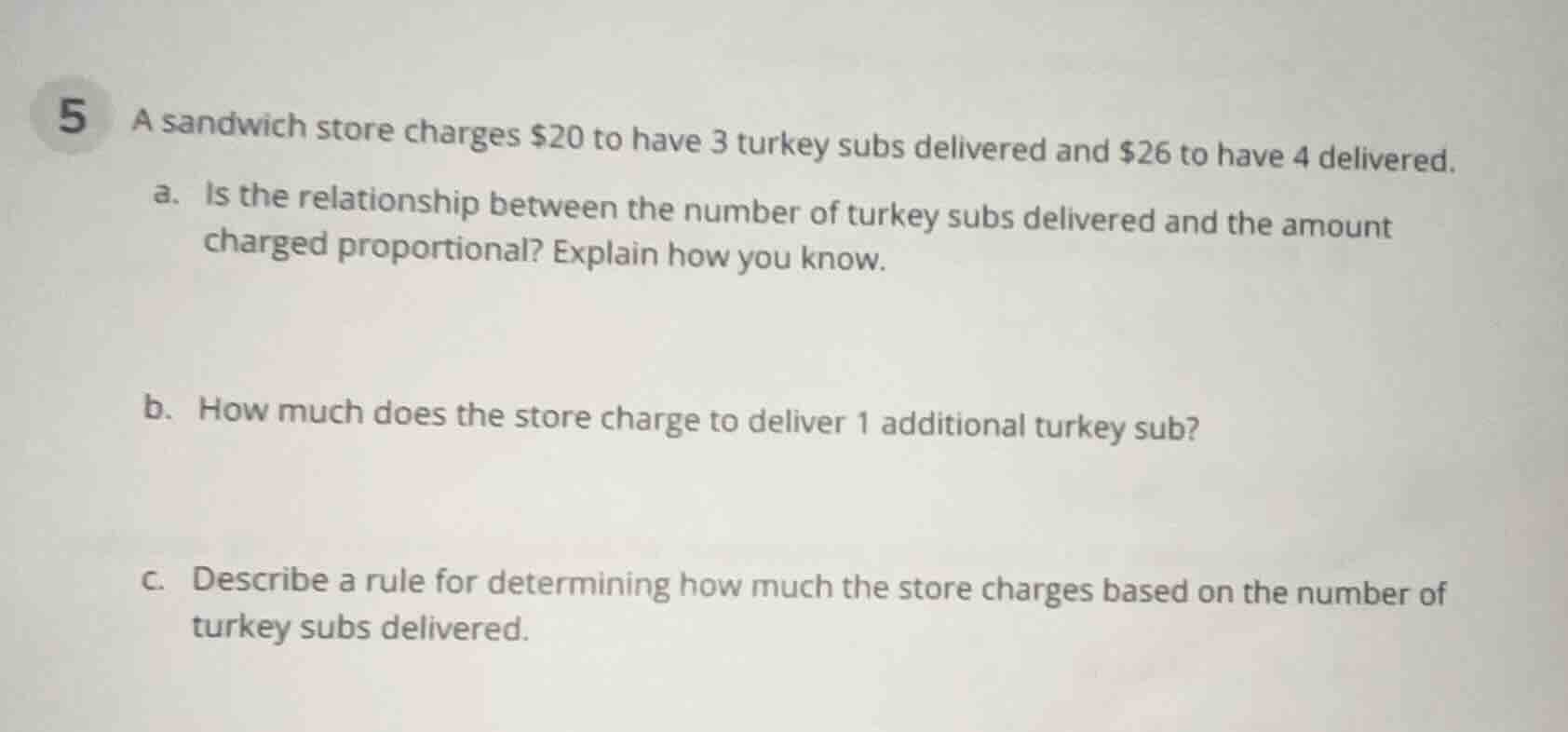
5 a sandwich store charges $20 to have 3 turkey subs delivered and $26 to have 4 delivered. a. is the relationship between the number of turkey subs delivered and the amount charged proportional? explain how you know. b. how much does the store charge to deliver 1 additional turkey sub? c. describe a rule for determining how much the store charges based on the number of turkey subs delivered.
Step1: Check proportionality (ratio test)
For 3 subs: $\frac{20}{3} \approx 6.67$; For 4 subs: $\frac{26}{4} = 6.5$
Step2: Compare the ratios
Since $\frac{20}{3}
eq \frac{26}{4}$, the relationship is not proportional.
Step3: Calculate cost per additional sub
Subtract the two total costs: $26 - 20 = 6$
Step4: Find fixed delivery fee
Use 3 subs: Let $C$ = total cost, $n$ = number of subs. $C = 6n + f$. Plug in $n=3, C=20$: $20 = 6(3) + f$ → $20 = 18 + f$ → $f=2$
Step5: Formulate the cost rule
Combine variable and fixed costs: $C = 6n + 2$

Snap & solve any problem in the app
Get step-by-step solutions on Sovi AI
Photo-based solutions with guided steps
Explore more problems and detailed explanations
a. No, the relationship is not proportional. The ratio of cost to number of subs is not consistent ($\frac{20}{3} \approx 6.67$ vs $\frac{26}{4}=6.5$), which is required for a proportional relationship.
b. $\$6$
c. Let $n$ = number of turkey subs delivered. The total cost $C$ (in dollars) is given by the rule: $C = 6n + 2$, meaning each sub costs $\$6$ plus a fixed $\$2$ delivery fee.