QUESTION IMAGE
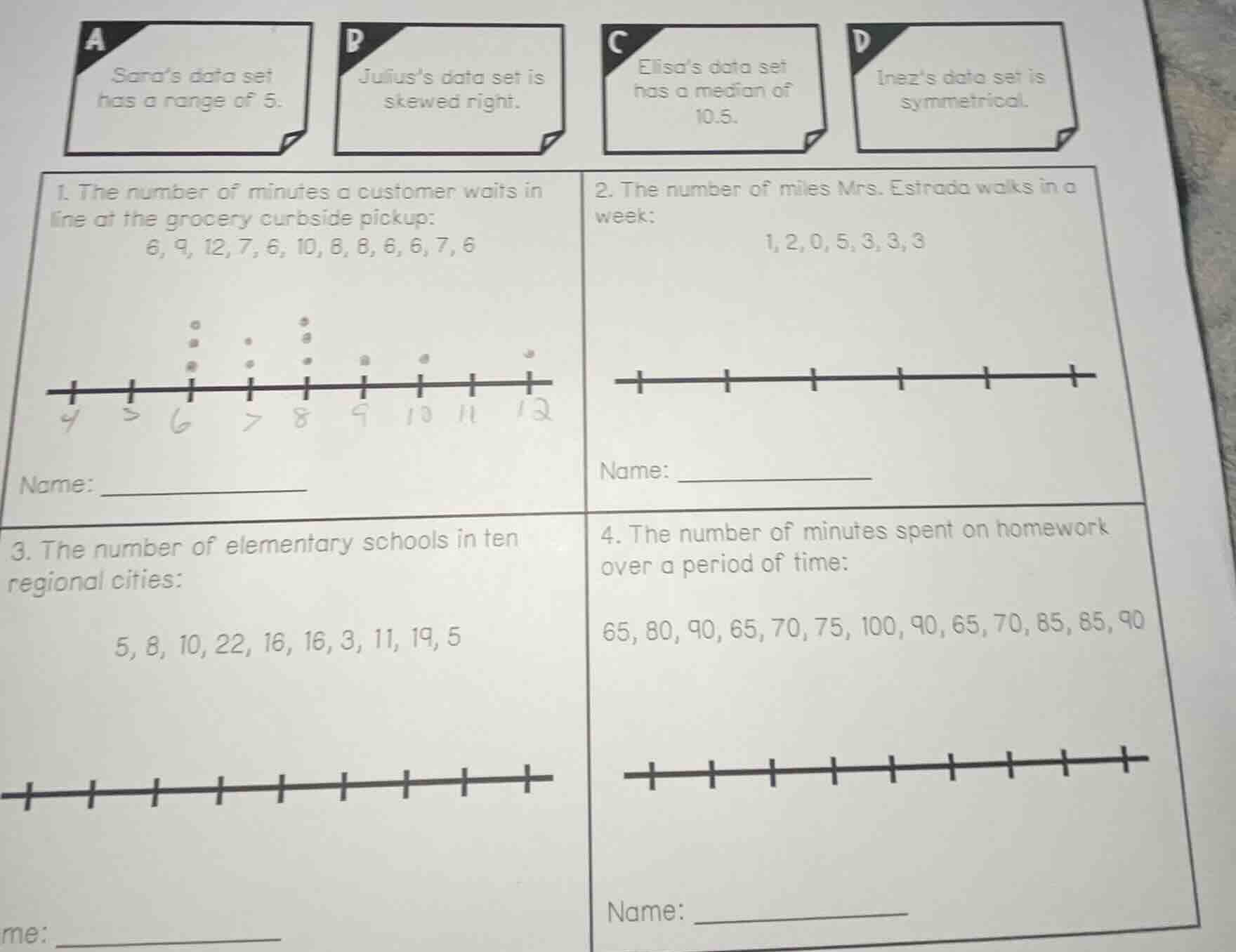
Question
a
sara’s data set
has a range of 5.
b
julius’s data set is
skewed right.
c
elisa’s data set
has a median of
10.5.
d
inez’s data set is
symmetrical.
- the number of minutes a customer waits in
line at the grocery curbside pickup:
6, 9, 12, 7, 6, 10, 8, 8, 6, 6, 7, 6
name: _____________
- the number of miles mrs. estrada walks in a
week:
1, 2, 0, 5, 3, 3, 3
name: _____________
- the number of elementary schools in ten
regional cities:
5, 8, 10, 22, 16, 16, 3, 11, 19, 5
me: _____________
- the number of minutes spent on homework
over a period of time:
65, 80, 90, 65, 70, 75, 100, 90, 65, 70, 85, 85, 90
name: _____________
Problem 1:
Step1: Find range of Sara's data
Range = Max - Min. Data: 6,9,12,7,6,10,8,8,6,6,7,6. Max=12, Min=6. Range = 12 - 6 = 6. Wait, no—wait, the dot plot? Wait, the data given: 6,9,12,7,6,10,8,8,6,6,7,6. Wait, maybe I misread. Wait, the name for problem 1: let's check the options. Wait, the dot plot has values from 6 to 12. Wait, maybe the data is for Sara? Wait, no, the options: A: range 5. Wait, maybe I made a mistake. Wait, problem 1's data: 6,9,12,7,6,10,8,8,6,6,7,6. Let's sort: 6,6,6,6,6,7,7,8,8,9,10,12. Max=12, Min=6. Range=6. But option A is range 5? Wait, maybe the data is different. Wait, maybe the dot plot: the x-axis is 4,5,6,7,8,9,10,11,12. The dots: at 6: several, 7: two, 8: three, 9: one, 10: one, 12: one. Wait, data points: 6 (multiple), 7 (2), 8 (3), 9 (1), 10 (1), 12 (1). So values: 6,6,6,6,7,7,8,8,8,9,10,12. Max=12, Min=6. Range=6. Not 5. Wait, maybe problem 2? Problem 2: data 1,2,0,5,3,3,3. Sort: 0,1,2,3,3,3,5. Range=5-0=5. Oh! So problem 1's name: let's check the options. Wait, problem 2's data has range 5? Wait, option A: Sara's data set has range 5. So problem 2: data 0,1,2,3,3,3,5. Range=5-0=5. So problem 2's name is Sara (A). Then problem 1: let's check option B: Julius's data set is skewed right. Problem 1's data: 6,6,6,6,7,7,8,8,8,9,10,12. The tail is on the right (12,10,9), so skewed right? Wait, no, the majority is on the left (6s), tail on right. So skewed right. So problem 1's name: Julius (B). Problem 3: data 5,8,10,22,16,16,3,11,19,5. Sort: 3,5,5,8,10,11,16,16,19,22. Median: (10+11)/2=10.5. Oh! Option C: Elisa's data set has median 10.5. So problem 3's name: Elisa (C). Problem 4: data 65,80,90,65,70,75,100,90,65,70,85,85,90. Sort: 65,65,65,70,70,75,80,85,85,90,90,90,100. Let's check symmetry. The data is symmetric around... Let's see: 65 (3), 70 (2), 75 (1), 80 (1), 85 (2), 90 (3), 100 (1). Wait, 65 and 90 both have 3, 70 and 85 both have 2, 75 and 80? No, 75 is one, 80 is one. Wait, maybe symmetric? The middle value: 13 data points, median is 7th: 80. Wait, but the distribution: left side (65,70,75) and right side (85,90,100) mirror? 65 (3) vs 90 (3), 70 (2) vs 85 (2), 75 (1) vs 80 (1). Yes, symmetric. So option D: Inez's data set is symmetric. So problem 4's name: Inez (D).
Problem 1:
Data: 6,9,12,7,6,10,8,8,6,6,7,6 (or dot plot). Skewed right (tail on right). So name: Julius (B).
Problem 2:
Data: 0,1,2,3,3,3,5. Range=5-0=5. So name: Sara (A).
Problem 3:
Data: 3,5,5,8,10,11,16,16,19,22. Median=(10+11)/2=10.5. So name: Elisa (C).
Problem 4:
Data: 65,65,65,70,70,75,80,85,85,90,90,90,100. Symmetric (mirror on both sides). So name: Inez (D).

Snap & solve any problem in the app
Get step-by-step solutions on Sovi AI
Photo-based solutions with guided steps
Explore more problems and detailed explanations
s:
- Name: Julius (B)
- Name: Sara (A)
- Name: Elisa (C)
- Name: Inez (D)