QUESTION IMAGE
Question
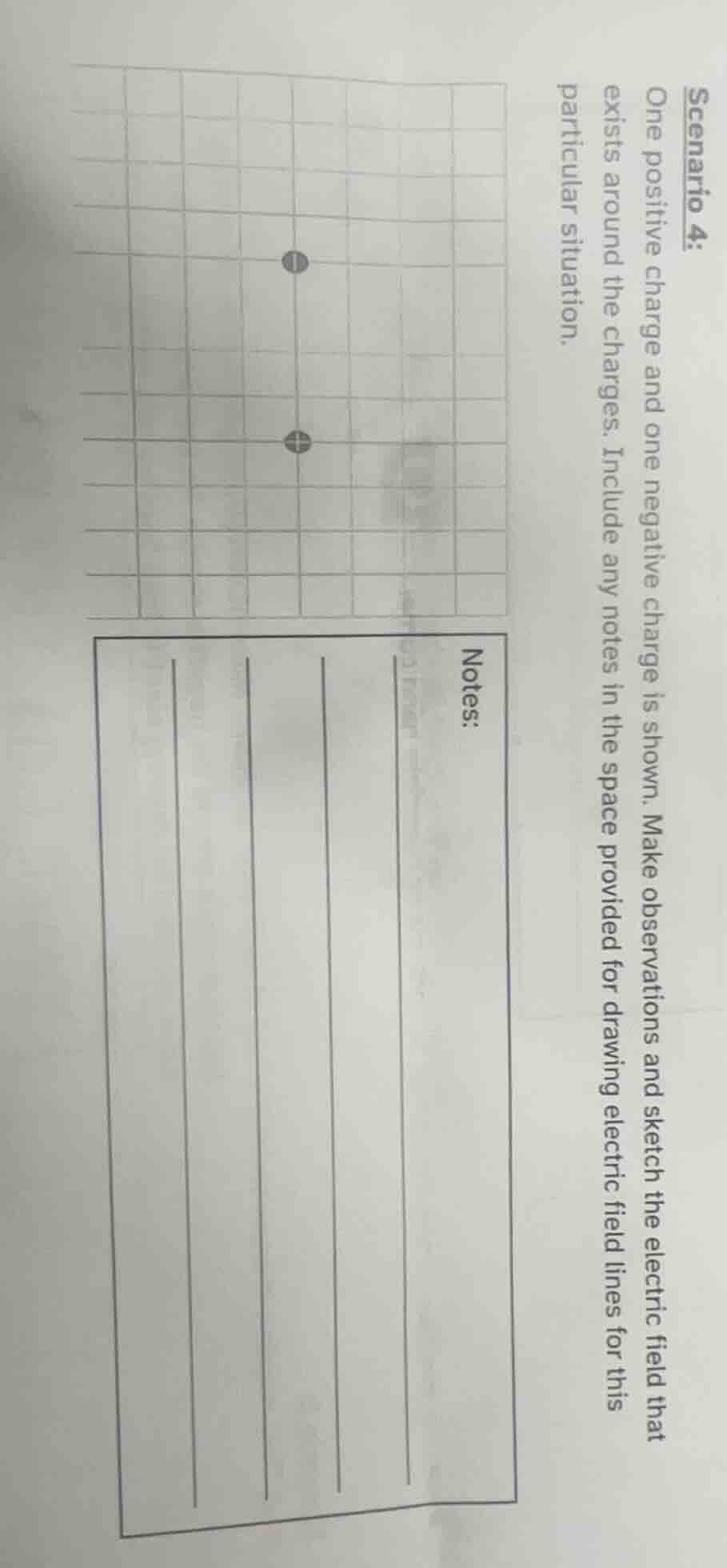
scenario 4: one positive charge and one negative charge is shown. make observations and sketch the electric field that exists around the charges. include any notes in the space provided for drawing electric field lines for this particular situation. notes:
Brief Explanations
- Observation: The charges are a positive (+) and a negative (-) charge, aligned vertically (separated by a few grid units). This is a dipole configuration (two equal - magnitude, opposite - sign charges separated by a distance).
- Electric Field Line Rules:
- Electric field lines start from positive charges and end at negative charges.
- The lines should be symmetric with respect to the vertical line passing through both charges (since the charges are aligned vertically and, assuming equal magnitude, the dipole is symmetric about its axis).
- The density of field lines can indicate the strength (but for a simple dipole, we focus on the direction and pattern).
- Sketching the Field Lines:
- Draw smooth curves (or straight lines, but for a dipole, the lines curve) that originate from the positive charge and terminate at the negative charge.
- For the region between the charges, the field lines will be directed from + to - (almost straight, but slightly curved depending on the perspective).
- For the regions above the negative charge and below the positive charge, the field lines will curve outward and then connect back, showing the dipole's field pattern (like the classic dipole field with lines forming loops that start at + and end at -).

Snap & solve any problem in the app
Get step-by-step solutions on Sovi AI
Photo-based solutions with guided steps
Explore more problems and detailed explanations
Observations:
- There is one positive charge (\(+\)) and one negative charge (\(-\)) separated by a vertical distance on a grid.
- The charges form an electric dipole (assuming equal magnitudes, as is typical in such basic setups).
Sketch of Electric Field Lines (Description):
- Electric field lines start at the positive charge and end at the negative charge.
- Between the two charges, the field lines are approximately straight (directed from \(+\) to \(-\)) and symmetric about the vertical line through both charges.
- Above the negative charge and below the positive charge, the field lines curve outward, creating a pattern characteristic of a dipole: lines from the positive charge curve around the outside and terminate on the negative charge, with the overall pattern being symmetric with respect to the vertical axis of the two - charge system.
(If a diagram were drawn, it would show lines originating from \(+\), curving to connect to \(-\), with symmetry about the vertical line through the two charges.)