QUESTION IMAGE
Question
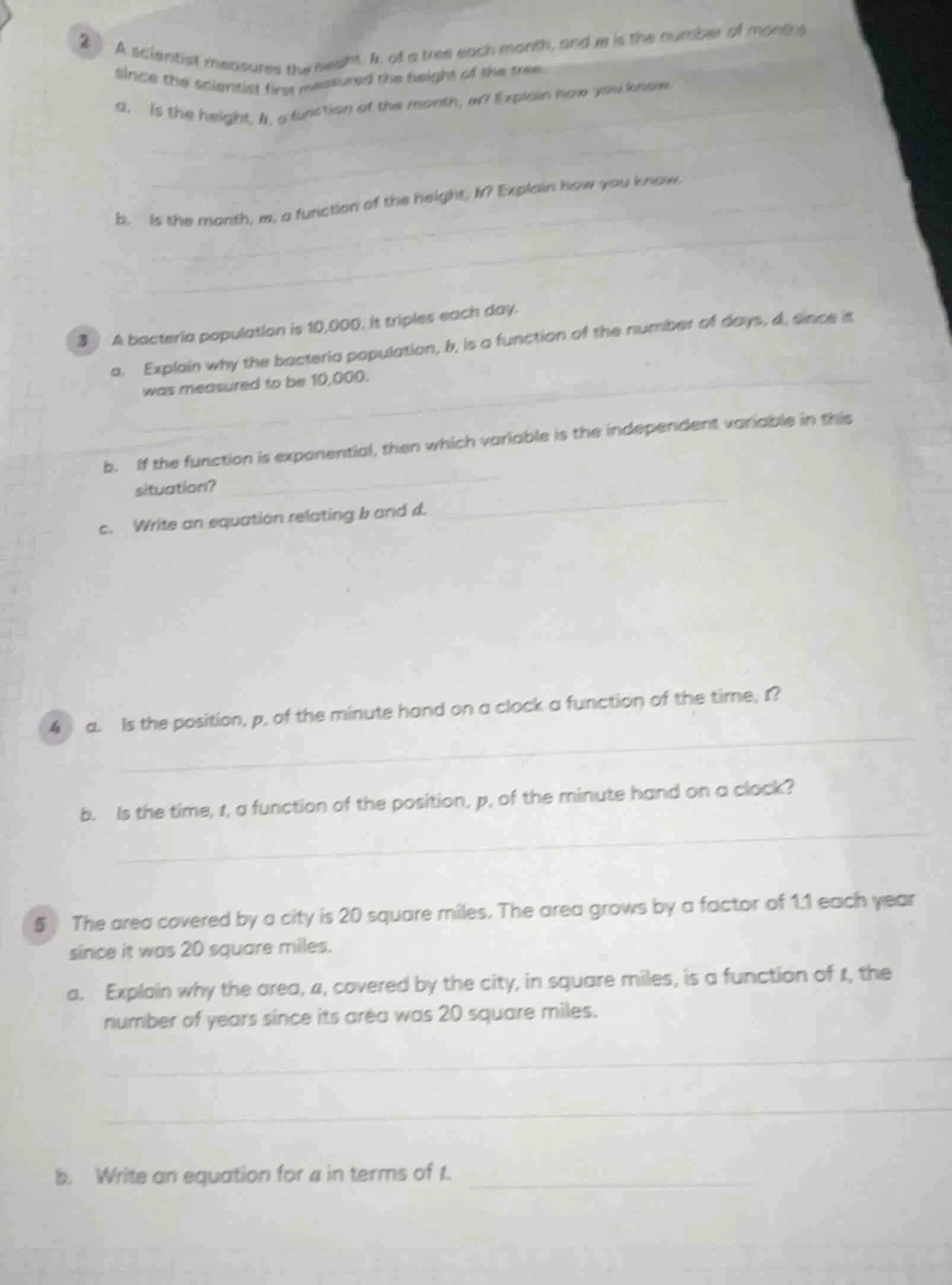
2 a scientist measures the height, $h$, of a tree each month, and $m$ is the number of months since the scientist first measured the height of the tree.
a. is the height, $h$, a function of the month, $m$? explain how you know.
b. is the month, $m$, a function of the height, $h$? explain how you know.
3 a bacteria population is 10,000. it triples each day.
a. explain why the bacteria population, $b$, is a function of the number of days, $d$, since it was measured to be 10,000.
b. if the function is exponential, then which variable is the independent variable in this situation?
c. write an equation relating $b$ and $d$.
4 a. is the position, $p$, of the minute hand on a clock a function of the time, $t$?
b. is the time, $t$, a function of the position, $p$, of the minute hand on a clock?
5 the area covered by a city is 20 square miles. the area grows by a factor of 1.1 each year since it was 20 square miles.
a. explain why the area, $a$, covered by the city, in square miles, is a function of $t$, the number of years since its area was 20 square miles.
b. write an equation for $a$ in terms of $t$.
Question 2
a. Each month $m$ has exactly one corresponding tree height $h$ (a tree cannot have two different heights at the same time), so it satisfies the definition of a function.
b. A single height $h$ could correspond to multiple months (the tree could be the same height in different months as it stops growing temporarily or is measured imprecisely), so one input has multiple outputs, violating function rules.
Question 3
a. Each day $d$ has exactly one unique bacteria population $b$ (the population triples predictably each day, no ambiguous values), so it meets function criteria.
b. The independent variable is the input that drives change; here, the number of days $d$ determines the population $b$.
c. Exponential growth formula is $initial\ value \cdot growth\ factor^{time}$, so substitute the given values.
Question 4
a. Each time $t$ corresponds to exactly one position $p$ of the minute hand (a clock's minute hand has only one position at any specific time), so it is a function.
b. A single position $p$ of the minute hand corresponds to infinitely many times (e.g., the 12 position occurs every 60 minutes), so one input has multiple outputs, not a function.
Question 5
a. Each year $t$ has exactly one unique city area $a$ (the area grows by a fixed factor annually, no ambiguous values), so it satisfies the function definition.
b. Exponential growth formula is $initial\ value \cdot growth\ factor^{time}$, so substitute the given values.

Snap & solve any problem in the app
Get step-by-step solutions on Sovi AI
Photo-based solutions with guided steps
Explore more problems and detailed explanations
Question 2
a. Yes, $h$ is a function of $m$.
b. No, $m$ is not a function of $h$.
Question 3
a. Yes, $b$ is a function of $d$.
b. $d$ (number of days)
c. $b = 10000 \cdot 3^d$
Question 4
a. Yes, $p$ is a function of $t$.
b. No, $t$ is not a function of $p$.
Question 5
a. Yes, $a$ is a function of $t$.
b. $a = 20 \cdot 1.1^t$