QUESTION IMAGE
Question
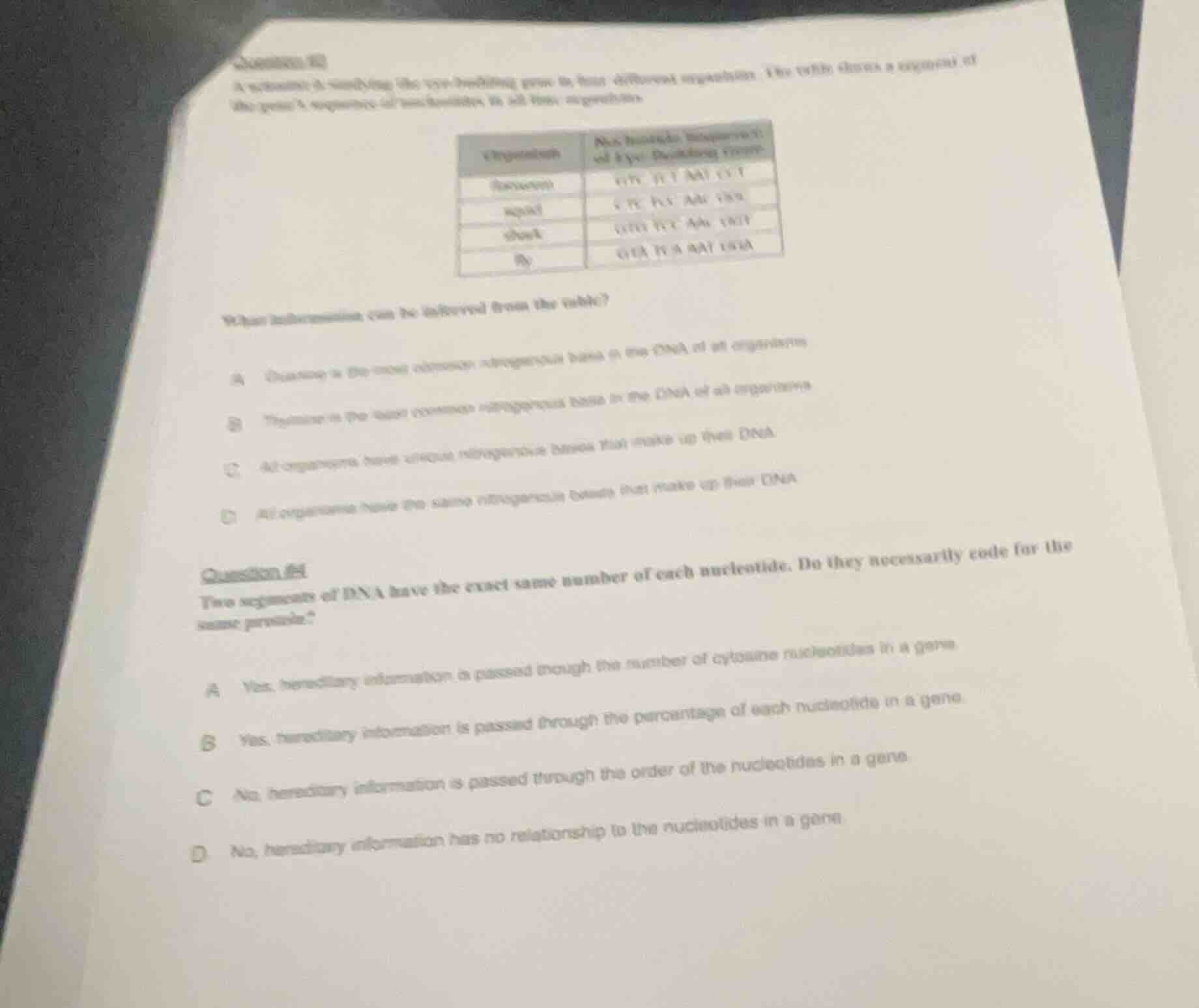
a scientist is studying the eye - building gene in four different organisms. the table shows a segment of the gene (a sequence of nucleotides) in all four organisms.
(table content: organisms - non - template (template?) strand of the eye - building gene; human - atg ttt aat cgt; squid - atc ttt aat gga; shark - gtta ttc aag tgt; fly - gca tta aat gga)
what information can be inferred from the table?
a. guanine is the most common nitrogenous base in the dna of all organisms
b. thymine is the most common nitrogenous base in the dna of all organisms
c. all organisms have unique nitrogenous bases that make up their dna
d. all organisms have the same nitrogenous bases that make up their dna
question #4
two segments of dna have the exact same number of each nucleotide. do they necessarily code for the same protein?
a. yes, hereditary information is passed through the number of cytosine nucleotides in a gene.
b. yes, hereditary information is passed through the percentage of each nucleotide in a gene.
c. no, hereditary information is passed through the order of the nucleotides in a gene.
d. no, hereditary information has no relationship to the nucleotides in a gene
For Question 1:
- Option A is incorrect: The table does not show guanine is the most common across all organisms (e.g., human has more thymine).
- Option B is incorrect: Thymine is not the least common (e.g., shark has less adenine).
- Option C is incorrect: All organisms use the same four nitrogenous bases (A, T, C, G) as seen in the table.
- Option D is correct: The table shows all four organisms have DNA made of the same four nitrogenous bases (adenine, thymine, cytosine, guanine).
For Question 2:
- Options A and B are incorrect: The number/amount of nucleotides does not determine the protein; the sequence does.
- Option C is correct: Hereditary information is encoded in the order (sequence) of nucleotides, so identical counts do not mean the same protein.
- Option D is incorrect: Hereditary information is directly tied to nucleotide sequences.

Snap & solve any problem in the app
Get step-by-step solutions on Sovi AI
Photo-based solutions with guided steps
Explore more problems and detailed explanations
Question 1: D. All organisms have the same nitrogenous bases that make up their DNA
Question 2: C. No, hereditary information is passed through the order of the nucleotides in a gene