QUESTION IMAGE
Question
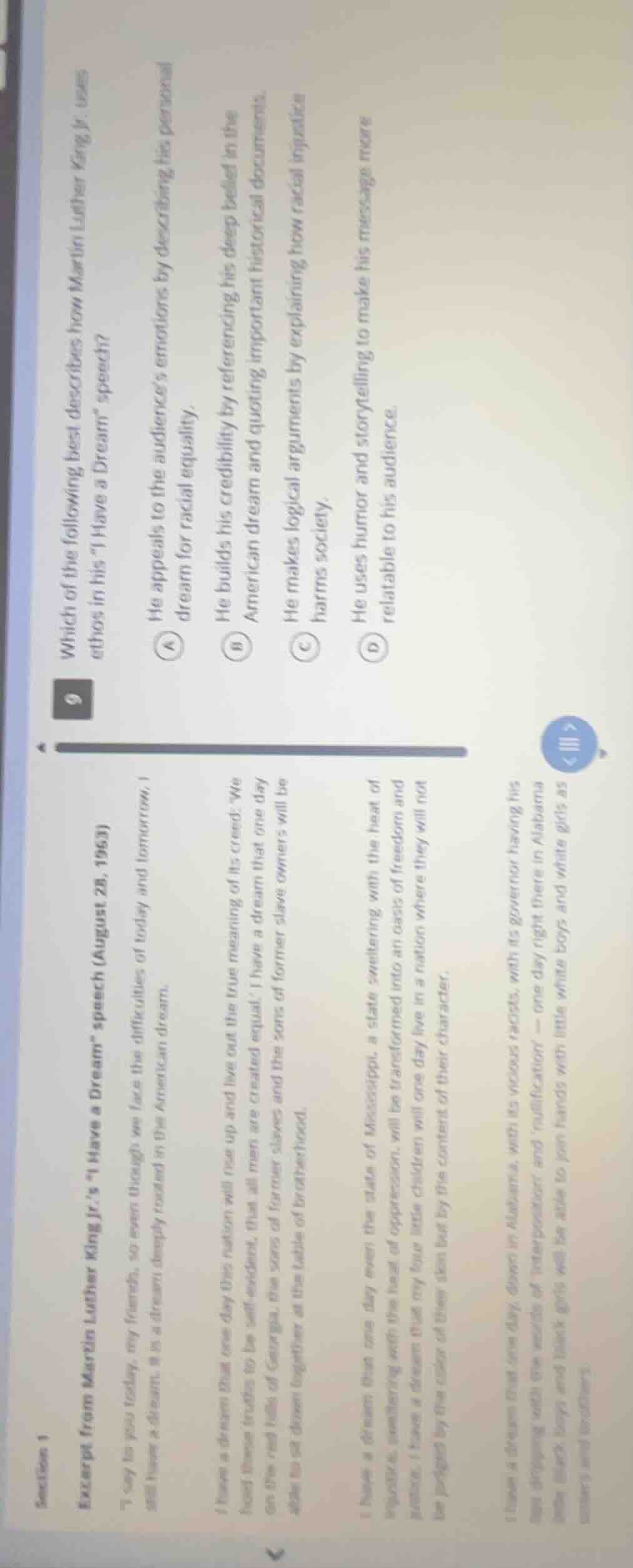
section 1excerpt from martin luther king jr.s \i have a dream\ speech (august 28, 1963)i say to you today, my friends, so even though we face the difficulties of today and tomorrow, i still have a dream. it is a dream deeply rooted in the american dream.i have a dream that one day this nation will rise up and live out the true meaning of its creed: we hold these truths to be self-evident, that all men are created equal. i have a dream that one day on the red hills of georgia, the sons of former slaves and the sons of former slave owners will be able to sit down together at the table of brotherhood.i have a dream that one day even the state of mississippi, a state sweltering with the heat of injustice, sweltering with the heat of oppression, will be transformed into an oasis of freedom and justice. i have a dream that my four little children will one day live in a nation where they will not be judged by the color of their skin but by the content of their character.i have a dream that one day, down in alabama, with its vicious racists, with its governor having his lips dripping with the words of interposition and nullification — one day right there in alabama little black boys and black girls will be able to join hands with little white boys and white girls as sisters and brothers.9 which of the following best describes how martin luther king jr. uses ethos in his \i have a dream\ speech?a he appeals to the audiences emotions by describing his personal dream for racial equality.b he builds his credibility by referencing his deep belief in the american dream and quoting important historical documents.c he makes logical arguments by explaining how racial injustice harms society.d he uses humor and storytelling to make his message more relatable to his audience.
Ethos focuses on building credibility and trust with an audience. Martin Luther King Jr. references the foundational "American dream" principle that "all men are created equal" (a core, widely accepted historical/ideological document reference, the Declaration of Independence) to establish his credibility as someone advocating for a nation living up to its own stated values. Option A refers to pathos (emotional appeals), option C refers to logos (logical arguments), and option D does not reflect the use of ethos in the speech.

Snap & solve any problem in the app
Get step-by-step solutions on Sovi AI
Photo-based solutions with guided steps
Explore more problems and detailed explanations
B. He builds his credibility by referencing his deep belief in the American dream and quoting important historical documents.