QUESTION IMAGE
Question
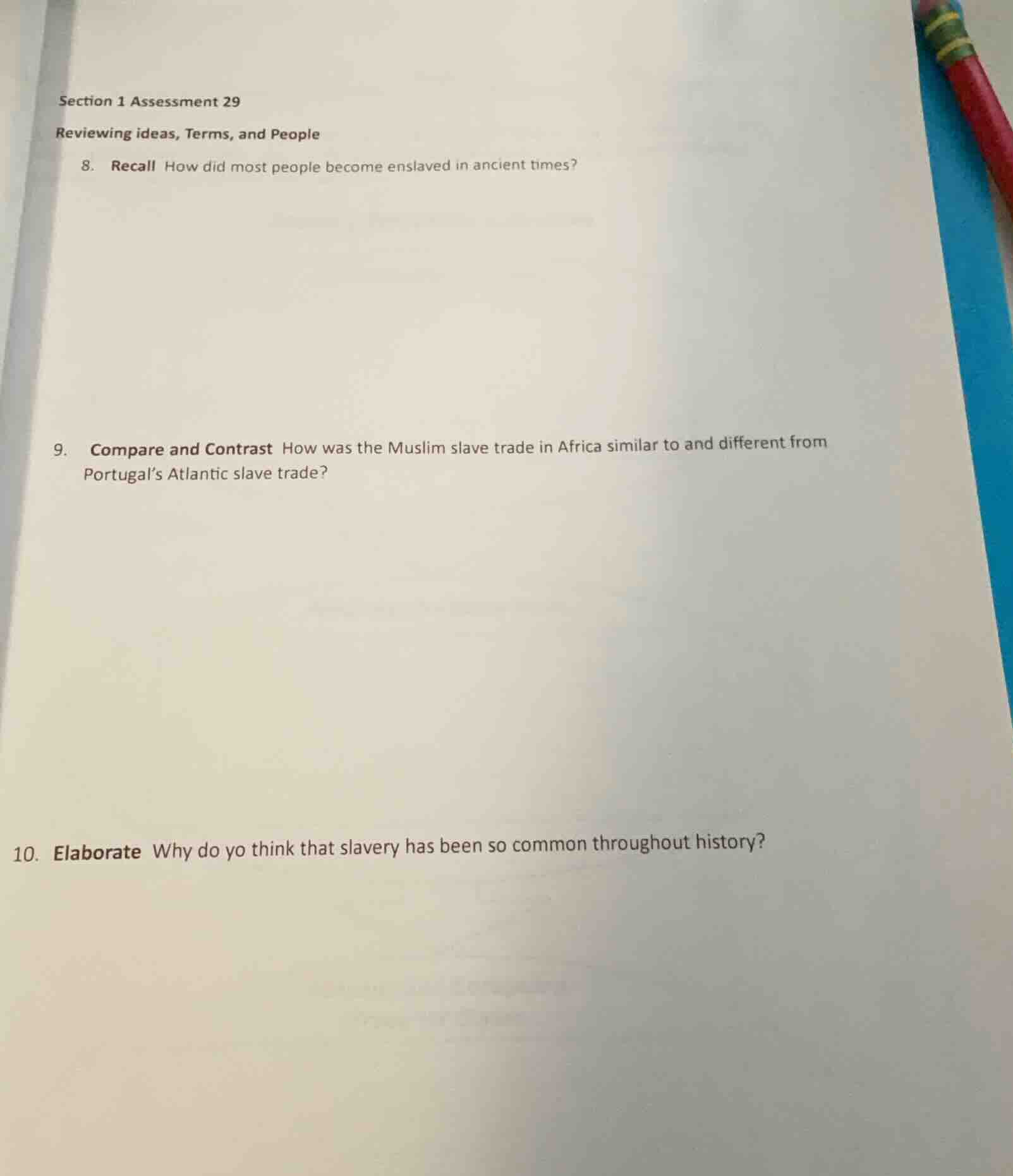
section 1 assessment 29
reviewing ideas, terms, and people
- recall how did most people become enslaved in ancient times?
- compare and contrast how was the muslim slave trade in africa similar to and different from portugal’s atlantic slave trade?
- elaborate why do yo think that slavery has been so common throughout history?
Question 8
In ancient times, most people became enslaved through warfare (captured in battles), debt (unable to repay debts and forced into slavery), or being born into slavery (children of enslaved people inherited the status). Also, some were enslaved due to criminal punishment or being sold by family/community in times of hardship.
- Similarities: Both the Muslim slave trade in Africa and Portugal’s Atlantic slave trade involved the capture and trade of African people. Both were driven by economic motives (using slaves for labor or trade goods) and had a significant impact on African societies (disrupting communities, causing population shifts).
- Differences: The Muslim slave trade often had a more regional focus (slaves were used within the Islamic world, e.g., for domestic service, military, or trade in the Mediterranean/Indian Ocean), while Portugal’s Atlantic slave trade was part of the trans - Atlantic system, focusing on transporting slaves to the Americas (especially plantations). The Muslim trade also had a religious dimension (some slaves could convert to Islam and gain certain rights, though still enslaved), while the Atlantic trade was more racially - based and part of the emerging capitalist plantation economy. The scale and duration also differed, with the Atlantic trade becoming larger and more industrialized over time.
Slavery has been common throughout history for several reasons:
- Economic: Slaves provided cheap labor for agriculture (e.g., plantations), mining, and domestic work. In pre - industrial and early industrial societies, labor was a key resource, and slavery was a way to acquire labor without wages.
- Social/Political: Societies had hierarchical structures, and slavery was a way to maintain social order (subjugating “inferior” groups, prisoners of war, or debtors). Rulers and elites used slaves to display wealth and power.
- Military/Conflict: Warfare often led to the capture of enemies, who were then enslaved. This was a way to deal with captives (instead of killing them) and gain labor.
- Technological: Before modern machinery, human labor was essential, and slavery was an efficient (for the enslavers) way to mobilize large - scale labor.
- Cultural/Religious: Some cultures/religions either tolerated or even legitimized slavery (e.g., ancient religions, early Christianity/Islam had complex relationships with slavery, sometimes viewing it as a natural order).
- Power Dynamics: Groups with military or political power could enslave weaker groups, as there were few legal or moral constraints against it in many historical periods.

Snap & solve any problem in the app
Get step-by-step solutions on Sovi AI
Photo-based solutions with guided steps
Explore more problems and detailed explanations
Most people in ancient times became enslaved through warfare (captured as prisoners of war), debt (enslaved to repay debts), being born into slavery (inheriting the status from enslaved parents), or as a form of punishment for crimes.