QUESTION IMAGE
Question
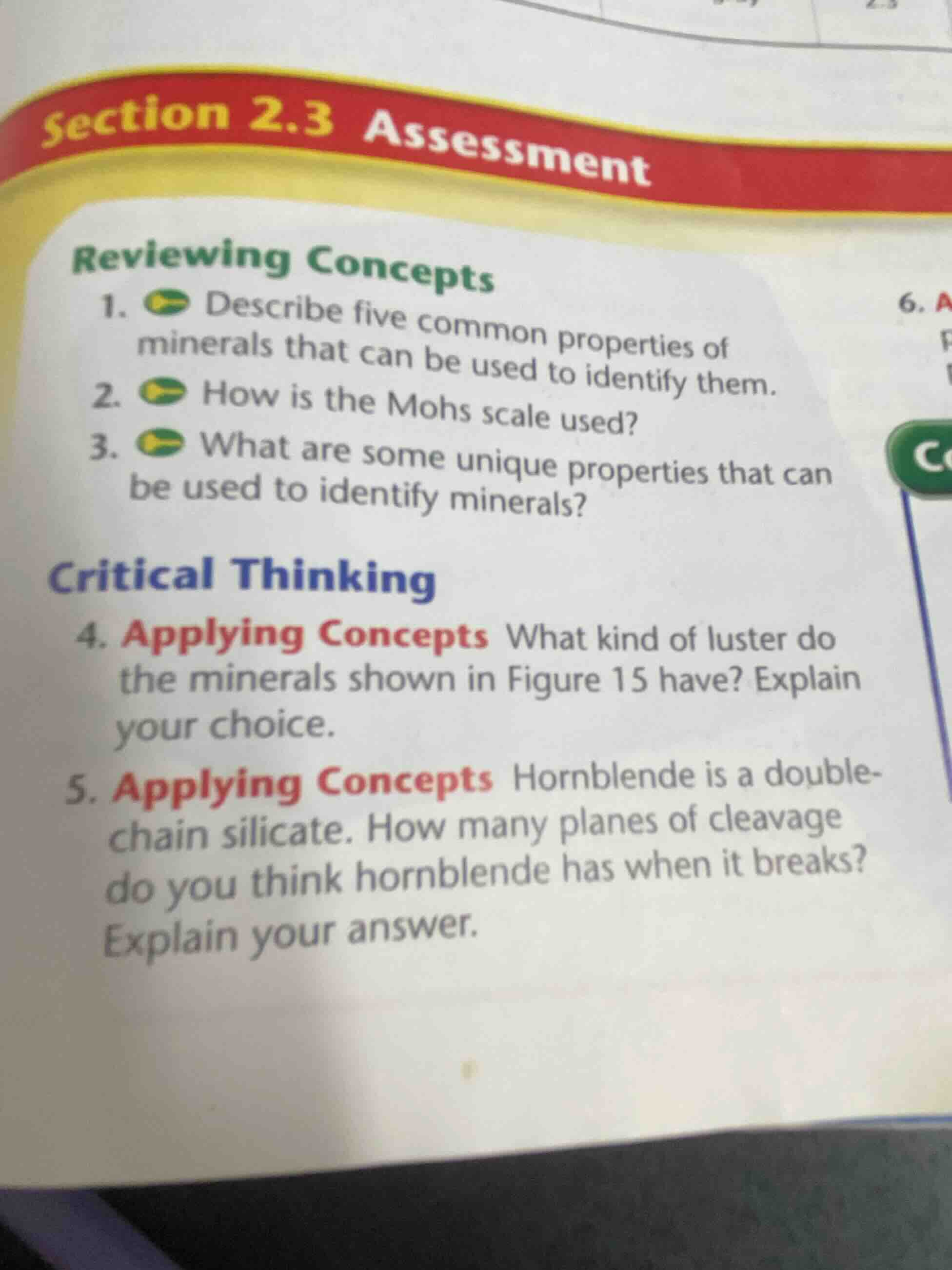
section 2.3 assessment
reviewing concepts
- describe five common properties of minerals that can be used to identify them.
- how is the mohs scale used?
- what are some unique properties that can be used to identify minerals?
critical thinking
- applying concepts what kind of luster do the minerals shown in figure 15 have? explain your choice.
- applying concepts hornblende is a double-chain silicate. how many planes of cleavage do you think hornblende has when it breaks? explain your answer.
To answer these questions, we'll address each one in the "Reviewing Concepts" and "Critical Thinking" sections:
Reviewing Concepts
- Five common mineral properties for identification:
- Color: Visible hue (e.g., pyrite is brass-yellow).
- Luster: How light reflects (e.g., metallic, glassy).
- Hardness: Resistance to scratching (tested via Mohs scale).
- Cleavage/Fracture: How a mineral breaks (cleavage = flat planes; fracture = irregular).
- Streak: Color of powdered mineral (e.g., hematite has a red-brown streak).
- How is the Mohs scale used?
The Mohs scale (1–10, with 1 = talc, 10 = diamond) ranks minerals by hardness. To use it, scratch an unknown mineral with a known Mohs mineral (or vice versa) to determine relative hardness.
- Unique properties for mineral identification:
- Magnetism (e.g., magnetite attracts magnets).
- Fluorescence (glows under UV light, e.g., calcite).
- Reaction to acid (e.g., calcite fizzes in HCl).
- Density (mass/volume, e.g., galena is very dense).
- Double refraction (e.g., calcite splits light into two rays).
Critical Thinking
- Luster of minerals in Figure 15 (assuming typical minerals like quartz, feldspar, or pyrite):
- If metallic (e.g., pyrite), luster is metallic (shiny like metal).
- If non-metallic (e.g., quartz), luster is glassy (vitreous) or pearly (e.g., feldspar).
Explain: Luster depends on light reflection. Metallic minerals reflect light strongly (like metal), while non-metallic have weaker reflections (e.g., glassy, earthy).
- Cleavage planes of hornblende (double-chain silicate):
Double-chain silicates (amphiboles like hornblende) typically have two planes of cleavage that intersect at ~60° or 120°. This is because their atomic structure (double chains) creates weak planes along which they break.

Snap & solve any problem in the app
Get step-by-step solutions on Sovi AI
Photo-based solutions with guided steps
Explore more problems and detailed explanations
s (Key Points)
- Color, luster, hardness, cleavage/fracture, streak.
- Ranks mineral hardness (1–10) to identify relative scratch resistance.
- Magnetism, fluorescence, acid reaction, density, double refraction.
- Depends on Figure 15 (e.g., metallic or glassy; explain via light reflection).
- Two cleavage planes (due to double-chain silicate structure).