QUESTION IMAGE
Question
section 3.1 basic concepts of probability and counting 141
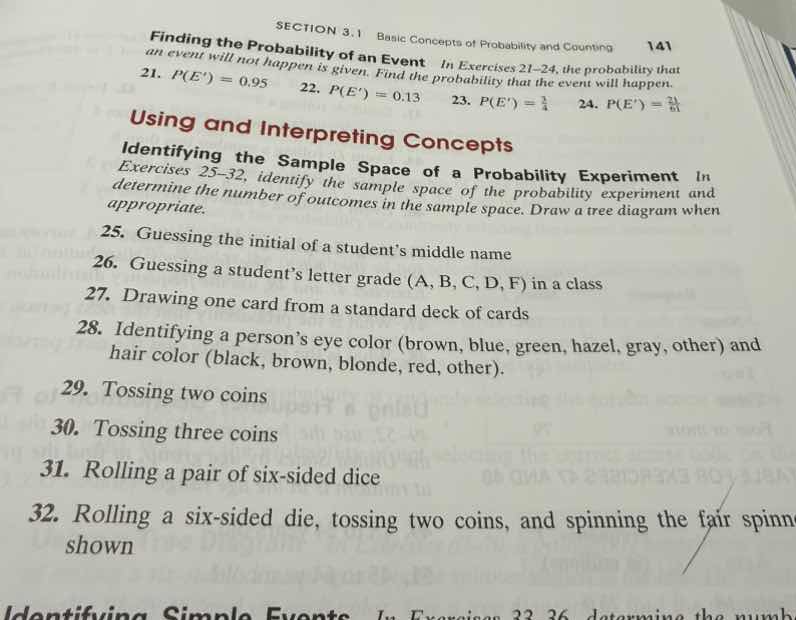
finding the probability of an event in exercises 21–24, the probability that
an event will not happen is given. find the probability that the event will happen.
- ( p(e) = 0.95 ) 22. ( p(e) = 0.13 ) 23. ( p(e)=\frac{1}{4} ) 24. ( p(e)=\frac{29}{30} )
using and interpreting concepts
identifying the sample space of a probability experiment in
exercises 25–32, identify the sample space of the probability experiment and
determine the number of outcomes in the sample space. draw a tree diagram when
appropriate.
- guessing the initial of a student’s middle name
- guessing a student’s letter grade (a, b, c, d, f) in a class
- drawing one card from a standard deck of cards
- identifying a person’s eye color (brown, blue, green, hazel, gray, other) and
hair color (black, brown, blonde, red, other).
- tossing two coins
- tossing three coins
- rolling a pair of six - sided dice
- rolling a six - sided die, tossing two coins, and spinning the fair spinn
shown
identifying simple events in exercises 33 - 36, determine the numb
For Exercises 21-24:
Step1: Recall complement rule
For any event $E$, $P(E) = 1 - P(E')$
Step2: Solve for Exercise 21
Substitute $P(E')=0.95$:
$P(E) = 1 - 0.95$
Step3: Solve for Exercise 22
Substitute $P(E')=0.13$:
$P(E) = 1 - 0.13$
Step4: Solve for Exercise 23
Substitute $P(E')=\frac{1}{4}$:
$P(E) = 1 - \frac{1}{4}$
Step5: Solve for Exercise 24
Substitute $P(E')=\frac{21}{25}$:
$P(E) = 1 - \frac{21}{25}$
- The sample space includes every possible letter in the English alphabet (26 outcomes), as the initial can be any letter.
- The sample space is the set of possible letter grades: {A, B, C, D, F}, with 5 outcomes.
- A standard deck has 52 unique cards (13 ranks × 4 suits), so the sample space has 52 outcomes.
- The sample space is all combinations of eye color and hair color: 6 eye colors × 6 hair colors = 36 outcomes.
- Tossing two coins gives outcomes: {HH, HT, TH, TT}, with 4 outcomes.
- Tossing three coins gives outcomes: {HHH, HHT, HTH, HTT, THH, THT, TTH, TTT}, with 8 outcomes.
- Rolling two six-sided dice: each die has 6 outcomes, so total outcomes = $6 \times 6 = 36$, with the sample space being all pairs $(x,y)$ where $x,y \in \{1,2,3,4,5,6\}$.
Calculate total outcomes by multiplying the number of results for each experiment: 6 (die) × 4 (two coins) × number of spinner sections (assumed equal sections; if the spinner has $n$ sections, total outcomes = $6 \times 4 \times n$).

Snap & solve any problem in the app
Get step-by-step solutions on Sovi AI
Photo-based solutions with guided steps
Explore more problems and detailed explanations
- $0.05$
- $0.87$
- $\frac{3}{4}$
- $\frac{4}{25}$
---