QUESTION IMAGE
Question
section 6.3, continued
transcription and translation
practice 4
answer the following questions about transcription and translation. darken the circle that corresponds to your answer choice.
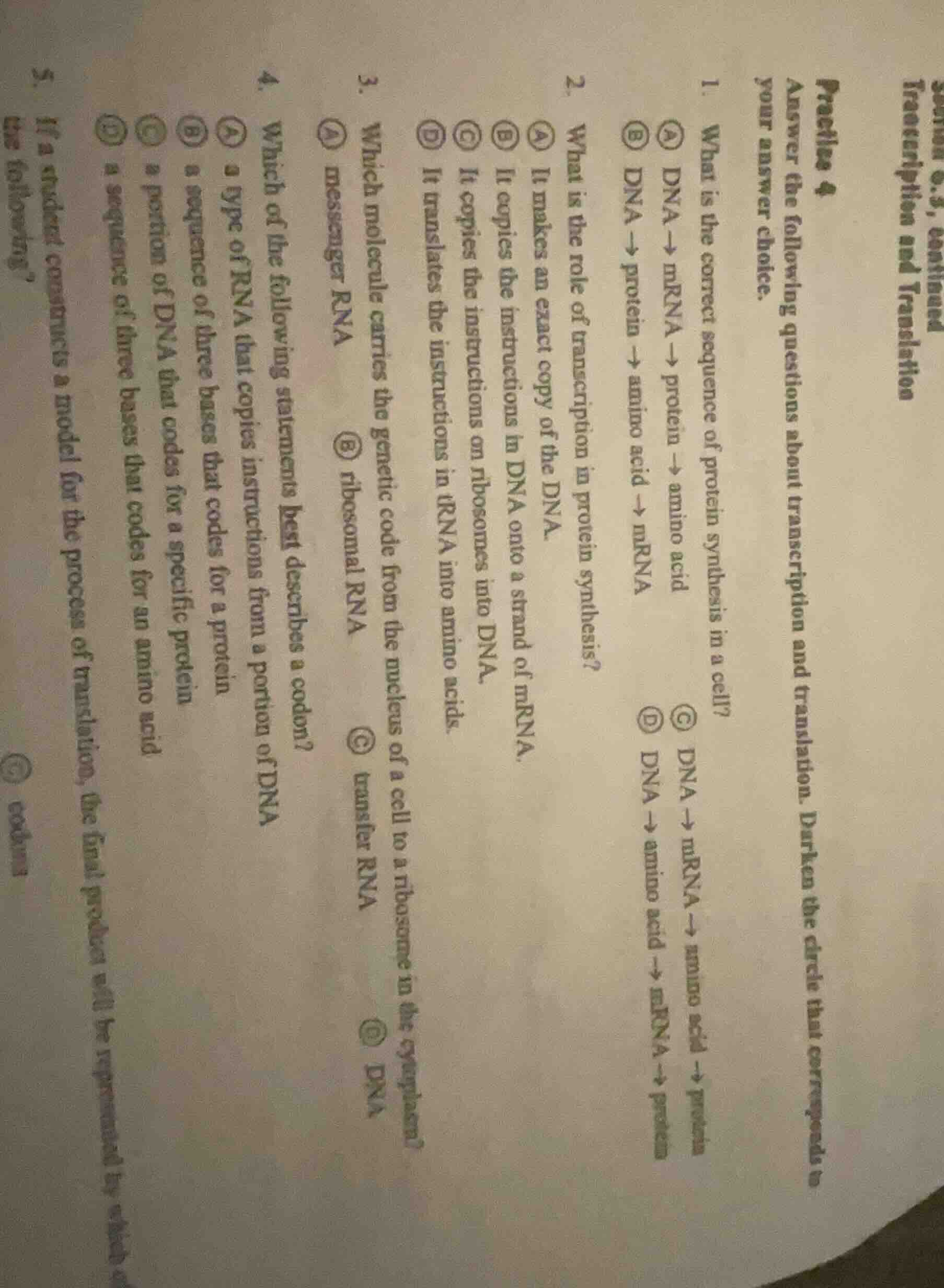
- what is the correct sequence of protein synthesis in a cell?
ⓐ dna → mrna → protein → amino acid
ⓑ dna → protein → amino acid → mrna
ⓒ dna → mrna → amino acid → protein
ⓓ dna → amino acid → mrna → protein
- what is the role of transcription in protein synthesis?
ⓐ it makes an exact copy of the dna.
ⓑ it copies the instructions in dna onto a strand of mrna.
ⓒ it copies the instructions on ribosomes into dna.
ⓓ it translates the instructions in trna into amino acids.
- which molecule carries the genetic code from the nucleus of a cell to a ribosome in the cytoplasm?
ⓐ messenger rna
ⓑ ribosomal rna
ⓒ transfer rna
ⓓ dna
- which of the following statements best describes a codon?
ⓐ a type of rna that copies instructions from a portion of dna
ⓑ a sequence of three bases that codes for a protein
ⓒ a portion of dna that codes for a specific protein
ⓓ a sequence of three bases that codes for an amino acid
- if a student constructs a model for the process of translation, the final product will be represented by which of the following?
- Protein synthesis first uses DNA to make mRNA (transcription), then mRNA is used to build a chain of amino acids that forms a protein (translation).
- Transcription is the process where genetic information from DNA is copied into a complementary mRNA strand.
- Messenger RNA (mRNA) carries the genetic code from the cell's nucleus to ribosomes in the cytoplasm for translation.
- A codon is a 3-base sequence on mRNA that corresponds to a specific amino acid.
- The final product of translation is a protein (polypeptide chain made of amino acids), though the full question cut-off confirms the product is a protein, matching the end of the synthesis pathway.

Snap & solve any problem in the app
Get step-by-step solutions on Sovi AI
Photo-based solutions with guided steps
Explore more problems and detailed explanations
- C. DNA → mRNA → amino acid → protein
- B. It copies the instructions in DNA onto a strand of mRNA.
- A. messenger RNA
- D. a sequence of three bases that codes for an amino acid
- (Completed based on context: a protein)