QUESTION IMAGE
Question
section 4: non mendelian genetics
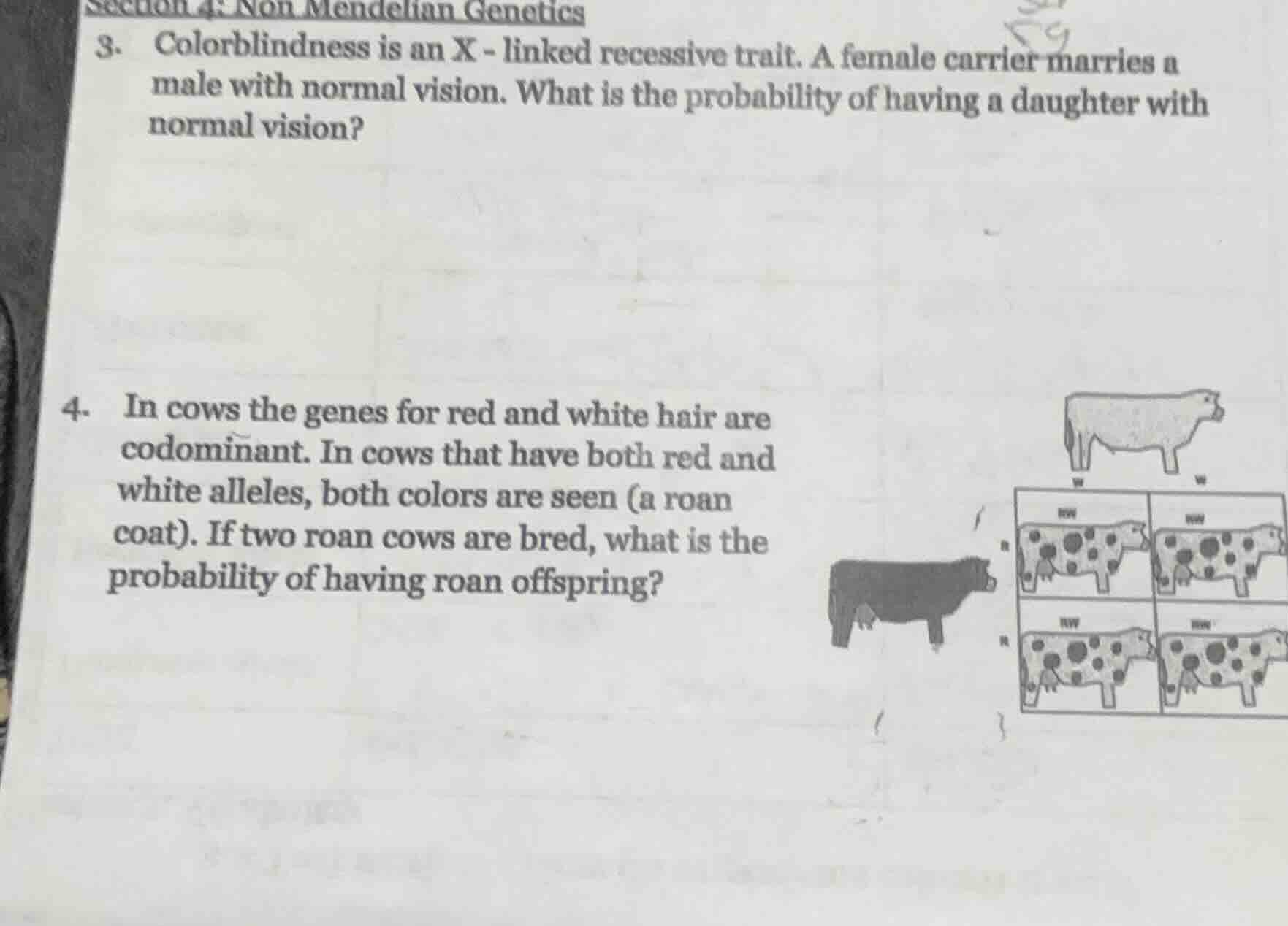
- colorblindness is an x - linked recessive trait. a female carrier marries a male with normal vision. what is the probability of having a daughter with normal vision?
- in cows the genes for red and white hair are codominant. in cows that have both red and white alleles, both colors are seen (a roan coat). if two roan cows are bred, what is the probability of having roan offspring?
Question 3
Step 1: Define Genotypes
Let \( X^C \) be the normal allele and \( X^c \) be the colorblind allele. A female carrier has genotype \( X^C X^c \), and a male with normal vision has genotype \( X^C Y \).
Step 2: Set Up Punnett Square
The possible gametes for the female are \( X^C \) and \( X^c \). For the male, they are \( X^C \) and \( Y \). The Punnett square combinations for daughters (since we focus on daughters, we only consider the \( X^C \) from the father and either \( X^C \) or \( X^c \) from the mother):
- \( X^C \) (father) + \( X^C \) (mother) = \( X^C X^C \) (normal daughter)
- \( X^C \) (father) + \( X^c \) (mother) = \( X^C X^c \) (carrier daughter, still normal vision)
Step 3: Calculate Probability
For daughters, there are 2 possible genotypes (from the 4 total in the Punnett square, but we filter for daughters: 2 out of 2 possible daughter genotypes are normal vision? Wait, no. Wait, the total offspring: 4 possibilities: \( X^C X^C \), \( X^C X^c \), \( X^C Y \), \( X^c Y \). The daughters are \( X^C X^C \) and \( X^C X^c \), both with normal vision. So out of 2 possible daughters (since gender is 50% chance, but wait, no: the probability of having a daughter is 50%, and then the probability that the daughter has normal vision. Wait, maybe I messed up. Let's re-express:
The cross is \( X^C X^c \times X^C Y \). The Punnett square:
| \( X^C \) | \( Y \) | |
|---|---|---|
| \( X^c \) | \( X^C X^c \) | \( X^c Y \) |
Now, the probability of having a daughter: the two female genotypes are \( X^C X^C \) and \( X^C X^c \), so 2 out of 4 offspring are daughters. The probability of having a daughter is \( \frac{2}{4} = \frac{1}{2} \). Then, among daughters, both have normal vision (since \( X^C X^C \) is normal, \( X^C X^c \) is carrier but normal vision). So the probability of having a daughter with normal vision is the probability of having a daughter ( \( \frac{1}{2} \)) multiplied by the probability that the daughter has normal vision (which is 1, since both daughter genotypes are normal). Wait, no: actually, the question is "probability of having a daughter with normal vision". So we can calculate it as (number of daughter genotypes with normal vision) / (total number of offspring). The total offspring: 4. The daughter genotypes with normal vision: 2 ( \( X^C X^C \) and \( X^C X^c \) ). So \( \frac{2}{4} = \frac{1}{2} \)? Wait, no, because the gender is part of the offspring. Wait, no: the 4 offspring include 2 males and 2 females. The 2 females are both normal vision. So the probability is \( \frac{2}{4} = \frac{1}{2} \)? Wait, no, that can't be. Wait, no: the probability of having a daughter is 50% (since half are female), and then the probability that the daughter has normal vision is 100% (since both possible daughter genotypes are normal). So the combined probability is \( \frac{1}{2} \times 1 = \frac{1}{2} \)? Wait, no, maybe I made a mistake. Wait, the female carrier is \( X^C X^c \), male is \( X^C Y \). The daughters will get one \( X \) from each parent. The father gives \( X^C \), the mother gives either \( X^C \) or \( X^c \). So the daughter's genotype is \( X^C X^C \) or \( X^C X^c \), both of which result in normal vision (since colorblindness is recessive, and the daughter needs two \( X^c \) to be colorblind, which she can't get because the father only gives \( X^C \)). So the probability of having a daughter with normal vision is the probability of having a daughter (50%) times the probability that the daughter has normal visi…
Step 1: Define Genotypes
Let \( R \) be the red allele and \( W \) be the white allele. Roan cows have genotype \( RW \) (since red and white are codominant, both colors are expressed).
Step 2: Set Up Punnett Square
Two roan cows (\( RW \)) are bred. The possible gametes for each are \( R \) and \( W \). The Punnett square:
| \( R \) | \( W \) | |
|---|---|---|
| \( W \) | \( RW \) | \( WW \) |
Step 3: Calculate Probability of Roan (\( RW \))
From the Punnett square, the genotypes are \( RR \), \( RW \), \( RW \), \( WW \). So there are 2 out of 4 offspring with genotype \( RW \) (roan). Thus, the probability is \( \frac{2}{4} = \frac{1}{2} \) (50%).

Snap & solve any problem in the app
Get step-by-step solutions on Sovi AI
Photo-based solutions with guided steps
Explore more problems and detailed explanations
The probability is \( \boldsymbol{\frac{1}{2}} \) (or 50%).