QUESTION IMAGE
Question
section 6 - solfege.
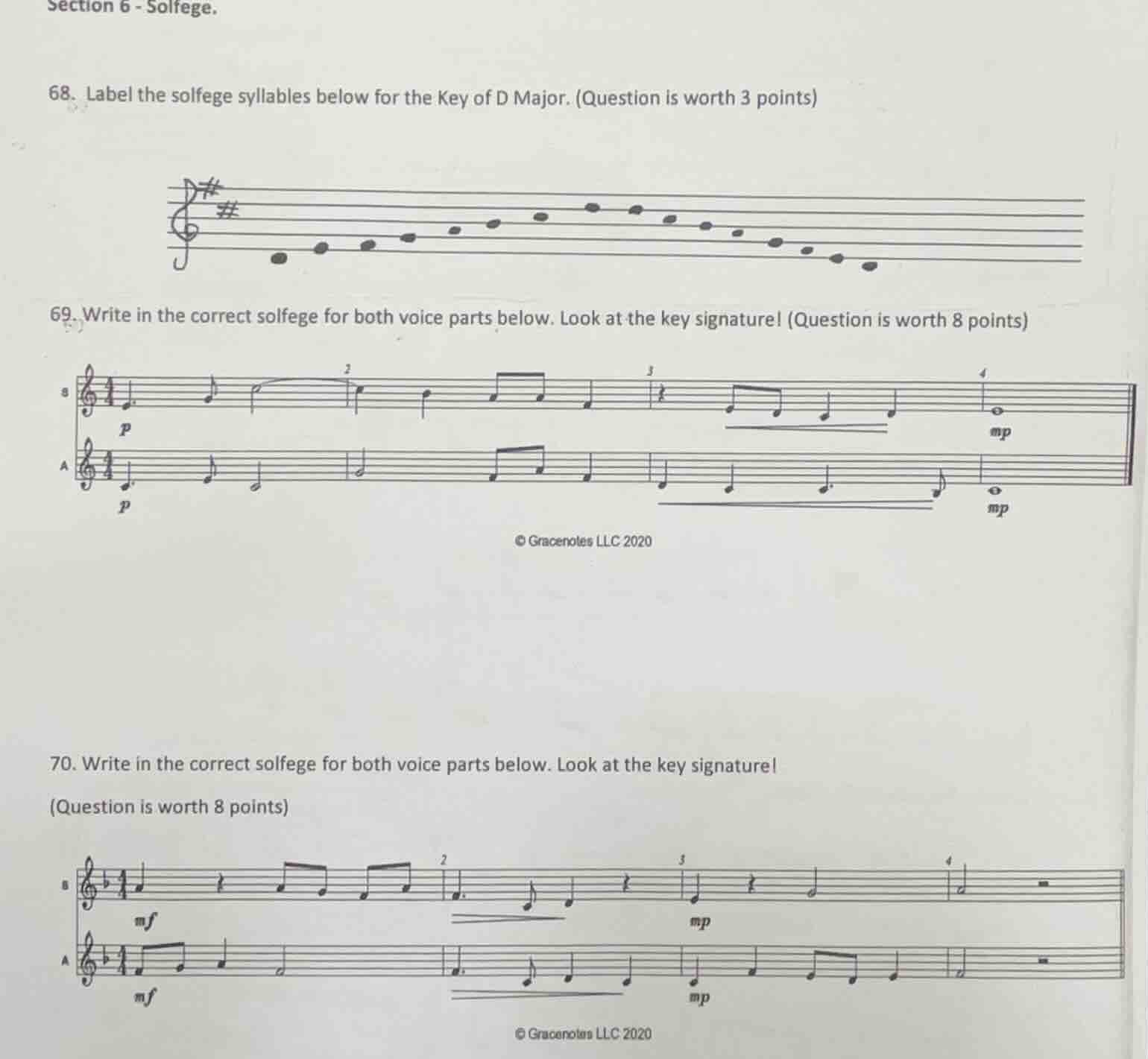
- label the solfege syllables below for the key of d major. (question is worth 3 points)
musical notation image
- write in the correct solfege for both voice parts below. look at the key signature! (question is worth 8 points)
musical notation image
© gracenotes llc 2020
- write in the correct solfege for both voice parts below. look at the key signature!
(question is worth 8 points)
musical notation image
© gracenotes llc 2020
Response
Question 68:
Brief Explanations
- Recall the D Major scale: D (do), E (re), F♯ (mi), G (fa), A (sol), B (la), C♯ (ti), D (do).
- Identify the notes in the given staff (treble clef, key of D Major with two sharps). The notes (from left to right, considering the positions) correspond to the D Major scale degrees. So label each note with the corresponding solfege syllable: do (D), re (E), mi (F♯), fa (G), sol (A), la (B), ti (C♯), do (D), etc. (adjusting for the actual note positions in the staff).
Brief Explanations
- First, determine the key signature. The treble clef has no additional sharps or flats? Wait, no, looking at the staff, the key signature for the first (soprano) and second (alto) parts: Wait, the soprano part has a treble clef, and let's check the key. Wait, maybe it's C Major? Wait, no, let's check the time signature (4/4) and the notes. Wait, the soprano part: first note is G (dotted quarter), then G (eighth), then C (half). Wait, maybe the key is C Major (no sharps or flats). So solfege for C Major: C - do, D - re, E - mi, F - fa, G - sol, A - la, B - ti, C - do.
- Soprano part (s):
- First note: G (sol, dotted quarter, p)
- Second note: G (sol, eighth)
- Third note: C (do, half)
- Then (second measure): C (do, quarter), B (ti, quarter), A (la, eighth), A (la, eighth), F (fa, quarter)
- Third measure: rest (quarter), E (mi, eighth), D (re, eighth), C (do, quarter), D (re, quarter)
- Fourth measure: E (mi, whole, mp) Wait, no, the fourth measure is E? Wait, no, the last note in soprano is E? Wait, no, the fourth measure in soprano is a whole note, maybe E? Wait, no, let's re - evaluate. Wait, maybe the key is G Major? No, the key signature has no sharps. Wait, maybe it's C Major.
- Alto part (A):
- First note: C (do, dotted quarter, p)
- Second note: E (mi, eighth)
- Third note: C (do, half)
- Second measure: G (sol, half), F (fa, eighth), A (la, eighth), F (fa, quarter)
- Third measure: D (re, quarter), C (do, quarter), C (do, dotted quarter), B (ti, eighth)
- Fourth measure: C (do, whole, mp)
- Wait, maybe I made a mistake. Let's use the key signature (no sharps or flats, so C Major). So solfege for each note:
- Soprano (s):
- Measure 1: G (sol) dotted quarter, G (sol) eighth, C (do) half
- Measure 2: C (do) quarter, B (ti) quarter, A (la) eighth, A (la) eighth, F (fa) quarter
- Measure 3: rest (quarter), E (mi) eighth, D (re) eighth, C (do) quarter, D (re) quarter
- Measure 4: E (mi) whole (mp)? Wait, no, the last note in soprano is E? Wait, the fourth measure in soprano is a whole note, maybe E? Wait, no, the staff shows a whole note in the soprano's fourth measure, maybe E? But in C Major, E is mi. Wait, maybe the key is G Major? No, key signature has no sharps. I think I need to re - check. Alternatively, maybe the key is C Major, so the solfege is based on C Major scale.
- Alto (A):
- Measure 1: C (do) dotted quarter, E (mi) eighth, C (do) half
- Measure 2: G (sol) half, F (fa) eighth, A (la) eighth, F (fa) quarter
- Measure 3: D (re) quarter, C (do) quarter, C (do) dotted quarter, B (ti) eighth
- Measure 4: C (do) whole (mp)
- So writing the solfege for each voice part:
- Soprano: sol, sol, do; do, ti, la, la, fa; (rest), mi, re, do, re; mi (whole, mp)
- Alto: do, mi, do; sol, fa, la, fa; re, do, do, ti; do (whole, mp)
- Wait, this is a bit error - prone without the exact note - by - note analysis, but the general approach is:
- 1. Determine key (C Major here, no sharps/flats).
- 2. Assign solfege (do - C, re - D, mi - E, fa - F, sol - G, la - A, ti - B) to each note in the soprano and alto parts.
Brief Explanations
- Determine the key signature: the treble clef has one flat (B♭), so the key is F Major. Solfege for F Major: F - do, G - re, A - mi, B♭ - fa, C - sol, D - la, E - ti, F - do.
- Analyze the soprano (s) and alto (A) parts:
- Soprano (s):
- First measure: A (mi, quarter, mf), rest (quarter), A (mi, eighth), G (re, eighth), F (do, eighth), A (mi, eighth)
- Second measure: F (do, dotted quarter), C (sol, eighth), D (la, quarter), rest (quarter)
- Third measure: E (ti, quarter, mp), rest (quarter), G (re, half)
- Fourth measure: A (mi, half), rest (half)
- Alto (A):
- First measure: F (do, eighth, mf), G (re, eighth), A (mi, quarter), F (do, half)
- Second measure: F (do, dotted quarter), C (sol, eighth), D (la, quarter), C (sol, quarter)
- Third measure: C (sol, quarter, mp), F (do, quarter), E (ti, eighth), D (la, eighth), E (ti, quarter)
- Fourth measure: F (do, half), rest (half)
- Assign solfege based on F Major (do - F, re - G, mi - A, fa - B♭, sol - C, la - D, ti - E) to each note in both parts.

Snap & solve any problem in the app
Get step-by-step solutions on Sovi AI
Photo-based solutions with guided steps
Explore more problems and detailed explanations
For the Key of D Major, the solfege syllables (matching the D Major scale: D - do, E - re, F♯ - mi, G - fa, A - sol, B - la, C♯ - ti) are assigned to each note in the staff as: do, re, mi, fa, sol, la, ti, do, re, mi, fa, sol, la, ti, do (depending on the exact note positions; the general scale - based solfege for D Major is do (D), re (E), mi (F♯), fa (G), sol (A), la (B), ti (C♯), do (D) and repeating).