QUESTION IMAGE
Question
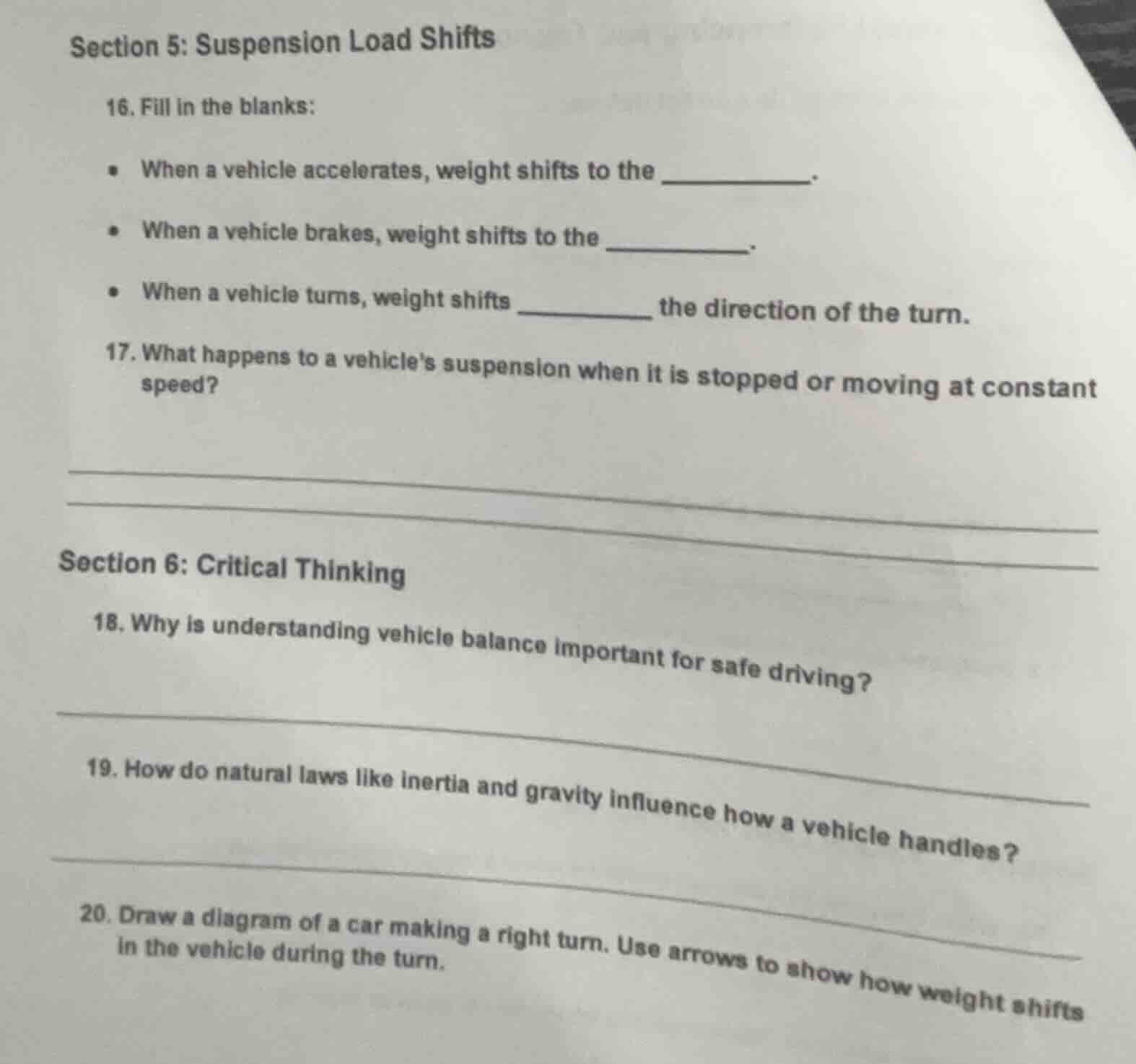
section 5: suspension load shifts
- fill in the blanks:
- when a vehicle accelerates, weight shifts to the ______.
- when a vehicle brakes, weight shifts to the ______.
- when a vehicle turns, weight shifts ______ the direction of the turn.
- what happens to a vehicles suspension when it is stopped or moving at constant speed?
section 6: critical thinking
- why is understanding vehicle balance important for safe driving?
- how do natural laws like inertia and gravity influence how a vehicle handles?
- draw a diagram of a car making a right turn. use arrows to show how weight shifts in the vehicle during the turn.
Response
Question 16
Brief Explanations
- For vehicle acceleration, due to inertia (Newton's first law), the weight shifts to the rear. When braking, inertia makes weight shift to the front. When turning, centrifugal force (in non - inertial frame) or inertia (in inertial frame) causes weight to shift opposite to the turn direction.
Brief Explanations
When a vehicle is stopped or moving at a constant speed, the net force acting on it is zero (Newton's first law). So the suspension is in a state of equilibrium, with the weight of the vehicle evenly distributed among the suspension components (like springs, shocks) and there is no additional weight shift.
Brief Explanations
Understanding vehicle balance is important for safe driving because:
- Traction and Control: Proper balance ensures that the tires have optimal contact with the road. For example, during braking, if weight shifts correctly to the front, the front tires can maintain better traction for steering and stopping.
- Stability: It prevents the vehicle from tipping over, especially during turns or sudden maneuvers. A vehicle with poor balance may lose control, skid, or roll over.
- Wear and Tear: Balanced weight distribution reduces uneven wear on suspension components, tires, and brakes, which in turn improves the vehicle's lifespan and reduces maintenance costs.
- Driver and Passenger Safety: By maintaining control and stability, it protects the occupants from accidents caused by loss of control due to imbalanced weight (e.g., during emergency braking or sharp turns).

Snap & solve any problem in the app
Get step-by-step solutions on Sovi AI
Photo-based solutions with guided steps
Explore more problems and detailed explanations
- When a vehicle accelerates, weight shifts to the \(\boldsymbol{\text{rear}}\).
- When a vehicle brakes, weight shifts to the \(\boldsymbol{\text{front}}\).
- When a vehicle turns, weight shifts \(\boldsymbol{\text{opposite}}\) the direction of the turn.