QUESTION IMAGE
Question
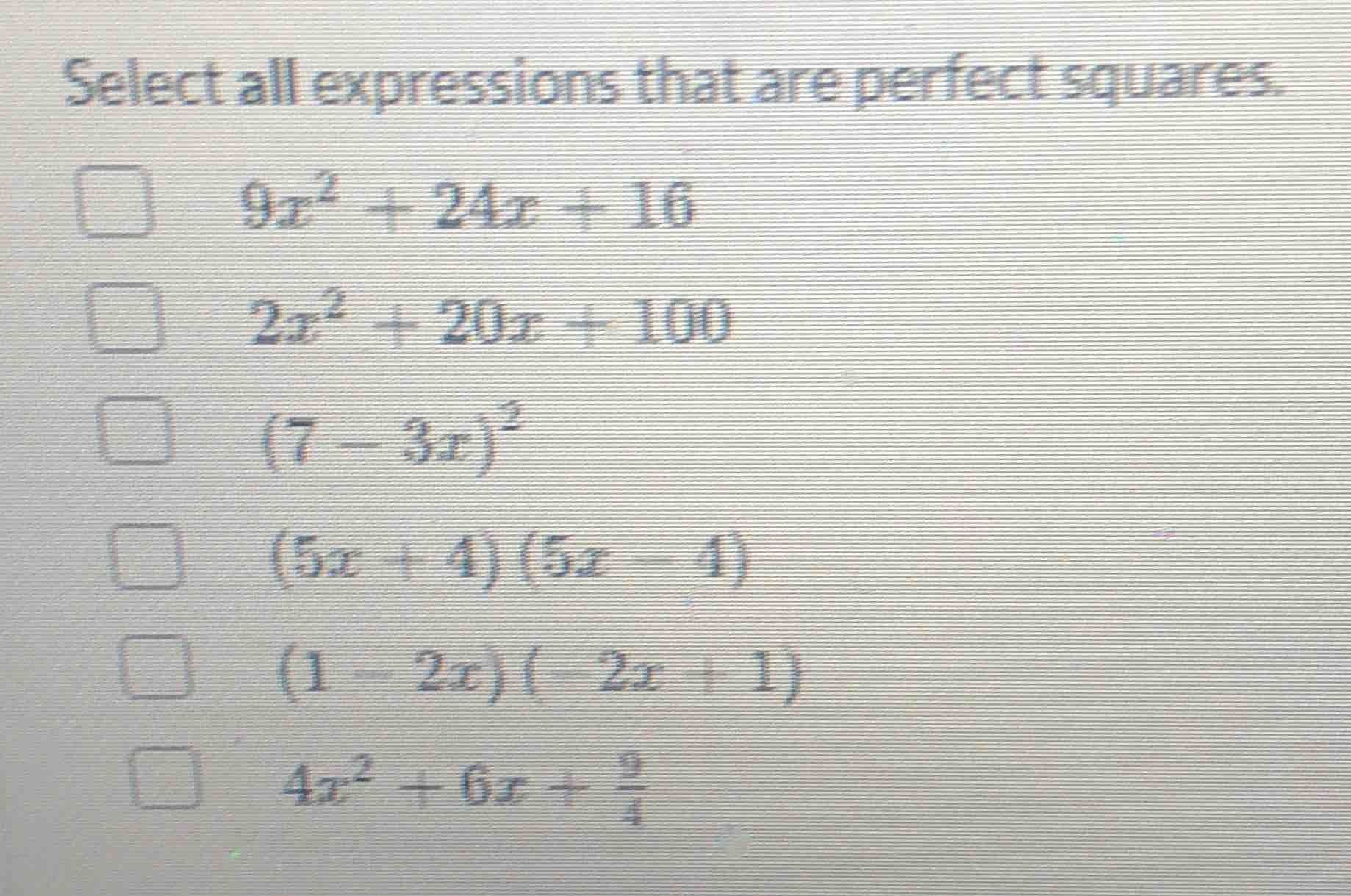
select all expressions that are perfect squares. 9x² + 24x + 16 2x² + 20x + 100 (7 - 3x)² (5x + 4)(5x - 4) (1 - 2x)(-2x + 1) 4x² + 6x + 9/4
Step1: Recall the perfect square trinomial formula
A perfect square trinomial has the form \((a + b)^2=a^{2}+2ab + b^{2}\) or \((a - b)^2=a^{2}-2ab + b^{2}\). Also, expressions that are already in the form of a square (like \((7 - 3x)^2\)) are perfect squares, and we can check binomial products (like \((5x + 4)(5x - 4)\)) using difference of squares or perfect square rules.
Step2: Analyze \(9x^{2}+24x + 16\)
Compare with \((a + b)^2=a^{2}+2ab + b^{2}\). Here, \(a^{2}=9x^{2}\), so \(a = 3x\); \(b^{2}=16\), so \(b = 4\). Then \(2ab=2\times(3x)\times4 = 24x\), which matches the middle term. So \(9x^{2}+24x + 16=(3x + 4)^2\), a perfect square.
Step3: Analyze \(2x^{2}+20x + 100\)
The coefficient of \(x^{2}\) is \(2\), not a perfect square (except in the case of factoring out 2, but \(2(x^{2}+10x + 50)\), and \(x^{2}+10x + 50\) is not a perfect square trinomial since \(10^{2}-4\times1\times50=100 - 200=- 100<0\) and also the coefficient of \(x^{2}\) in the original is 2, not a perfect square. So not a perfect square.
Step4: Analyze \((7 - 3x)^2\)
This is already in the form of a square of a binomial, so it is a perfect square.
Step5: Analyze \((5x + 4)(5x - 4)\)
This is a difference of squares: \((5x)^{2}-4^{2}=25x^{2}-16\), which is not a perfect square trinomial (it's a difference of squares, not a perfect square in the trinomial sense, and the expression is \(25x^{2}-16\), not a square of a binomial with a middle term. So not a perfect square trinomial (it's a difference of squares, but the question is about perfect squares, but this is a difference of squares, not a perfect square trinomial. Wait, actually, a perfect square can be a square of a binomial (trinomial) or a square of a monomial, etc. But \((5x + 4)(5x - 4)=25x^{2}-16\), which is not a perfect square (since it's a difference of squares, not a square of a single binomial with a middle term. So it's not a perfect square trinomial, and as a binomial product, it's a difference of squares, not a perfect square in the sense of a square of a binomial with a middle term. So not a perfect square.
Step6: Analyze \((1 - 2x)(-2x + 1)\)
Rewrite \((1 - 2x)(-2x + 1)=( - 2x + 1)(-2x + 1)=(-2x + 1)^2=(2x - 1)^2\) (since \((a - b)^2=(b - a)^2\)). So this is a perfect square.
Step7: Analyze \(4x^{2}+6x+\frac{9}{4}\)
Compare with \((a + b)^2=a^{2}+2ab + b^{2}\). \(a^{2}=4x^{2}\), so \(a = 2x\); \(b^{2}=\frac{9}{4}\), so \(b=\frac{3}{2}\). Then \(2ab=2\times(2x)\times\frac{3}{2}=6x\), which matches the middle term. So \(4x^{2}+6x+\frac{9}{4}=(2x+\frac{3}{2})^2\), a perfect square.

Snap & solve any problem in the app
Get step-by-step solutions on Sovi AI
Photo-based solutions with guided steps
Explore more problems and detailed explanations
- \(9x^{2}+24x + 16\) (since \(9x^{2}+24x + 16=(3x + 4)^2\))
- \((7 - 3x)^2\) (already a square of a binomial)
- \((1 - 2x)(-2x + 1)\) (simplifies to \((-2x + 1)^2=(2x - 1)^2\))
- \(4x^{2}+6x+\frac{9}{4}\) (since \(4x^{2}+6x+\frac{9}{4}=(2x+\frac{3}{2})^2\))