QUESTION IMAGE
Question
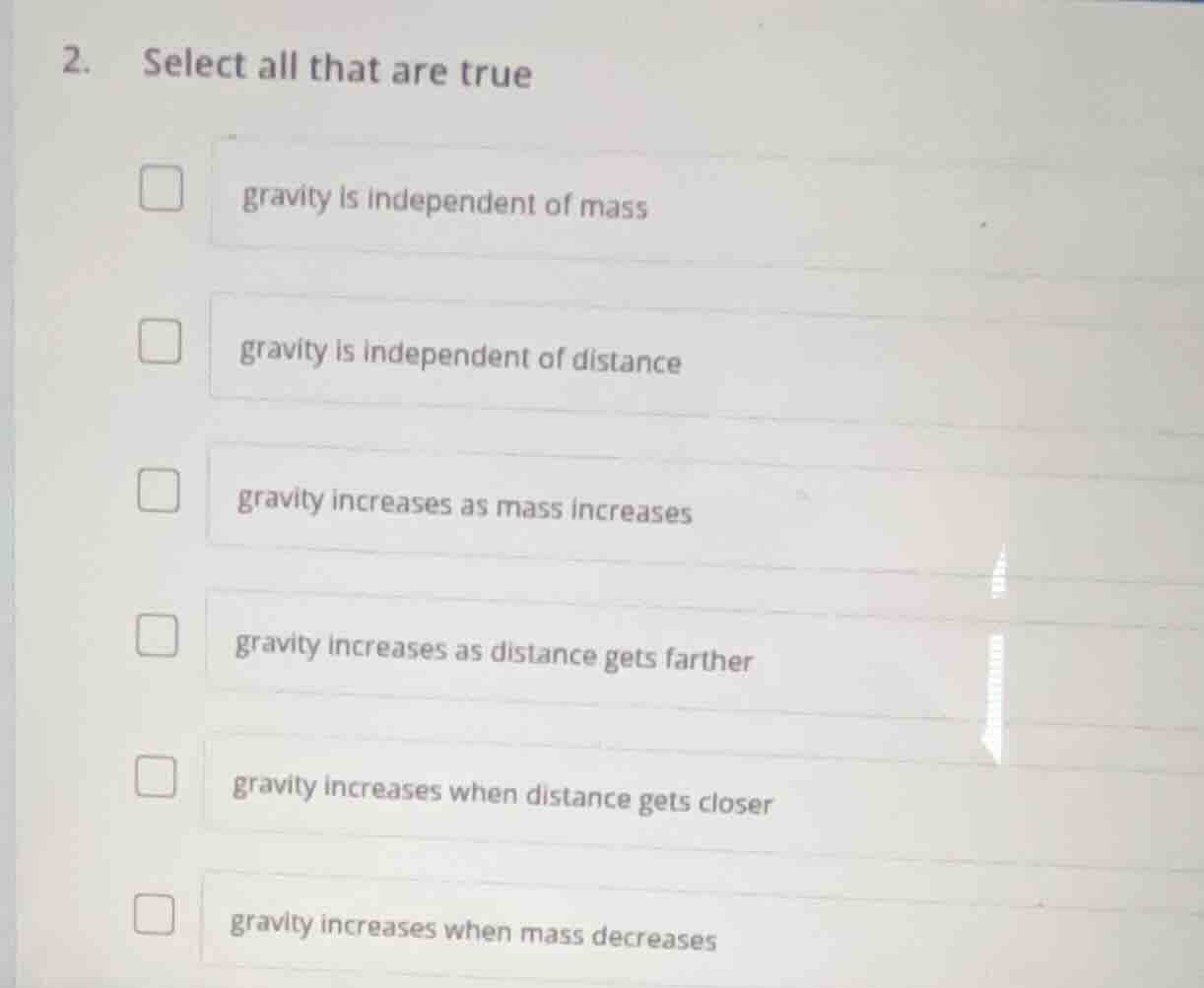
- select all that are true
□ gravity is independent of mass
□ gravity is independent of distance
□ gravity increases as mass increases
□ gravity increases as distance gets farther
□ gravity increases when distance gets closer
□ gravity increases when mass decreases
Brief Explanations
To determine the true statements about gravity, we use Newton's law of universal gravitation, \( F = G\frac{m_1m_2}{r^2} \), where \( F \) is the gravitational force, \( G \) is the gravitational constant, \( m_1 \) and \( m_2 \) are the masses of the two objects, and \( r \) is the distance between their centers.
- "gravity is independent of mass": False, as the formula shows gravity depends on mass.
- "gravity is independent of distance": False, as the formula shows gravity depends on the square of the distance (inversely).
- "gravity increases as mass increases": True, since force is directly proportional to the product of the masses.
- "gravity increases as distance gets farther": False, since force is inversely proportional to the square of the distance (so as distance increases, gravity decreases).
- "gravity increases when distance gets closer": True, because as \( r \) decreases, \( \frac{1}{r^2} \) increases, so the gravitational force increases.
- "gravity increases when mass decreases": False, as force is directly proportional to mass (so decreasing mass decreases gravity).

Snap & solve any problem in the app
Get step-by-step solutions on Sovi AI
Photo-based solutions with guided steps
Explore more problems and detailed explanations
- gravity increases as mass increases
- gravity increases when distance gets closer