QUESTION IMAGE
Question
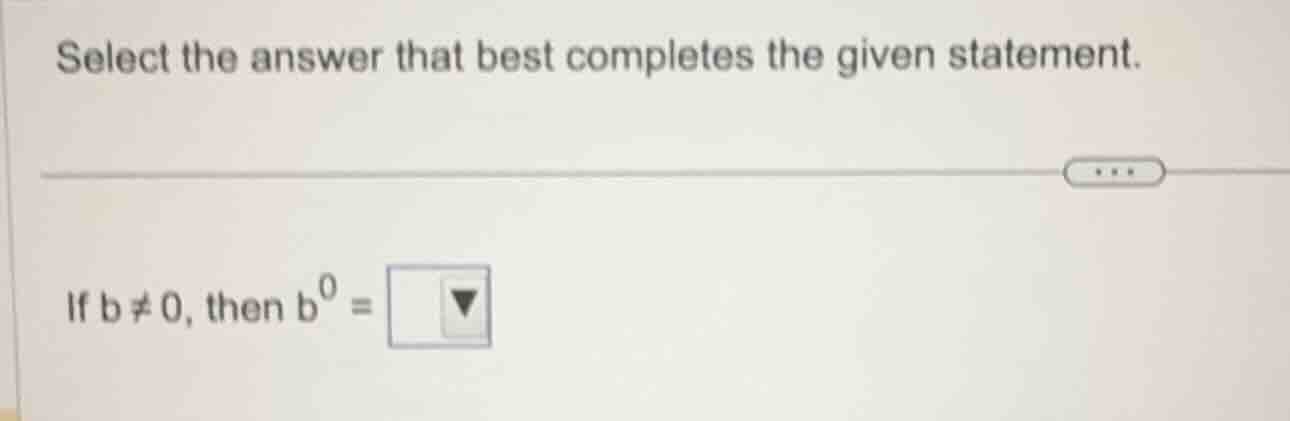
select the answer that best completes the given statement.
if ( b
eq 0 ), then ( b^0 = )
Step1: Recall the zero - exponent rule
The zero - exponent rule states that for any non - zero real number \(b\), \(b^{0}=1\). This is derived from the quotient rule of exponents: \(b^{m}\div b^{n}=b^{m - n}\). If we let \(m = n\), then \(b^{m}\div b^{m}=b^{m - m}=b^{0}\). But \(b^{m}\div b^{m}=\frac{b^{m}}{b^{m}} = 1\) (as long as \(b
eq0\), because division by zero is undefined), so \(b^{0}=1\) when \(b
eq0\).

Snap & solve any problem in the app
Get step-by-step solutions on Sovi AI
Photo-based solutions with guided steps
Explore more problems and detailed explanations
\(1\)