QUESTION IMAGE
Question
select the best transition words or phrases in the text below.
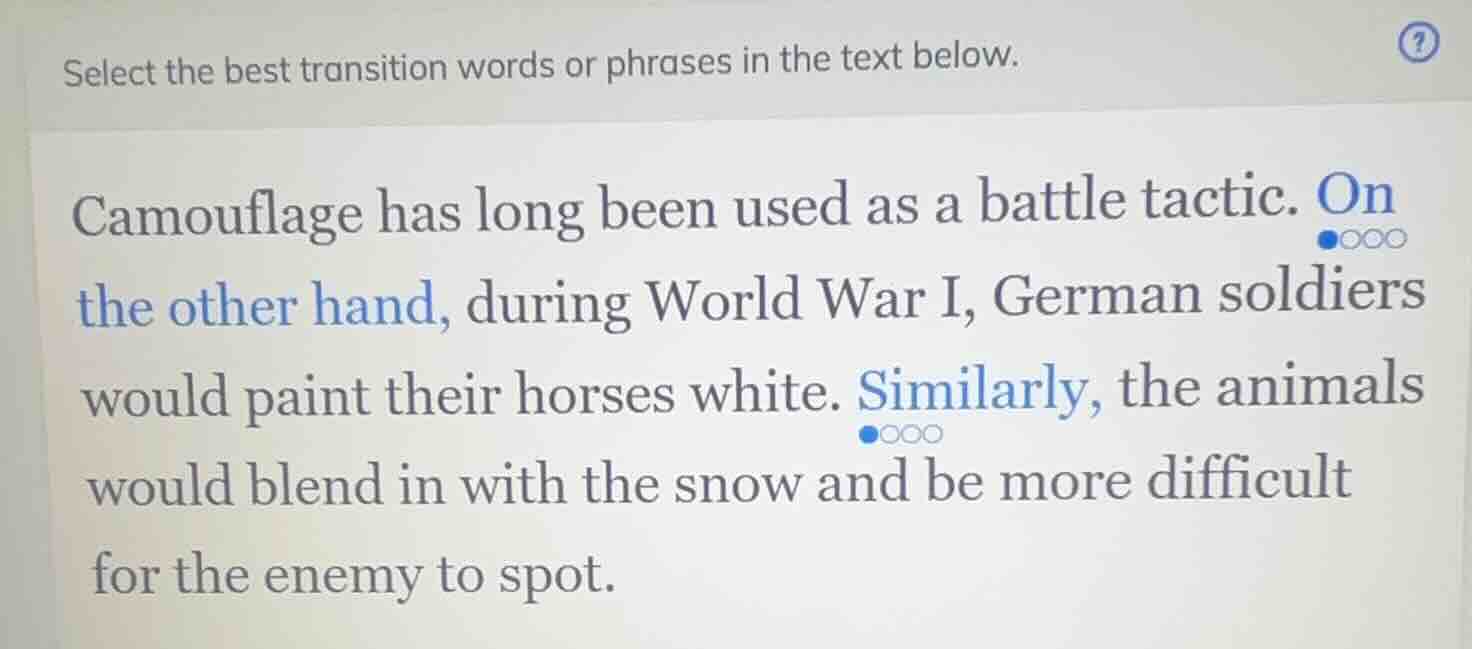
camouflage has long been used as a battle tactic. on the other hand, during world war i, german soldiers would paint their horses white. similarly, the animals would blend in with the snow and be more difficult for the enemy to spot.
- For "On the other hand": The first sentence introduces camouflage as a battle tactic, and the next sentence gives a specific example from WWI. "On the other hand" is used to show a contrast or a different perspective (here, an example of how camouflage was used), but actually, a better transition like "For example" would be more appropriate as it's an example, not a contrast. However, if we consider the intended use (maybe the user wants to check the existing or choose the best), but in the given text, the first transition: the context is introducing a general idea then an example, so "For example" is better, but if we have to work with the options (assuming the original has "On the other hand" as a wrong choice and we need to correct or choose the best). Wait, the problem is to select the best transition. Let's analyze:
- "On the other hand": Used to show contrast, but here the next sentence is an example of the general idea (camouflage as battle tactic), so it's not a contrast. So this transition is incorrect. A better transition would be "For example".
- "Similarly": The sentence after "Similarly" is about animals blending in, which is similar to the horses being painted white (to blend in with snow). So "Similarly" is correct here as it shows a similarity between the soldiers' action (painting horses white to camouflage) and animals' natural camouflage. Wait, the first transition: "On the other hand" is wrong, "Similarly" is correct? Wait, let's re-express:
First part: Camouflage is a battle tactic. Then, example: WWI German soldiers painted horses white (to camouflage). Then, similarly, animals blend in. So "Similarly" is correct because both the soldiers' action and animals' behavior are examples of camouflage (the soldiers' action is a human-made camouflage, animals' is natural, so they are similar in purpose). But the first transition "On the other hand" is incorrect because there's no contrast. So the best transitions:
For the first blank (after "battle tactic"): "For example" (to introduce an example)
For the second blank (after "white"): "Similarly" (to show similarity between the human camouflage and animal camouflage)
But the problem is to select the best transition words or phrases in the text. So let's check each:
- "On the other hand": Incorrect, as it's an example, not a contrast.
- "Similarly": Correct, as it shows the similarity between the soldiers' camouflage method and the animals' natural camouflage.
Wait, maybe the user's text has these two transitions, and we need to check if they are correct or choose the best. Let's confirm:
First sentence: Camouflage is a battle tactic.
Second sentence: On the other hand, during WWI, German soldiers painted horses white. → This is an example, so "On the other hand" is wrong. Should be "For example".
Third sentence: Similarly, the animals would blend in... → This is correct because painting horses white (to blend with snow) is similar to animals blending with snow, so "Similarly" shows the similarity.
So the best transitions:
- Replace "On the other hand" with "For example" (but if we have to choose from the given, maybe the problem is to check which is best. So "Similarly" is correct, "On the other hand" is incorrect.
But the problem says "Select the best transition words or phrases in the text below." So maybe the two transitions:
First transition: "On the other hand" is incorrect (should be "For example"), second: "Similarly" is correct.
But maybe the question is to choose the best among the given (assuming the options are as in the text). Wait, the t…

Snap & solve any problem in the app
Get step-by-step solutions on Sovi AI
Photo-based solutions with guided steps
Explore more problems and detailed explanations
- For the first transition ("On the other hand"): A better transition would be "For example" (as it introduces an example of camouflage as a battle tactic).
- For the second transition ("Similarly"): This is correct, as it shows the similarity between the soldiers’ camouflage (painting horses white) and animals’ natural camouflage (blending with snow) to avoid detection.
If choosing the best from the given text’s transitions, "Similarly" is the best (correctly showing similarity), while "On the other hand" is incorrect (no contrast, just an example).