QUESTION IMAGE
Question
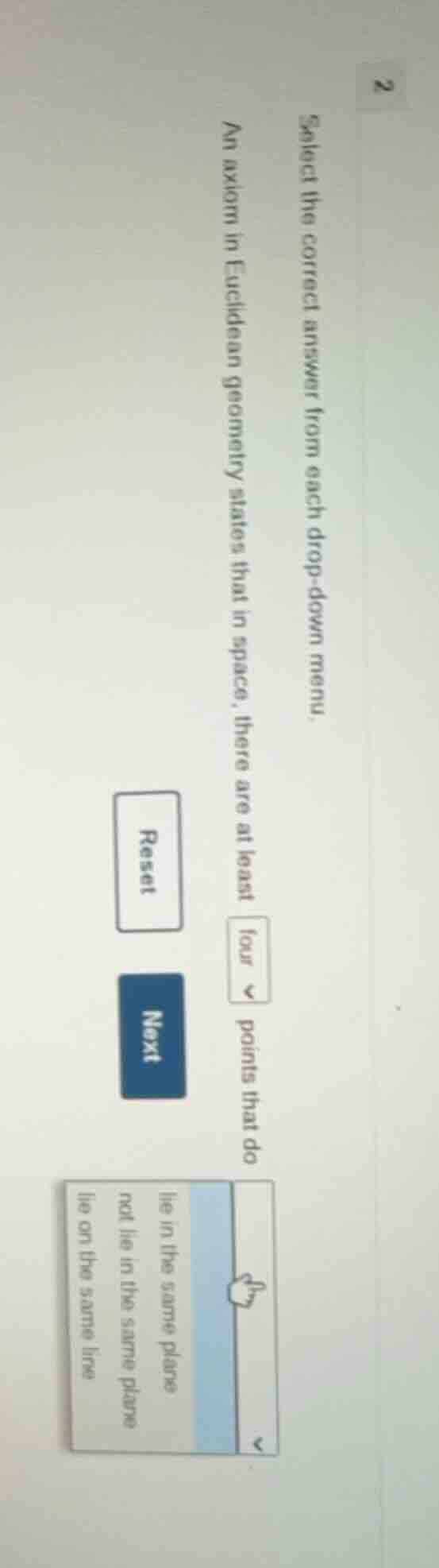
select the correct answer from each drop - down menu. an axiom in euclidean geometry states that in space, there are at least four points that do drop - down options: lie in the same plane, not lie in the same plane, lie on the same line
In Euclidean geometry, the axiom about space states that in space, there are at least four points that do not lie in the same plane. Let's analyze each option:
- "lie in the same plane": A plane is a flat, two - dimensional surface. In space, we need points that are not confined to a single plane to define the three - dimensional space. So this is incorrect.
- "not lie in the same plane": In three - dimensional space (which is what we consider in the context of space in geometry), we need at least four non - coplanar (not lying in the same plane) points. For example, think of a tetrahedron, which has four vertices, and no three of them are coplanar in a way that all four would be. So this is the correct option.
- "lie on the same line": A line is one - dimensional. Having four points on the same line does not help in defining the three - dimensional space. So this is incorrect.
For the first drop - down (the number of points), the correct number is four. In Euclidean geometry, the axiom is: "In space, there are at least four points that do not lie in the same plane." This is because a plane is two - dimensional, and to define a three - dimensional space, we need points that are not all confined to a single plane. Three non - collinear points define a plane, but to get into the three - dimensional space, we need a fourth point that is not in that plane.
Step 1: Analyze the number of points
The axiom in Euclidean geometry about space states that there are at least four points. So the first drop - down should be "four".
Step 2: Analyze the condition of the points
We need to determine the correct description of the points. As we know, in space (three - dimensional), the points should not lie in the same plane. If they lay in the same plane, they would be part of a two - dimensional figure, not defining the three - dimensional space. If they lay on the same line, they are one - dimensional and also not defining the three - dimensional space. So the second drop - down should be "not lie in the same plane".

Snap & solve any problem in the app
Get step-by-step solutions on Sovi AI
Photo-based solutions with guided steps
Explore more problems and detailed explanations
First drop - down: four
Second drop - down: not lie in the same plane