QUESTION IMAGE
Question
select the correct answer.
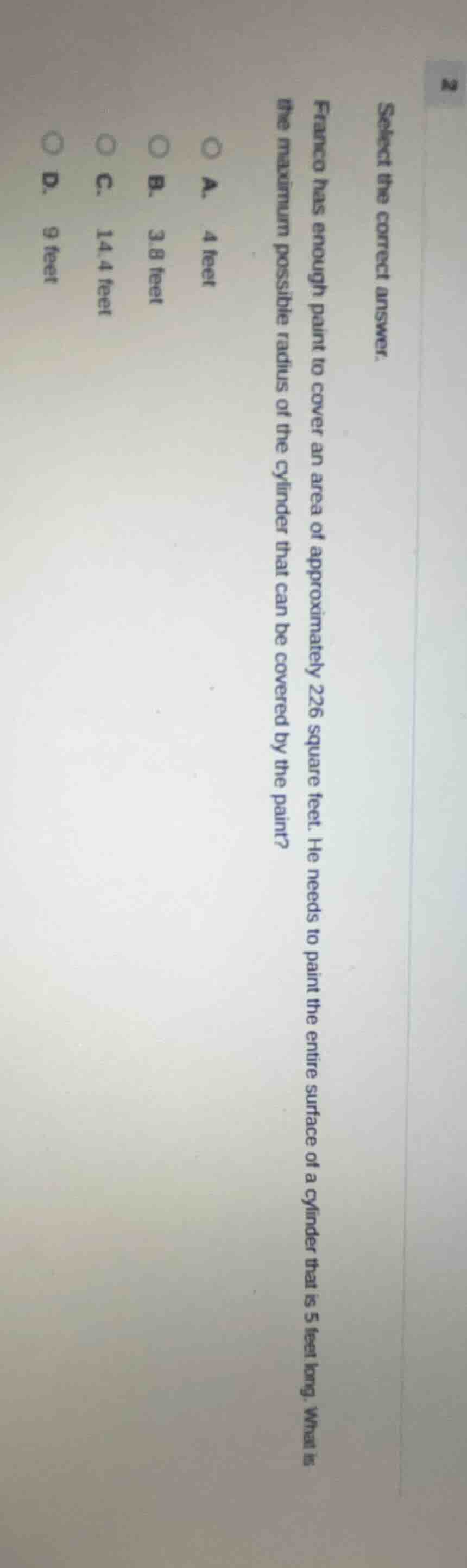
franco has enough paint to cover an area of approximately 226 square feet. he needs to paint the entire surface of a cylinder that is 5 feet long. what is the maximum possible radius of the cylinder that can be covered by the paint?
a. 4 feet
b. 3.8 feet
c. 14.4 feet
d. 9 feet
Step1: Recall the surface area formula of a cylinder
The surface area \( S \) of a cylinder is given by the formula \( S = 2\pi r^2 + 2\pi rh \), where \( r \) is the radius and \( h \) is the height (or length in this case). We know that \( S\approx226 \) square feet and \( h = 5 \) feet. So we substitute these values into the formula:
\( 226\approx2\pi r^2 + 2\pi r\times5 \)
Step2: Simplify the equation
Let's use \( \pi\approx3.14 \). Then the equation becomes:
\( 226\approx2\times3.14\times r^2 + 2\times3.14\times r\times5 \)
\( 226\approx6.28r^2 + 31.4r \)
Rearrange it to a quadratic equation form \( ax^2+bx + c = 0 \) (let \( x = r \)):
\( 6.28r^2+31.4r - 226 = 0 \)
We can simplify this equation by dividing all terms by \( 6.28 \):
\( r^2 + 5r - \frac{226}{6.28}=0 \)
Calculate \( \frac{226}{6.28}\approx36 \), so the equation is \( r^2 + 5r - 36 = 0 \)
Step3: Solve the quadratic equation
We can factor the quadratic equation \( r^2 + 5r - 36 = 0 \). We need two numbers that multiply to \( - 36 \) and add up to \( 5 \). The numbers are \( 9 \) and \( - 4 \). So:
\( (r + 9)(r - 4)=0 \)
Setting each factor equal to zero gives \( r + 9 = 0 \) or \( r - 4 = 0 \). Since the radius cannot be negative, we take \( r - 4 = 0 \), so \( r = 4 \) feet. We can also check by plugging \( r = 4 \) back into the surface area formula:
\( S=2\times3.14\times4^2+2\times3.14\times4\times5=2\times3.14\times16 + 125.6=100.48+125.6 = 226.08\approx226 \), which matches the given area.

Snap & solve any problem in the app
Get step-by-step solutions on Sovi AI
Photo-based solutions with guided steps
Explore more problems and detailed explanations
A. 4 feet