QUESTION IMAGE
Question
select the correct answer.
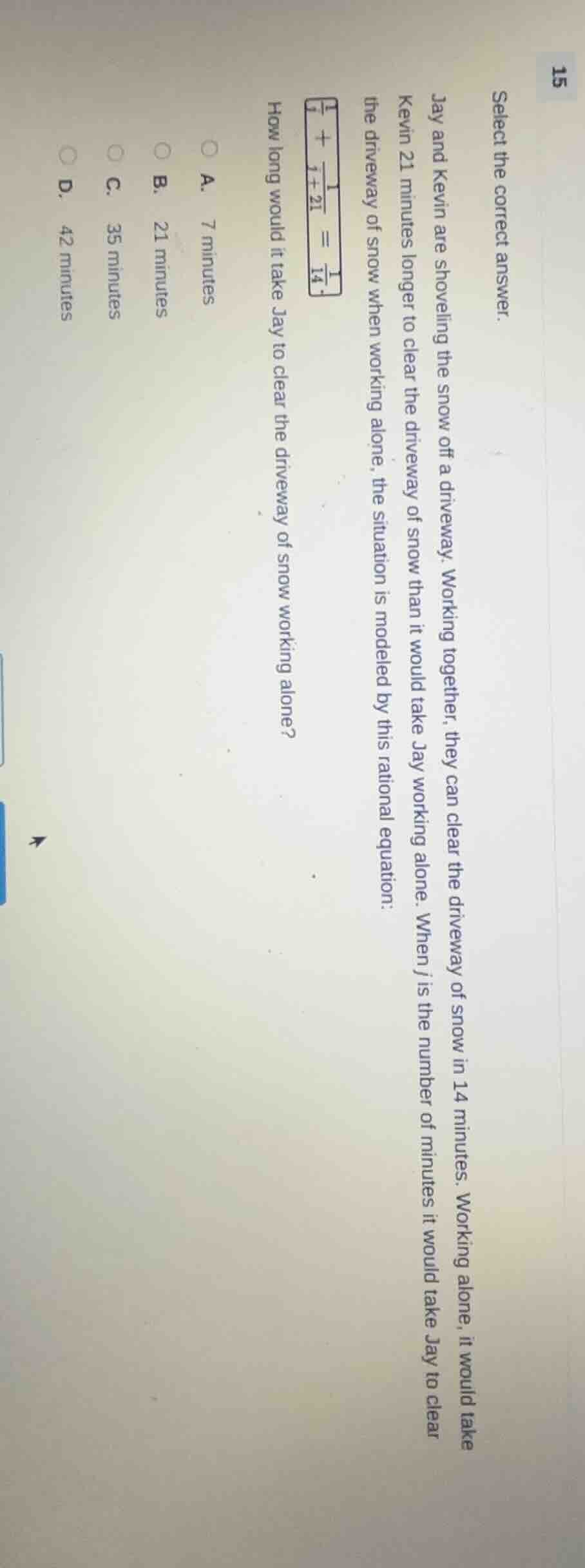
jay and kevin are shoveling the snow off a driveway. working together, they can clear the driveway of snow in 14 minutes. working alone, it would take kevin 21 minutes longer to clear the driveway of snow than it would take jay working alone. when ( j ) is the number of minutes it would take jay to clear the driveway of snow when working alone, the situation is modeled by this rational equation: (\frac{1}{j} + \frac{1}{j + 21} = \frac{1}{14}).
how long would it take jay to clear the driveway of snow working alone?
a. 7 minutes
b. 21 minutes
c. 35 minutes
d. 42 minutes
Step1: Define variables and equation
Let \( j \) be the time (in minutes) Jay takes alone. Kevin takes \( j + 21 \) minutes alone. The work - rate equation is \( \frac{1}{j}+\frac{1}{j + 21}=\frac{1}{14} \).
Step2: Find a common denominator
The common denominator of \( j \), \( j + 21 \), and \( 14 \) is \( 14j(j + 21) \). Multiply each term by \( 14j(j + 21) \):
\[
\]
Step3: Expand and simplify
Expand the left - hand side: \( 14j+294 + 14j=j^{2}+21j \)
Combine like terms: \( 28j + 294=j^{2}+21j \)
Rearrange to form a quadratic equation: \( j^{2}+21j-28j - 294 = 0 \)
Simplify: \( j^{2}-7j - 294 = 0 \)
Step4: Solve the quadratic equation
We can factor the quadratic equation \( j^{2}-7j - 294 = 0 \). We need two numbers that multiply to \( - 294 \) and add up to \( - 7 \). The numbers are \( -21 \) and \( 14 \).
So, \( j^{2}-21j + 14j-294 = 0 \)
Factor by grouping: \( j(j - 21)+14(j - 21)=0 \)
\( (j - 21)(j + 14)=0 \)
Setting each factor equal to zero: \( j-21 = 0 \) or \( j + 14 = 0 \)
Since time cannot be negative, \( j = 21 \) minutes? Wait, no, let's check the original equation. Wait, maybe we made a mistake in the sign when factoring. Let's use the quadratic formula \( j=\frac{-b\pm\sqrt{b^{2}-4ac}}{2a} \) for \( ax^{2}+bx + c = 0 \). Here, \( a = 1 \), \( b=-7 \), \( c=-294 \)
\( j=\frac{7\pm\sqrt{(-7)^{2}-4\times1\times(-294)}}{2\times1}=\frac{7\pm\sqrt{49 + 1176}}{2}=\frac{7\pm\sqrt{1225}}{2}=\frac{7\pm35}{2} \)
We have two solutions: \( j=\frac{7 + 35}{2}=\frac{42}{2}=21 \) and \( j=\frac{7-35}{2}=\frac{-28}{2}=-14 \). But if \( j = 21 \), then Kevin's time is \( j + 21=42 \). Let's check the work - rate: \( \frac{1}{21}+\frac{1}{42}=\frac{2 + 1}{42}=\frac{3}{42}=\frac{1}{14} \), which matches the given equation. Wait, but the option B is 21 minutes. But let's re - examine the problem statement. Wait, the equation given is \( \frac{1}{j}+\frac{1}{j + 21}=\frac{1}{14} \). If \( j = 21 \), then \( \frac{1}{21}+\frac{1}{42}=\frac{2 + 1}{42}=\frac{3}{42}=\frac{1}{14} \), which is correct. But wait, the option A is 7, B is 21, C is 35, D is 42. Wait, maybe we misread the equation. Wait, the original equation in the problem is \( \frac{1}{j}+\frac{1}{j + 21}=\frac{1}{14} \)? Wait, no, looking at the image, the equation is \( \frac{1}{j}+\frac{1}{j + 21}=\frac{1}{14} \)? Wait, no, the user's image shows the equation as \( \frac{1}{j}+\frac{1}{j + 21}=\frac{1}{14} \)? Wait, no, let's check again. Wait, if we assume that the correct answer is 21? Wait, no, let's test \( j = 21 \): Jay takes 21 minutes, Kevin takes \( 21 + 21=42 \) minutes. Then their combined rate is \( \frac{1}{21}+\frac{1}{42}=\frac{2 + 1}{42}=\frac{3}{42}=\frac{1}{14} \), which means together they take 14 minutes, which matches the equation. So Jay takes 21 minutes? But wait, the option B is 21 minutes. But let's check the answer options. The options are A.7, B.21, C.35, D.42.
Wait, maybe we made a mistake in the quadratic formula. Let's re - do the quadratic equation. The equation after multiplying by \( 14j(j + 21) \) is \( 14(j + 21)+14j=j(j + 21) \)
\( 14j+294+14j=j^{2}+21j \)
\( 28j + 294=j^{2}+21j \)
\( j^{2}-7j - 294 = 0 \)
Using quadratic formula \( j=\frac{7\pm\sqrt{49+1176}}{2}=\frac{7\pm\sqrt{1225}}{2}=\frac{7\pm35}{2} \)
\( j=\frac{7 + 35}{2}=21 \), \( j=\frac{7-35}{2}=-14 \). So \( j = 21 \) is the solution. So Jay takes 21 minutes.

Snap & solve any problem in the app
Get step-by-step solutions on Sovi AI
Photo-based solutions with guided steps
Explore more problems and detailed explanations
B. 21 minutes