QUESTION IMAGE
Question
select the correct answer.
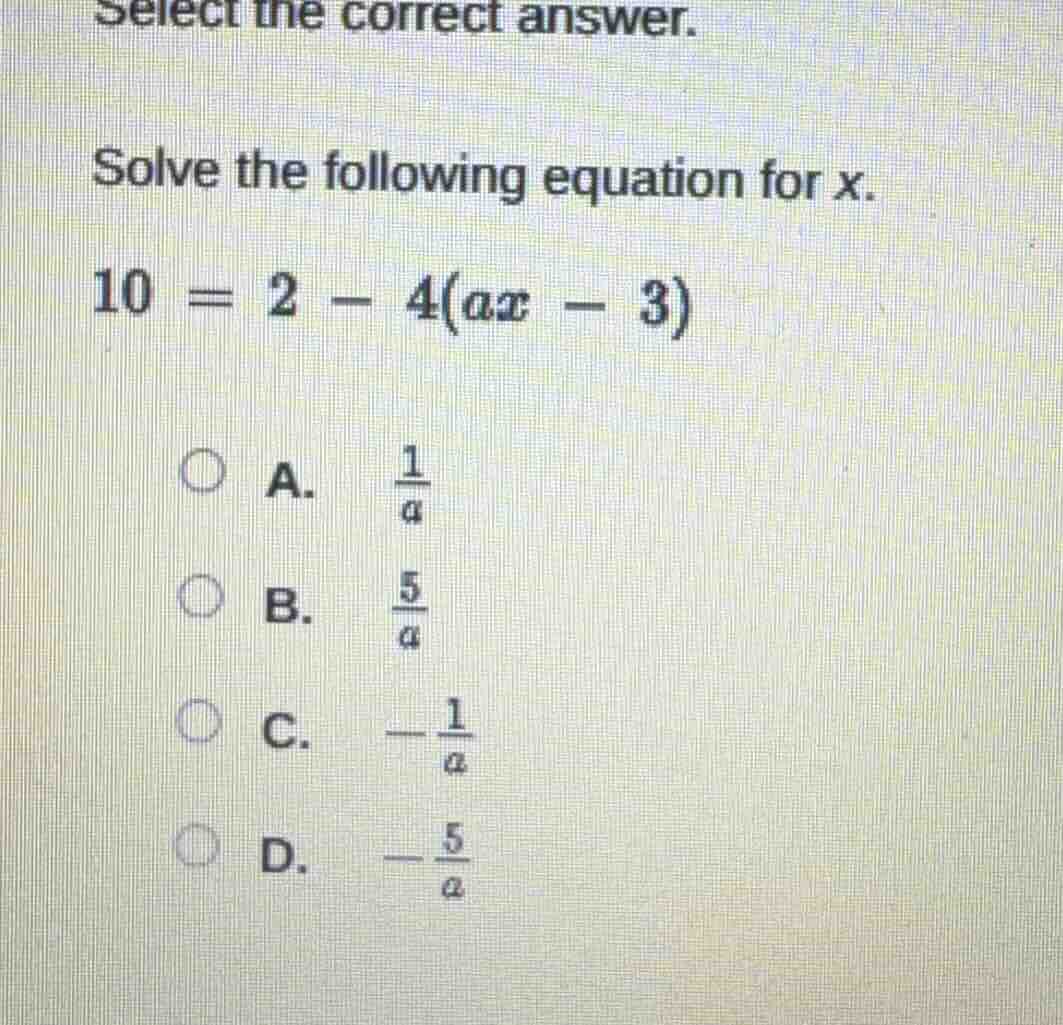
solve the following equation for x.
10 = 2 - 4(ax - 3)
a. \\(\frac{1}{a}\\)
b. \\(\frac{5}{a}\\)
c. \\(-\frac{1}{a}\\)
d. \\(-\frac{5}{a}\\)
Step1: Subtract 2 from both sides
$10 - 2 = 2 - 4(ax - 3) - 2$
$8 = -4(ax - 3)$
Step2: Divide both sides by -4
$\frac{8}{-4} = \frac{-4(ax - 3)}{-4}$
$-2 = ax - 3$
Step3: Add 3 to both sides
$-2 + 3 = ax - 3 + 3$
$1 = ax$
Step4: Divide both sides by \(a\) (assuming \(a
eq 0\))
$\frac{1}{a} = \frac{ax}{a}$
$x = \frac{1}{a}$ Wait, no, wait. Wait, let's re - check the steps.
Wait, original equation: \(10 = 2-4(ax - 3)\)
Step 1: Subtract 2 from both sides: \(10 - 2=2-4(ax - 3)-2\) → \(8=-4(ax - 3)\)
Step 2: Divide both sides by - 4: \(8\div(-4)=-4(ax - 3)\div(-4)\) → \(-2 = ax - 3\)
Step 3: Add 3 to both sides: \(-2 + 3=ax-3 + 3\) → \(1 = ax\)
Step 4: Divide both sides by \(a\) ( \(a
eq0\)): \(x=\frac{1}{a}\)? But that's option A. Wait, but let's check again.
Wait, maybe I made a mistake. Let's expand the right - hand side first.
Original equation: \(10 = 2-4(ax - 3)\)
Expand \(-4(ax - 3)\): \(-4ax+12\)
So the equation becomes: \(10 = 2-4ax + 12\)
Combine like terms on the right - hand side: \(2 + 12=14\), so \(10=14-4ax\)
Subtract 14 from both sides: \(10 - 14=14-4ax-14\) → \(-4=-4ax\)
Divide both sides by - 4: \(\frac{-4}{-4}=\frac{-4ax}{-4}\) → \(1 = ax\)
Divide both sides by \(a\) ( \(a
eq0\)): \(x=\frac{1}{a}\)

Snap & solve any problem in the app
Get step-by-step solutions on Sovi AI
Photo-based solutions with guided steps
Explore more problems and detailed explanations
A. \(\frac{1}{a}\)