QUESTION IMAGE
Question
select the correct answer.
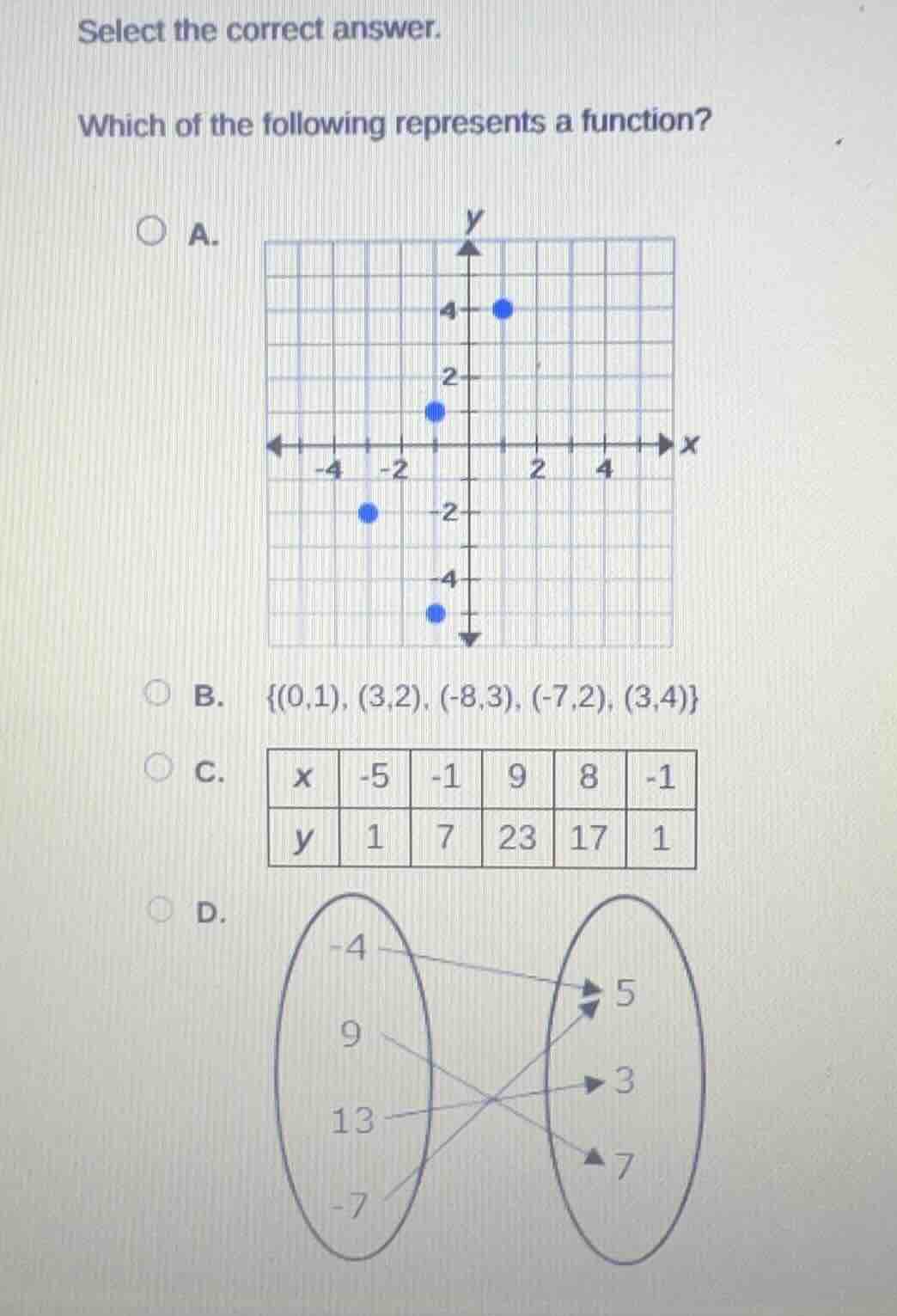
which of the following represents a function?
a.
graph with coordinate points
b. {(0,1), (3,2), (-8,3), (-7,2), (3,4)}
c.
| x | -5 | -1 | 9 | 8 | -1 |
| y | 1 | 7 | 23 | 17 | 1 |
d.
mapping diagram with two ovals and arrows
Step1: Recall the definition of a function
A function is a relation where each input (x - value) has exactly one output (y - value). We will check each option using this definition.
Step2: Analyze Option A
In the graph of Option A, we identify the coordinates of the points. Let's find the x - values:
- The first point: Let's assume the coordinates. From the graph, the points seem to have distinct x - values. Let's list the x - coordinates of the points. The points are \((-3, - 2)\), \((-1,1)\), \((1,4)\), \((-1,-5)\)? Wait, no, looking at the graph: The x - values of the points are \(-3\), \(-1\), \(1\), \(-1\)? Wait, no, let's re - examine. Wait, the points: one at \(x=-3,y = - 2\), one at \(x=-1,y = 1\), one at \(x = 1,y=4\), one at \(x=-1,y=-5\)? No, maybe I misread. Wait, actually, in a function, for each x, there is only one y. Let's check the x - values of the points in Option A. Let's find the x - coordinates:
Looking at the graph, the x - values of the plotted points: Let's see the grid. The x - values are \(-3\), \(-1\), \(1\), and \(-1\)? Wait, no, maybe the points are \((-3,-2)\), \((-1,1)\), \((1,4)\), \((-1, - 5)\)? No, that can't be. Wait, maybe I made a mistake. Wait, actually, in the graph of Option A, let's list the x - values of each point:
Suppose the points are: \((-3,-2)\) (x=-3), \((-1,1)\) (x = - 1), \((1,4)\) (x = 1), \((-1,-5)\) (x=-1). Wait, no, that would mean x=-1 has two y - values (1 and - 5), but wait, maybe I misread the graph. Wait, maybe the points are \((-3,-2)\), \((-1,1)\), \((1,4)\), and \((-1,-5)\) is not there. Wait, no, the original graph: Let's look again. The x - values of the points: Let's check the x - axis. The points: one at x=-3 (left - most), one at x=-1 (middle left), one at x = 1 (middle right), and one at x=-1? No, maybe the graph has points with distinct x - values. Wait, maybe I was wrong. Wait, let's check Option B, C, D first.
Step3: Analyze Option B
The set of ordered pairs is \(\{(0,1),(3,2),(-8,3),(-7,2),(3,4)\}\). Here, the x - value \(x = 3\) is paired with \(y = 2\) and \(y=4\). Since \(x = 3\) has two different y - values, this relation is not a function.
Step4: Analyze Option C
In the table of Option C, the x - values are given as \(-5\), \(-1\), \(9\), \(8\), \(-1\). The x - value \(-1\) is paired with \(y = 7\) and \(y = 1\). Since one x - value (\(x=-1\)) is associated with two different y - values, this relation is not a function.
Step5: Analyze Option D
In the mapping of Option D, we look at the input (left - hand oval) and output (right - hand oval). The input value \(-4\) maps to \(5\), \(9\) maps to \(3\) and \(7\)? Wait, no, the mapping: Let's see, the left oval has \(-4\), \(9\), \(13\), \(-7\). The right oval has \(5\), \(3\), \(7\). The input \(9\) maps to \(3\) and \(7\)? Wait, no, looking at the arrows: \(-4\) maps to \(5\), \(9\) maps to \(3\) and \(7\)? Wait, no, the arrows: \(-4\) to \(5\), \(9\) to \(3\) and \(7\)? Wait, no, maybe I misread. Wait, the mapping: If an input has more than one output, it's not a function. Wait, but in Option A, let's re - check. Wait, maybe I made a mistake in Option A. Wait, let's re - evaluate Option A.
Wait, maybe the points in Option A have distinct x - values. Let's list the x - coordinates of the points in Option A:
Looking at the graph, the x - values of the blue dots: Let's see the x - axis. The points are at \(x=-3\) (y=-2), \(x=-1\) (y = 1), \(x = 1\) (y = 4), and \(x=-1\) (y=-5)? No, that can't be. Wait, maybe the graph is such that each x - value has only one y - value. Wait, perhaps I made…

Snap & solve any problem in the app
Get step-by-step solutions on Sovi AI
Photo-based solutions with guided steps
Explore more problems and detailed explanations
A