QUESTION IMAGE
Question
select the correct answer.
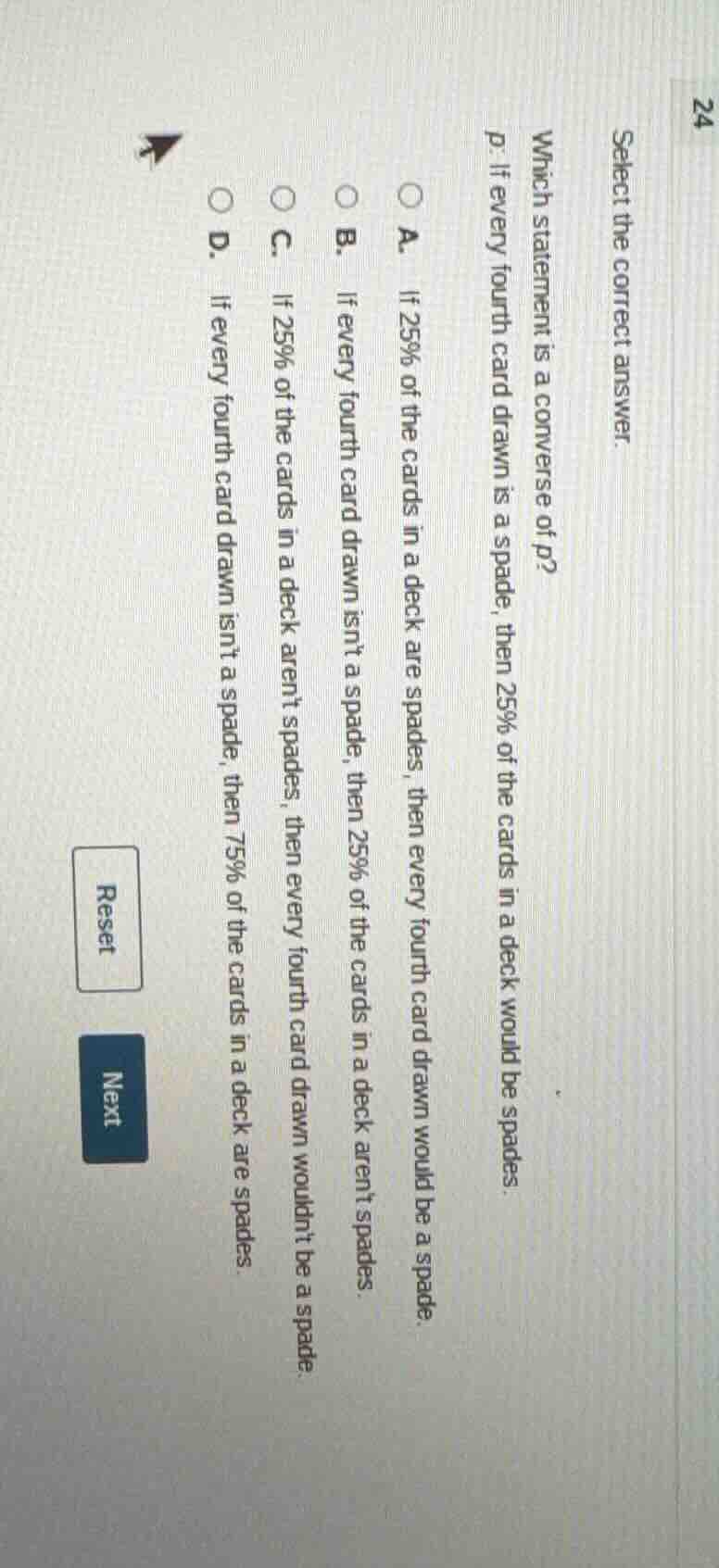
which statement is a converse of p?
p: if every fourth card drawn is a spade, then 25% of the cards in a deck would be spades.
a. if 25% of the cards in a deck are spades, then every fourth card drawn would be a spade.
b. if every fourth card drawn isnt a spade, then 25% of the cards in a deck arent spades.
c. if 25% of the cards in a deck arent spades, then every fourth card drawn wouldnt be a spade.
d. if every fourth card drawn isnt a spade, then 75% of the cards in a deck are spades.
To find the converse of a conditional statement \( p: \text{If } A, \text{ then } B \), we swap the hypothesis (\( A \)) and the conclusion (\( B \)). The original statement \( p \) is: "If every fourth card drawn is a spade, then 25% of the cards in a deck are spades." Here, \( A \) is "every fourth card drawn is a spade" and \( B \) is "25% of the cards in a deck are spades."
For the converse, we need to have "If \( B \), then \( A \)". Let's analyze each option:
- Option A: "If 25% of the cards in a deck are spades, then every fourth card drawn would be a spade." This matches "If \( B \), then \( A \)" (where \( B \) is 25% of cards are spades and \( A \) is every fourth card drawn is a spade).
- Option B: This is a contrapositive or inverse - like statement, not a converse. It negates both parts and swaps, which is not the converse.
- Option C: This negates both parts and is not a converse (it's more like an inverse - contrapositive mix).
- Option D: This also involves negation and percentage change, not a simple swap of hypothesis and conclusion.
So the converse of \( p \) is when we swap the "if" and "then" parts of the original conditional.

Snap & solve any problem in the app
Get step-by-step solutions on Sovi AI
Photo-based solutions with guided steps
Explore more problems and detailed explanations
A. If 25% of the cards in a deck are spades, then every fourth card drawn would be a spade.