QUESTION IMAGE
Question
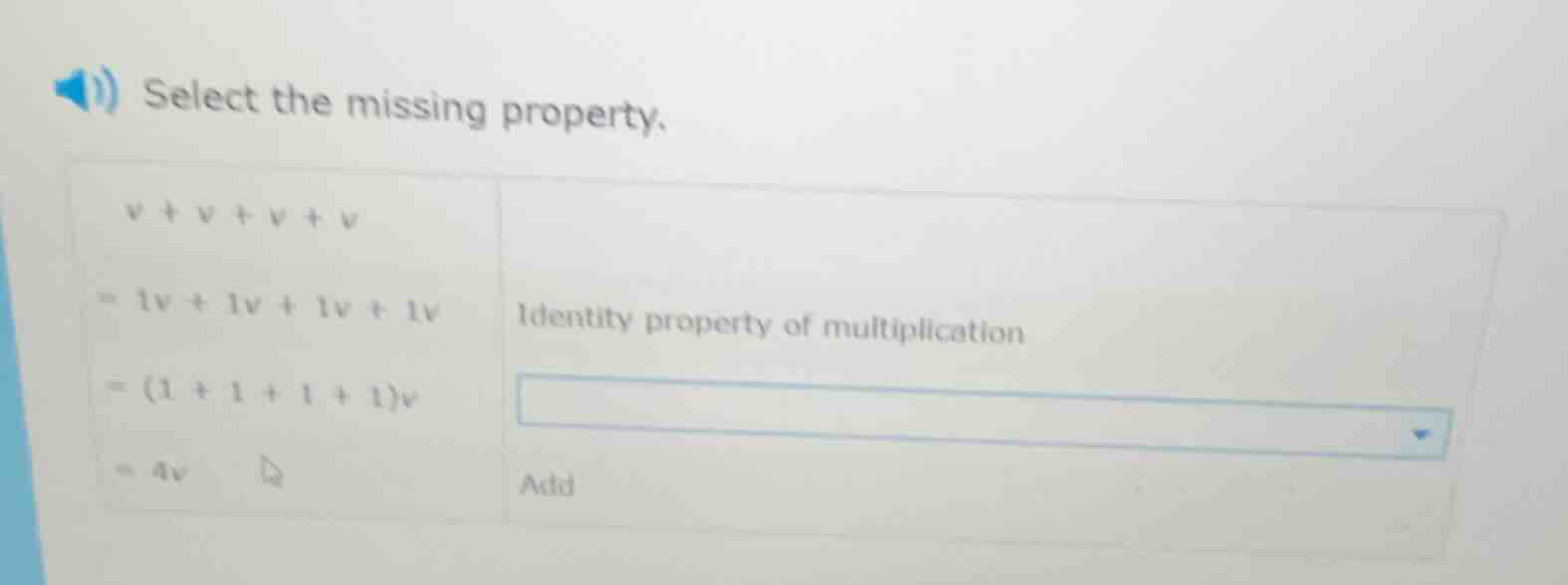
select the missing property.
$v + v + v + v$
$= 1v + 1v + 1v + 1v$ identity property of multiplication
$= (1 + 1 + 1 + 1)v$
$= 4v$ add
Step1: Recall the distributive property
The distributive property of multiplication over addition states that \(a(b + c)=ab + ac\), and in reverse, \(ab+ac=a(b + c)\). Here, we have \(1v+1v+1v+1v\), and we factor out the common factor \(v\) to get \((1 + 1+1 + 1)v\), which is the reverse of the distributive property (factoring form). So the property used here is the distributive property of multiplication over addition (or the distributive property for short, when applied in reverse for factoring).
Step2: Confirm the property
Looking at the step \(1v+1v+1v+1v=(1 + 1+1 + 1)v\), we are taking the common factor \(v\) out of each term \(1v\), which is exactly what the distributive property (in reverse) does. The identity property of multiplication was used in the first step to write \(v = 1v\), and now for combining the terms with the common factor \(v\), the distributive property (reverse) is used.

Snap & solve any problem in the app
Get step-by-step solutions on Sovi AI
Photo-based solutions with guided steps
Explore more problems and detailed explanations
Distributive property of multiplication over addition (or Distributive property)