QUESTION IMAGE
Question
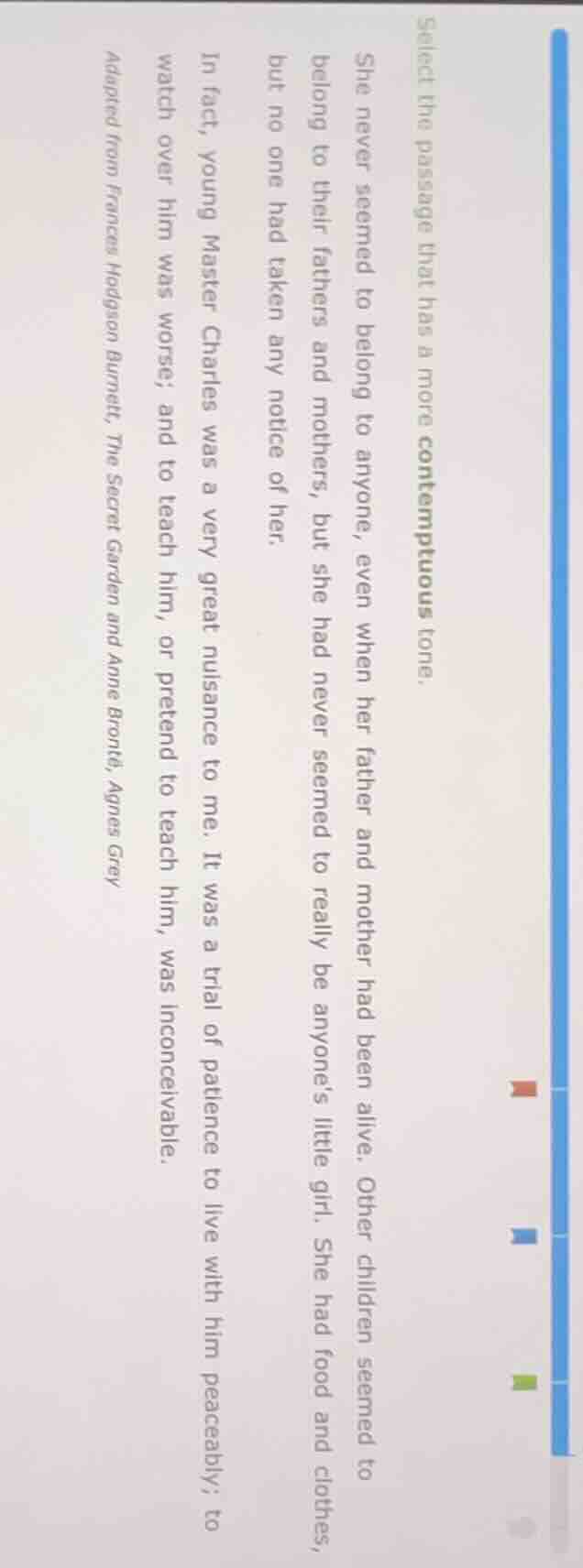
select the passage that has a more contemptuous tone.
she never seemed to belong to anyone, even when her father and mother had been alive. other children seemed to belong to their fathers and mothers, but she had never seemed to really be anyone’s little girl. she had food and clothes, but no one had taken any notice of her.
in fact, young master charles was a very great nuisance to me. it was a trial of patience to live with him peaceably; to watch over him was worse; and to teach him, or pretend to teach him, was inconceivable.
adapted from frances hodgson burnett, the secret garden and anne brontë, agnes grey
To determine the passage with a more contemptuous tone, we analyze each:
- First passage: Describes a girl who “never seemed to belong to anyone” (including parents) and “no one had taken any notice of her.” The tone is more detached or matter - of - fact about her isolation.
- Second passage: Refers to young Master Charles as “a very great nuisance,” and states that living with him peacefully, watching over him, or teaching him was “a trial of patience” and “inconceivable.” The use of “great nuisance,” “trial of patience,” and “inconceivable” shows a strong sense of annoyance and disdain (contempt) toward Master Charles.
The passage with the more contemptuous tone is the second one (the passage about young Master Charles):
In fact, young Master Charles was a very great nuisance to me. It was a trial of patience to live with him; to watch over him was worse; and to teach him, or pretend to teach him, was inconceivable.

Snap & solve any problem in the app
Get step-by-step solutions on Sovi AI
Photo-based solutions with guided steps
Explore more problems and detailed explanations
To determine the passage with a more contemptuous tone, we analyze each:
- First passage: Describes a girl who “never seemed to belong to anyone” (including parents) and “no one had taken any notice of her.” The tone is more detached or matter - of - fact about her isolation.
- Second passage: Refers to young Master Charles as “a very great nuisance,” and states that living with him peacefully, watching over him, or teaching him was “a trial of patience” and “inconceivable.” The use of “great nuisance,” “trial of patience,” and “inconceivable” shows a strong sense of annoyance and disdain (contempt) toward Master Charles.
The passage with the more contemptuous tone is the second one (the passage about young Master Charles):
In fact, young Master Charles was a very great nuisance to me. It was a trial of patience to live with him; to watch over him was worse; and to teach him, or pretend to teach him, was inconceivable.