QUESTION IMAGE
Question
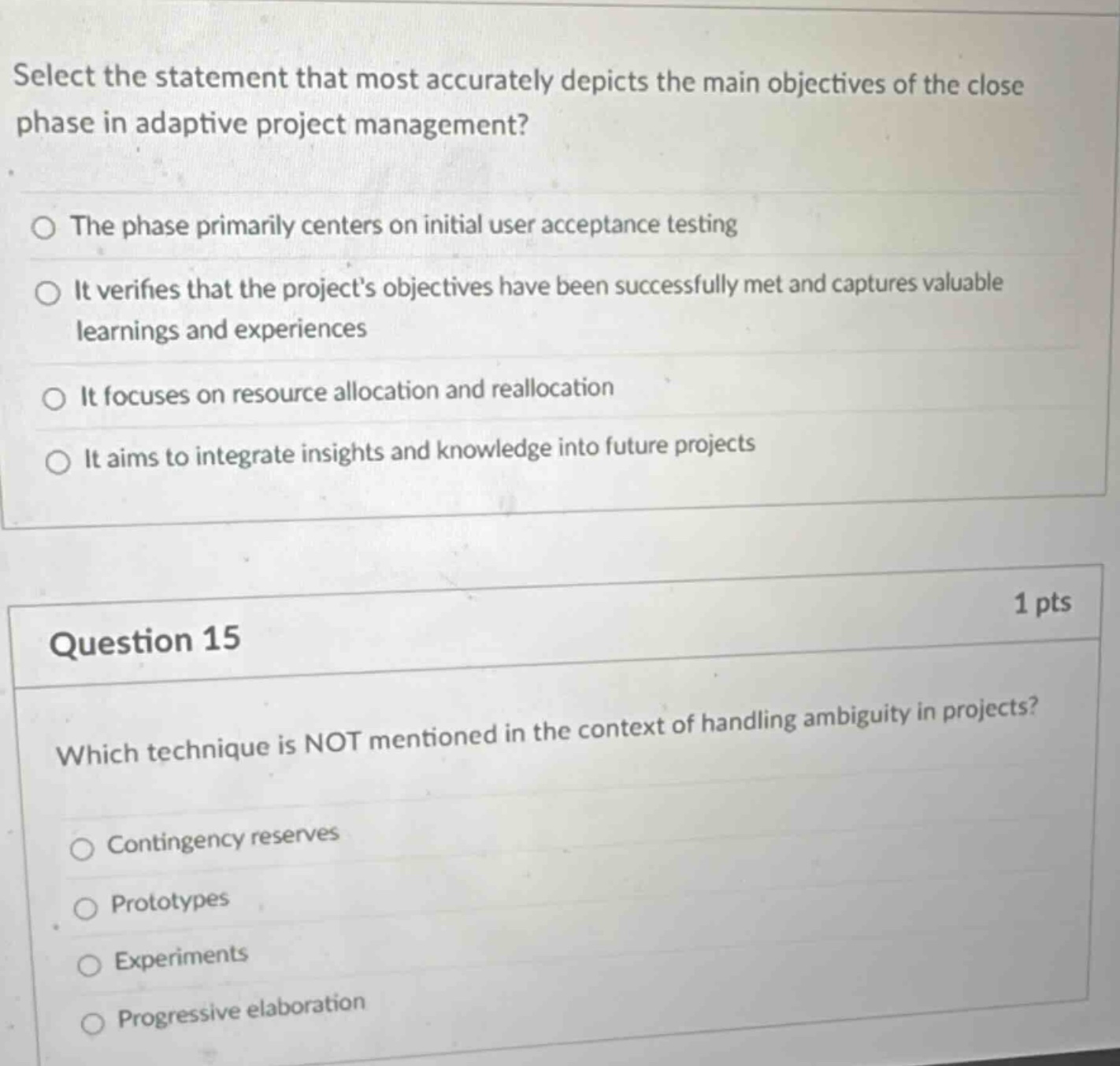
select the statement that most accurately depicts the main objectives of the close phase in adaptive project management?
the phase primarily centers on initial user acceptance testing
it verifies that the project’s objectives have been successfully met and captures valuable learnings and experiences
it focuses on resource allocation and reallocation
it aims to integrate insights and knowledge into future projects
question 15
1 pts
which technique is not mentioned in the context of handling ambiguity in projects?
contingency reserves
prototypes
experiments
progressive elaboration
First Question (Adaptive Project Management Close Phase)
- Analyze each option:
- Option 1: Initial user acceptance testing is part of earlier phases (like validation), not close phase.
- Option 2: The close phase in adaptive project management verifies if project objectives are met and captures lessons learned (key objectives of closing a project).
- Option 3: Resource allocation/reallocation is part of planning/execution phases, not close.
- Option 4: Integrating insights into future projects is part of lessons learned application, but the close phase’s main objective is verifying completion and capturing learnings (the option 2 is more direct about close phase objectives).
- Recall techniques for handling ambiguity:
- Prototypes: Used to clarify requirements/design (handle ambiguity).
- Experiments: Test ideas to reduce ambiguity.
- Progressive elaboration: Refine plans as more info is available (handles ambiguity).
- Contingency reserves: Are for managing risk (uncertainty, not ambiguity). Ambiguity is about lack of clarity/definition, while risk is about probability of events. So contingency reserves are not a technique for handling ambiguity.

Snap & solve any problem in the app
Get step-by-step solutions on Sovi AI
Photo-based solutions with guided steps
Explore more problems and detailed explanations
It verifies that the project’s objectives have been successfully met and captures valuable learnings and experiences