QUESTION IMAGE
Question
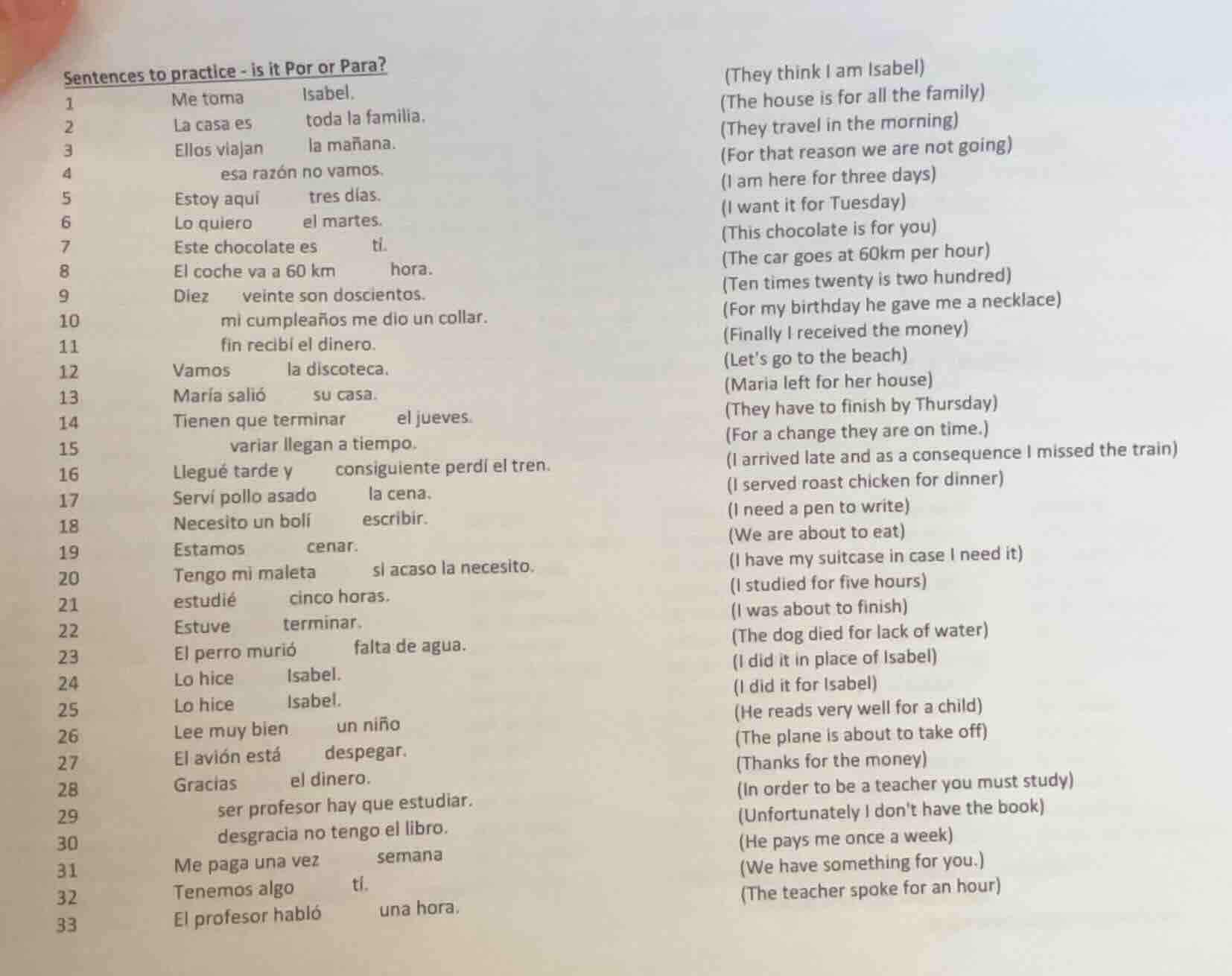
sentences to practice - is it por or para?
1 me toma isabel.
2 la casa es toda la familia.
3 ellos viajan la mañana.
4 esa razón no vamos.
5 estoy aquí tres días.
6 lo quiero el martes.
7 este chocolate es ti.
8 el coche va a 60 km hora.
9 diez veinte son doscientos.
10 mi cumpleaños me dio un collar.
11 fin recibí el dinero.
12 vamos la discoteca.
13 maría salió su casa.
14 tienen que terminar el jueves.
15 variar llegan a tiempo.
16 llegué tarde y consiguiente perdí el tren.
17 serví pollo asado la cena.
18 necesito un bolí escribir.
19 estamos cenar.
20 tengo mi maleta si acaso la necesito.
21 estudié cinco horas.
22 estuve terminar.
23 el perro murió falta de agua.
24 lo hice isabel.
25 lo hice isabel.
26 lee muy bien un niño
27 el avión está despegar.
28 gracias el dinero.
29 ser profesor hay que estudiar.
30 desgracia no tengo el libro.
31 me paga una vez semana
32 tenemos algo ti.
33 el profesor habló una hora.
(they think i am isabel)
(the house is for all the family)
(they travel in the morning)
(for that reason we are not going)
(i am here for three days)
(i want it for tuesday)
(this chocolate is for you)
(the car goes at 60km per hour)
(ten times twenty is two hundred)
(for my birthday he gave me a necklace)
(finally i received the money)
(lets go to the beach)
(maria left for her house)
(they have to finish by thursday)
(for a change they are on time.)
(i arrived late and as a consequence i missed the train)
(i served roast chicken for dinner)
(i need a pen to write)
(we are about to eat)
(i have my suitcase in case i need it)
(i studied for five hours)
(i was about to finish)
(the dog died for lack of water)
(i did it in place of isabel)
(i did it for isabel)
(he reads very well for a child)
(the plane is about to take off)
(thanks for the money)
(in order to be a teacher you must study)
(unfortunately i dont have the book)
(he pays me once a week)
(we have something for you.)
(the teacher spoke for an hour)
To solve this, we analyze each sentence using the rules for "por" and "para":
General Rules:
- Para: Purpose, destination, recipient, deadline, intended for.
- Por: Cause, exchange, duration (when meaning "during"), substitution, per (rate), time of day, reason, in place of.
Sentence-by-Sentence Analysis:
- Me toma ____ Isabel. (They think I am Isabel) → por (cause/reason: "for the reason that" they mistake me for Isabel).
- La casa es ____ toda la familia. (The house is for all the family) → para (recipient/intended for: the house is intended for the family).
- Ellos viajan ____ la mañana. (They travel in the morning) → por (time of day: "during" the morning).
- ____ esa razón no vamos. (For that reason we are not going) → Por (reason: "because of" that reason).
- Estoy aquí ____ tres días. (I am here for three days) → por (duration: "for" the period of three days).
- Lo quiero ____ el martes. (I want it for Tuesday) → para (deadline: intended for Tuesday).
- Este chocolate es ____ ti. (This chocolate is for you) → para (recipient: intended for you).
- El coche va a 60 km ____ hora. (The car goes at 60km per hour) → por (rate: "per" hour).
- Diez ____ veinte son doscientos. (Ten times twenty is two hundred) → por (multiplication: "times" as in 10 × 20).
- ____ mi cumpleaños me dio un collar. (For my birthday he gave me a necklace) → Por (reason: "because of" my birthday).
- ____ fin recibí el dinero. (Finally I received the money) → Por (fixed phrase: por fin = "finally").
- Vamos ____ la discoteca. (Let’s go to the beach) → para (destination: going to the discoteca).
- María salió ____ su casa. (Maria left for her house) → para (destination: leaving to go to her house).
- Tienen que terminar ____ el jueves. (They have to finish by Thursday) → para (deadline: intended to finish by Thursday).
- ____ variar llegan a tiempo. (For a change they are on time) → Por (reason: "for" the sake of changing).
- Llegué tarde y ____ consiguiente perdí el tren. (I arrived late and as a consequence I missed the train) → por (consequence: "as a result of" being late).
- Serví pollo asado ____ la cena. (I served roast chicken for dinner) → para (purpose: intended for dinner).
- Necesito un bolí ____ escribir. (I need a pen to write) → para (purpose: pen is needed to write).
- Estamos ____ cenar. (We are about to eat) → por (fixed phrase: por cenar = "about to eat").
- Tengo mi maleta ____ si acaso la necesito. (I have my suitcase in case I need it) → por (reason: "in case" = por si acaso).
- estudié ____ cinco horas. (I studied for five hours) → por (duration: "for" the period of five hours).
- Estuve ____ terminar. (I was about to finish) → por (fixed phrase: por terminar = "about to finish").
- El perro murió ____ falta de agua. (The dog died for lack of water) → por (cause: "because of" lack of water).
- Lo hice ____ Isabel. (I did it in place of Isabel) → por (substitution: "in place of" Isabel).
- Lo hice ____ Isabel. (I did it for Isabel) → para (purpose: intended for Isabel).
- Lee muy bien ____ un niño. (He reads very well for a child) → para (comparison: "for" a child’s level).
- El avión está ____ despegar. (The plane is about to take off) → por (fixed phrase: por despegar = "about to take off").
- Gracias ____ el dinero. (Thanks for the money) → por (reason: thank "for" the money).
- *____ ser prof…

Snap & solve any problem in the app
Get step-by-step solutions on Sovi AI
Photo-based solutions with guided steps
Explore more problems and detailed explanations
To solve this, we analyze each sentence using the rules for "por" and "para":
General Rules:
- Para: Purpose, destination, recipient, deadline, intended for.
- Por: Cause, exchange, duration (when meaning "during"), substitution, per (rate), time of day, reason, in place of.
Sentence-by-Sentence Analysis:
- Me toma ____ Isabel. (They think I am Isabel) → por (cause/reason: "for the reason that" they mistake me for Isabel).
- La casa es ____ toda la familia. (The house is for all the family) → para (recipient/intended for: the house is intended for the family).
- Ellos viajan ____ la mañana. (They travel in the morning) → por (time of day: "during" the morning).
- ____ esa razón no vamos. (For that reason we are not going) → Por (reason: "because of" that reason).
- Estoy aquí ____ tres días. (I am here for three days) → por (duration: "for" the period of three days).
- Lo quiero ____ el martes. (I want it for Tuesday) → para (deadline: intended for Tuesday).
- Este chocolate es ____ ti. (This chocolate is for you) → para (recipient: intended for you).
- El coche va a 60 km ____ hora. (The car goes at 60km per hour) → por (rate: "per" hour).
- Diez ____ veinte son doscientos. (Ten times twenty is two hundred) → por (multiplication: "times" as in 10 × 20).
- ____ mi cumpleaños me dio un collar. (For my birthday he gave me a necklace) → Por (reason: "because of" my birthday).
- ____ fin recibí el dinero. (Finally I received the money) → Por (fixed phrase: por fin = "finally").
- Vamos ____ la discoteca. (Let’s go to the beach) → para (destination: going to the discoteca).
- María salió ____ su casa. (Maria left for her house) → para (destination: leaving to go to her house).
- Tienen que terminar ____ el jueves. (They have to finish by Thursday) → para (deadline: intended to finish by Thursday).
- ____ variar llegan a tiempo. (For a change they are on time) → Por (reason: "for" the sake of changing).
- Llegué tarde y ____ consiguiente perdí el tren. (I arrived late and as a consequence I missed the train) → por (consequence: "as a result of" being late).
- Serví pollo asado ____ la cena. (I served roast chicken for dinner) → para (purpose: intended for dinner).
- Necesito un bolí ____ escribir. (I need a pen to write) → para (purpose: pen is needed to write).
- Estamos ____ cenar. (We are about to eat) → por (fixed phrase: por cenar = "about to eat").
- Tengo mi maleta ____ si acaso la necesito. (I have my suitcase in case I need it) → por (reason: "in case" = por si acaso).
- estudié ____ cinco horas. (I studied for five hours) → por (duration: "for" the period of five hours).
- Estuve ____ terminar. (I was about to finish) → por (fixed phrase: por terminar = "about to finish").
- El perro murió ____ falta de agua. (The dog died for lack of water) → por (cause: "because of" lack of water).
- Lo hice ____ Isabel. (I did it in place of Isabel) → por (substitution: "in place of" Isabel).
- Lo hice ____ Isabel. (I did it for Isabel) → para (purpose: intended for Isabel).
- Lee muy bien ____ un niño. (He reads very well for a child) → para (comparison: "for" a child’s level).
- El avión está ____ despegar. (The plane is about to take off) → por (fixed phrase: por despegar = "about to take off").
- Gracias ____ el dinero. (Thanks for the money) → por (reason: thank "for" the money).
- ____ ser profesor hay que estudiar. (In order to be a teacher you must study) → Para (purpose: "in order to" be a teacher).
- ____ desgracia no tengo el libro. (Unfortunately I don’t have the book) → Por (fixed phrase: por desgracia = "unfortunately").
- Me paga una vez ____ semana. (He pays me once a week) → por (rate: "per" week).
- Tenemos algo ____ ti. (We have something for you) → para (recipient: intended for you).
- El profesor habló ____ una hora. (The teacher spoke for an hour) → por (duration: "for" the period of an hour).
Final Answers (Filled Blanks):
- por
- para
- por
- Por
- por
- para
- para
- por
- por
- Por
- Por
- para
- para
- para
- Por
- por
- para
- para
- por
- por
- por
- por
- por
- por
- para
- para
- por
- por
- Para
- Por
- por
- para
- por
(Note: Capitalization matches the sentence structure; Por at the start of a sentence, lowercase otherwise.)