QUESTION IMAGE
Question
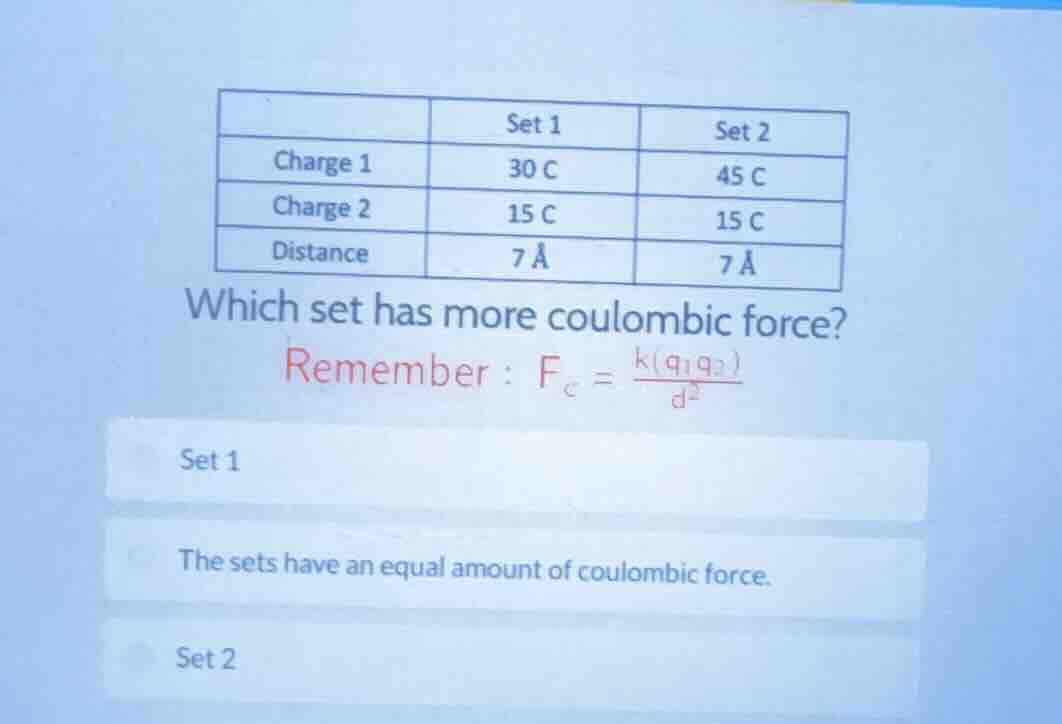
| set 1 | set 2 | |
| charge 1 | 30 c | 45 c |
| charge 2 | 15 c | 15 c |
| distance | 7 å | 7 å |
which set has more coulombic force?
remember : $f_c = \frac{k(q_1q_2)}{d^2}$
set 1
the sets have an equal amount of coulombic force.
set 2
Step1: Recall Coulomb's Law
The formula for Coulombic force is \( F_c = \frac{k(q_1q_2)}{d^2} \), where \( k \) is a constant, \( q_1, q_2 \) are charges, and \( d \) is distance. Since \( k \) and \( d \) (both 7 Å) are same for both sets, we compare \( q_1q_2 \).
Step2: Calculate \( q_1q_2 \) for Set 1
For Set 1: \( q_1 = 30 \, \text{C}, q_2 = 15 \, \text{C} \). So \( q_1q_2 = 30 \times 15 = 450 \, \text{C}^2 \).
Step3: Calculate \( q_1q_2 \) for Set 2
For Set 2: \( q_1 = 45 \, \text{C}, q_2 = 15 \, \text{C} \). So \( q_1q_2 = 45 \times 15 = 675 \, \text{C}^2 \).
Step4: Compare the products
Since \( 675 > 450 \), and \( F_c \) is proportional to \( q_1q_2 \) (same \( k, d \)), Set 2 has larger \( F_c \).

Snap & solve any problem in the app
Get step-by-step solutions on Sovi AI
Photo-based solutions with guided steps
Explore more problems and detailed explanations
Set 2