QUESTION IMAGE
Question
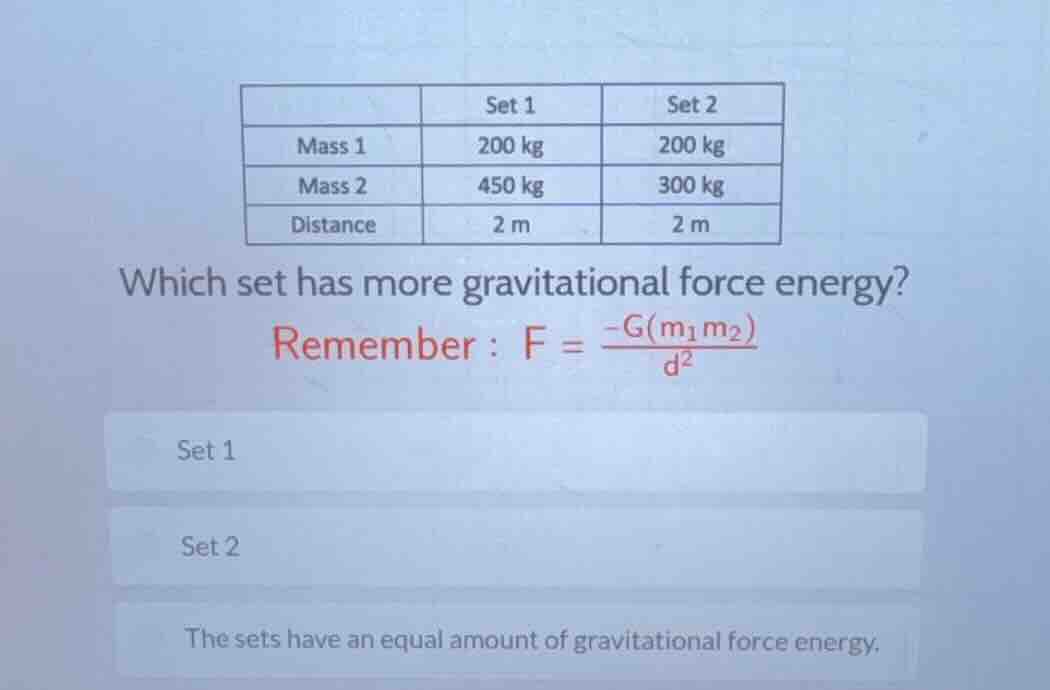
| set 1 | set 2 | |
| mass 1 | 200 kg | 200 kg |
| mass 2 | 450 kg | 300 kg |
| distance | 2 m | 2 m |
which set has more gravitational force energy?
remember : $f = \frac{-g(m_1m_2)}{d^2}$
set 1
set 2
the sets have an equal amount of gravitational force energy.
Step1: Analyze the formula for gravitational force
The formula for gravitational force is \( F = \frac{-G(m_1m_2)}{d^2} \). The magnitude of the gravitational force (ignoring the negative sign for comparison of strength) depends on the product of the masses (\( m_1m_2 \)) and the inverse square of the distance (\( d^2 \)). Since \( G \) is a constant and the distance \( d \) is the same (2 m) for both sets, we only need to compare the product of the masses for each set.
Step2: Calculate the product of masses for Set 1
For Set 1: \( m_1 = 200 \, \text{kg} \), \( m_2 = 450 \, \text{kg} \). The product \( m_1m_2 = 200 \times 450 = 90000 \, \text{kg}^2 \).
Step3: Calculate the product of masses for Set 2
For Set 2: \( m_1 = 200 \, \text{kg} \), \( m_2 = 300 \, \text{kg} \). The product \( m_1m_2 = 200 \times 300 = 60000 \, \text{kg}^2 \).
Step4: Compare the two products
Since \( 90000 > 60000 \), and the distance \( d \) is the same for both sets, the magnitude of the gravitational force (and thus the gravitational force energy, considering the relationship) will be greater for Set 1 because the product of the masses is larger. The negative sign in the formula indicates the nature of the force (attractive) but does not affect the comparison of the magnitude of the force (or energy related to it) here.

Snap & solve any problem in the app
Get step-by-step solutions on Sovi AI
Photo-based solutions with guided steps
Explore more problems and detailed explanations
Set 1