QUESTION IMAGE
Question
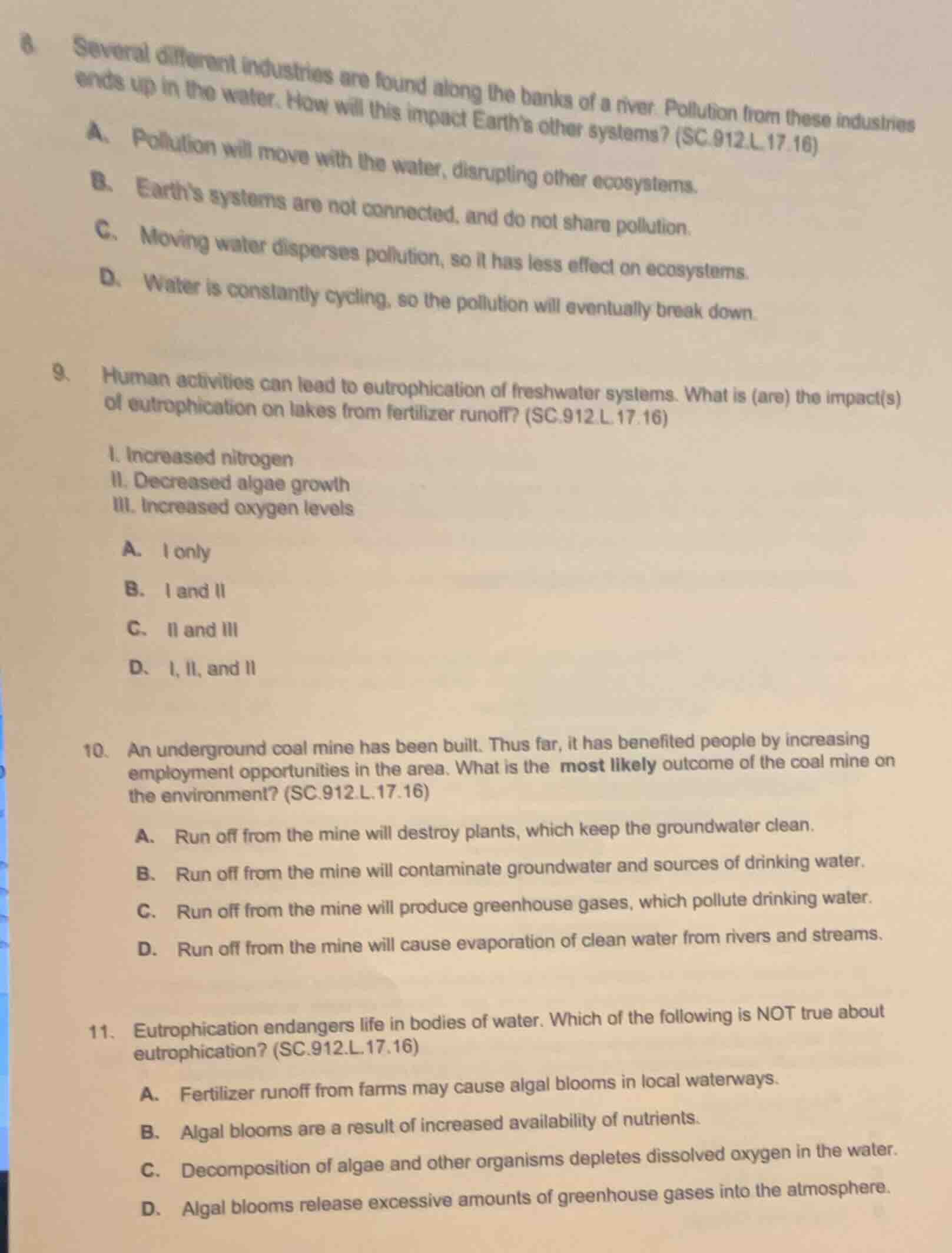
- several different industries are found along the banks of a river. pollution from these industries ends up in the water. how will this impact earth’s other systems? (sc.912.l.17.16)
a. pollution will move with the water, disrupting other ecosystems.
b. earth’s systems are not connected, and do not share pollution.
c. moving water disperses pollution, so it has less effect on ecosystems.
d. water is constantly cycling, so the pollution will eventually break down.
- human activities can lead to eutrophication of freshwater systems. what is (are) the impact(s) of eutrophication on lakes from fertilizer runoff? (sc.912.l.17.16)
i. increased nitrogen
ii. decreased algae growth
iii. increased oxygen levels
a. i only
b. i and ii
c. ii and iii
d. i, ii, and iii
- an underground coal mine has been built. thus far, it has benefited people by increasing employment opportunities in the area. what is the most likely outcome of the coal mine on the environment? (sc.912.l.17.16)
a. run off from the mine will destroy plants, which keep the groundwater clean.
b. run off from the mine will contaminate groundwater and sources of drinking water.
c. run off from the mine will produce greenhouse gases, which pollute drinking water.
d. run off from the mine will cause evaporation of clean water from rivers and streams.
- eutrophication endangers life in bodies of water. which of the following is not true about eutrophication? (sc.912.l.17.16)
a. fertilizer runoff from farms may cause algal blooms in local waterways.
b. algal blooms are a result of increased availability of nutrients.
c. decomposition of algae and other organisms depletes dissolved oxygen in the water.
d. algal blooms release excessive amounts of greenhouse gases into the atmosphere.
Question 8
To solve this, we analyze each option:
- Option A: Pollution in river water can flow (move with water) to other areas, affecting other ecosystems (like wetlands, oceans connected via water cycles), so this is correct.
- Option B: Earth's systems (hydrosphere, biosphere, atmosphere, geosphere) are interconnected, so this is wrong.
- Option C: Moving water can spread pollution, increasing its impact, not reducing, so wrong.
- Option D: While water cycles, pollution (especially non - biodegradable or persistent pollutants) doesn't always break down easily, and even if it does, it still disrupts systems during its presence, so this is not the main impact description.
Fertilizer runoff causes eutrophication:
- I. Fertilizers have nitrogen, so runoff increases nitrogen in lakes: correct.
- II. Increased nutrients (like nitrogen) promote algae growth, not decrease: wrong.
- III. Algae blooms lead to oxygen depletion (as algae die and decompose, using oxygen), so oxygen levels decrease, not increase: wrong.
So only I is correct.
Coal mine runoff:
- Option A: While plants help with groundwater, the main direct environmental impact of mine runoff is contamination, not just plant destruction (though plant destruction can be a secondary effect).
- Option B: Coal mine runoff contains pollutants (heavy metals, chemicals) that contaminate groundwater and drinking water sources: correct.
- Option C: Runoff doesn't produce greenhouse gases that pollute drinking water (greenhouse gases are gaseous, not in runoff to pollute water this way).
- Option D: Runoff doesn't cause evaporation of clean water; evaporation is a physical process related to temperature, etc., not runoff.

Snap & solve any problem in the app
Get step-by-step solutions on Sovi AI
Photo-based solutions with guided steps
Explore more problems and detailed explanations
A. Pollution will move with the water, disrupting other ecosystems.