QUESTION IMAGE
Question
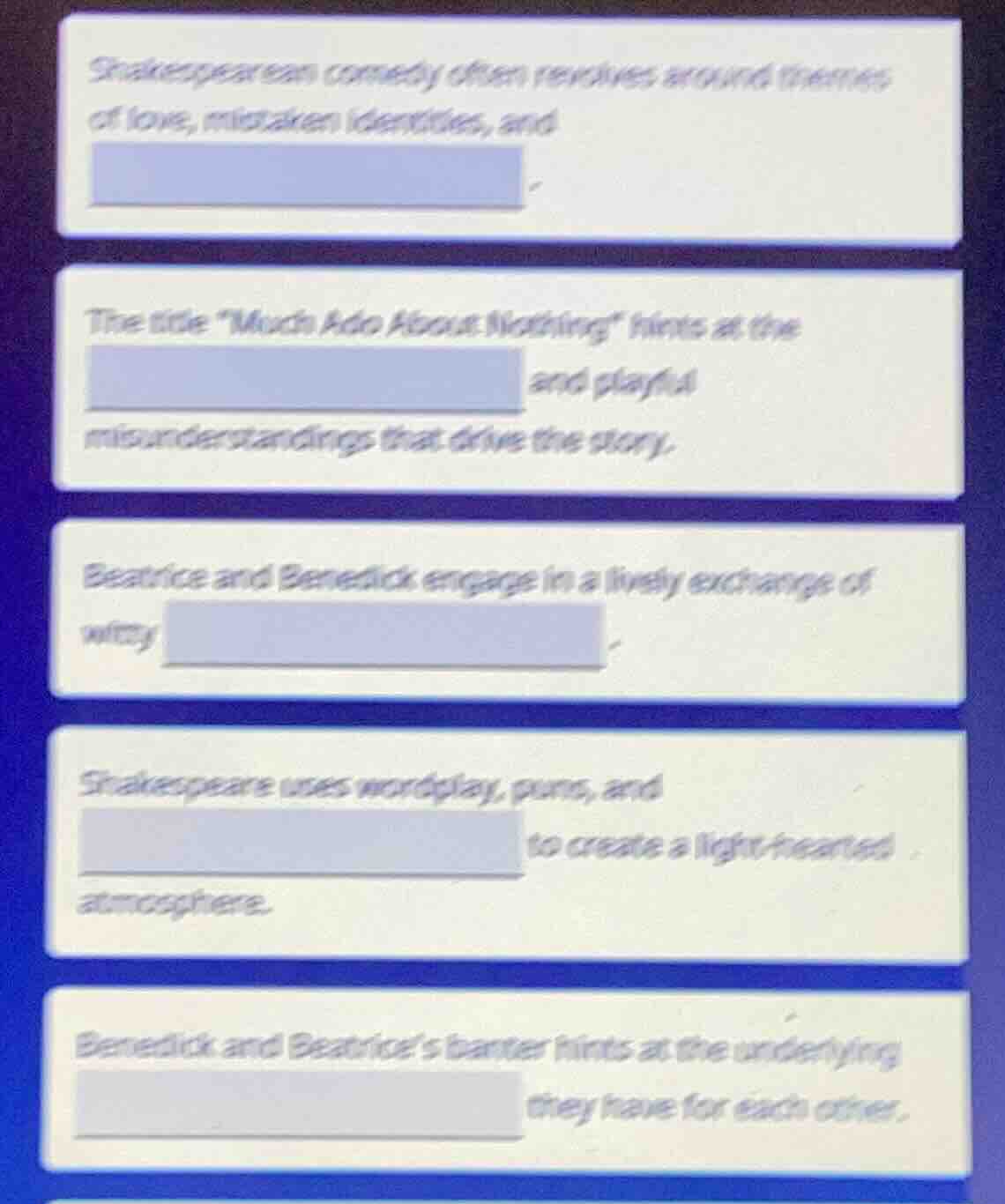
shakespearean comedy often revolves around themes of love, mistaken identities, and
the title \much ado about nothing\ hints at the
and playful misunderstandings that drive the story.
beatrice and benedick engage in a lively exchange of witty
shakespeare uses wordplay, puns, and
to create a light - hearted atmosphere.
benedick and beatrice’s banter hints at the underlying
they have for each other.
1st Blank (Shakespearean comedy themes)
Shakespearean comedies often include themes like love, mistaken identities, and foolishness (or "confusion", "deception" could also fit, but "foolishness" aligns with the comedic mix of errors). Another common theme is "social class" or "marriage", but in the context of comedic chaos, "foolishness" (or "misadventures") works. However, a more precise term is "misunderstandings" or "foolish behavior", but the most fitting is "foolishness" or "comedic errors". Wait, actually, the standard themes include "love, mistaken identities, and foolishness (or "deception", "confusion") but the best fit here is "foolishness" or "comedic situations". Alternatively, "marriage" is a big theme, but the blank is after "and", so a theme parallel to love and mistaken identities. Let's go with "foolishness" (or "misadventures"). But more accurately, Shakespearean comedy themes: love, mistaken identities, and "foolishness" (or "comedic misunderstandings"). Wait, the first blank: "Shakespearean comedy often revolves around themes of love, mistaken identities, and misunderstandings" (but that's similar to the next blank). Wait, no, the first blank: let's check standard themes. Shakespearean comedies (like Much Ado, A Midsummer Night's Dream) have themes of love, mistaken identities, and "foolishness" (or "deception", "social hierarchy"), but the most common is "love, mistaken identities, and comedic misunderstandings" but maybe "foolishness" or "marriage". Wait, maybe "marriage" is too broad. Alternatively, "disguise" but no. Let's think of Much Ado: themes of love, mistaken identities, and "foolishness" (the characters' silly actions). So first blank: foolishness (or "comedic errors").
2nd Blank ("Much Ado About Nothing" title hint)
The title "Much Ado About Nothing" hints at the "frivolous" (or "silly", "pointless") and playful misunderstandings. The title means a lot of fuss over nothing, so the misunderstandings are "frivolous" (or "pointless", "silly"). So the blank: frivolous (or "pointless", "silly") misunderstandings.
3rd Blank (Beatrice and Benedick's exchanges)
Beatrice and Benedick engage in lively exchanges of witty "banter" (or "wordplay", "dialogue"). Their interactions are famous for "witty banter" (verbal sparring with humor). So the blank: banter (or "wordplay", "dialogue").
4th Blank (Shakespeare's techniques)

Snap & solve any problem in the app
Get step-by-step solutions on Sovi AI
Photo-based solutions with guided steps
Explore more problems and detailed explanations
s:
- Shakespearean comedy often revolves around themes of love, mistaken identities, and \boxed{foolishness} (or "misunderstandings", "comedic errors").
- The title "Much Ado About Nothing" hints at the \boxed{frivolous} (or "pointless", "silly") and playful misunderstandings that drive the story.
- Beatrice and Benedick engage in a lively exchanges of witty \boxed{banter} (or "wordplay", "dialogue").
- Shakespeare uses wordplay, puns, and \boxed{irony} (or "comic relief", "double - entendres") to create a light - hearted atmosphere.
- Benedick and Beatrice’s banter hints at the underlying \boxed{love} (or "affection", "attraction") they have for each other.
(Note: These are the most likely answers based on the context of Shakespearean comedy, specifically Much Ado About Nothing. The boxes contain the single - word answers that fit best in the blanks.)