QUESTION IMAGE
Question
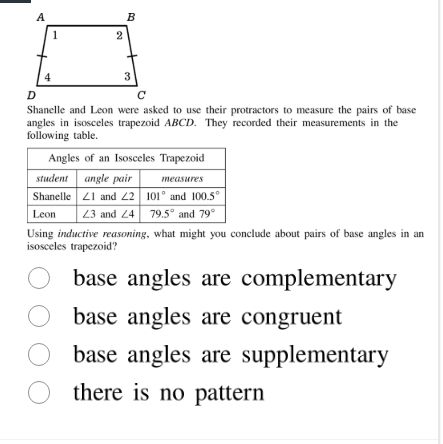
shanelle and leon were asked to use their protractors to measure the pairs of base angles in isosceles trapezoid (abcd). they recorded their measurements in the following table.
| student | angle pair | measures |
|---|---|---|
| leon | (angle 3) and (angle 4) | (79.5^circ) and (79^circ) |
using inductive reasoning, what might you conclude about pairs of base angles in an isosceles trapezoid?
- base angles are complementary
- base angles are congruent
- base angles are supplementary
- there is no pattern
Inductive reasoning involves observing patterns from specific examples. For Shantelle, ∠1 ≈ 101° and ∠2 ≈ 100.5° (very close, likely measurement slight error), so ∠1 ≈ ∠2. For Leon, ∠3 ≈ 79.5° and ∠4 ≈ 79° (also close, measurement error), so ∠3 ≈ ∠4. In an isosceles trapezoid, base angles (angles adjacent to each base) are congruent. The other options: complementary (sum 90°) – these angles sum more than 90°; supplementary (sum 180°) – Shantelle's angles sum ~201.5°, Leon's ~158.5°, not 180°; and "no pattern" is wrong as the angles in each pair are close (congruent with measurement errors). So the pattern is base angles are congruent.

Snap & solve any problem in the app
Get step-by-step solutions on Sovi AI
Photo-based solutions with guided steps
Explore more problems and detailed explanations
base angles are congruent