QUESTION IMAGE
Question
short answer
- the male of a monogamous bird species is highly valued for its plumage, and many males are killed so that fashion designers can use their feathers on clothing and hats. the sex ratio of this species is now 89 percent female and 11 percent male. what are the long-term prospects for the species? how might this be different if the species were not monogamous?
- in one year in a population of 100 squirrels, 12 individuals die of natural causes and 22 are born. seven juveniles leave the population to establish territories somewhere else, and 4 new individuals arrive from a different patch of forest. how would you calculate the growth rate of the population (per 100 individuals)?
- a population of elephants with an even sex ratio contains 30 elderly elephants, 25 adult elephants, 10 juvenile elephants, and 4 baby elephants. what population trend do you predict in this population of elephants, and why?
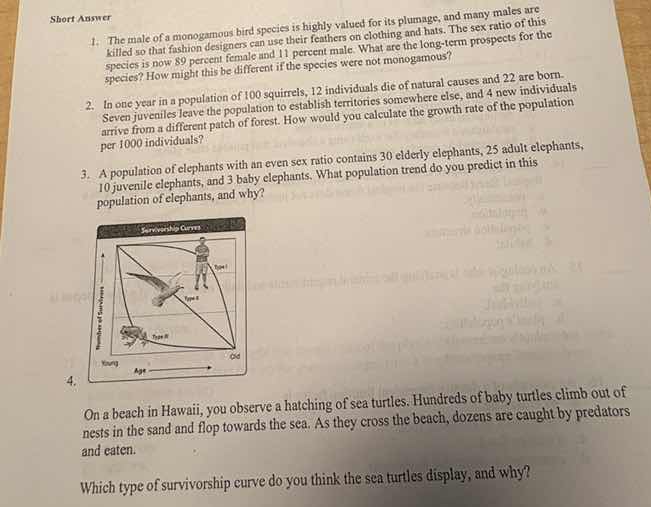
- on a beach in hawaii, you observe a hatching of sea turtles. hundreds of baby turtles climb out of nests in the sand and flop towards the sea. as they cross the beach, dozens are caught by predators and eaten.
which type of survivorship curve do you think the sea turtles display, and why?
Question 1
Step1: Analyze monogamous scenario
Monogamous species rely on 1:1 sex ratio for mating. With 11% males, most females cannot mate, so reproduction drops sharply. Over time, the population will decline drastically, leading to high risk of extinction.
Step2: Analyze non-monogamous scenario
In non-monogamous species, a single male can mate with multiple females. Even with 11% males, males can fertilize most females, so reproduction remains stable. The population can sustain itself.
Step1: Calculate total population change
First find net change: births - deaths + immigrants - emigrants.
$\text{Net change} = 22 - 12 + 4 - 7 = 7$
Step2: Calculate growth rate per 100
Use formula: $\text{Growth rate} = \frac{\text{Net change}}{\text{Initial population}} \times 100$
$\text{Growth rate} = \frac{7}{100} \times 100 = 7$
The population has a large number of elderly elephants (30) and few juveniles/babies (10 + 3 = 13), with a moderate number of breeding adults (25). The small number of young individuals means there will be far fewer elephants to replace the aging population as elderly elephants die off.

Snap & solve any problem in the app
Get step-by-step solutions on Sovi AI
Photo-based solutions with guided steps
Explore more problems and detailed explanations
- For monogamous birds: The species faces severe long-term risk of extinction. The extremely skewed sex ratio (11% male) means the vast majority of females cannot find mates, leading to a collapse in reproduction and a rapid decline in population size over generations.
- For non-monogamous birds: The long-term prospects are far better. A small number of males can mate with multiple females, so the population can still maintain sufficient reproduction to sustain its numbers, avoiding the reproductive collapse seen in monogamous species.
---