QUESTION IMAGE
Question
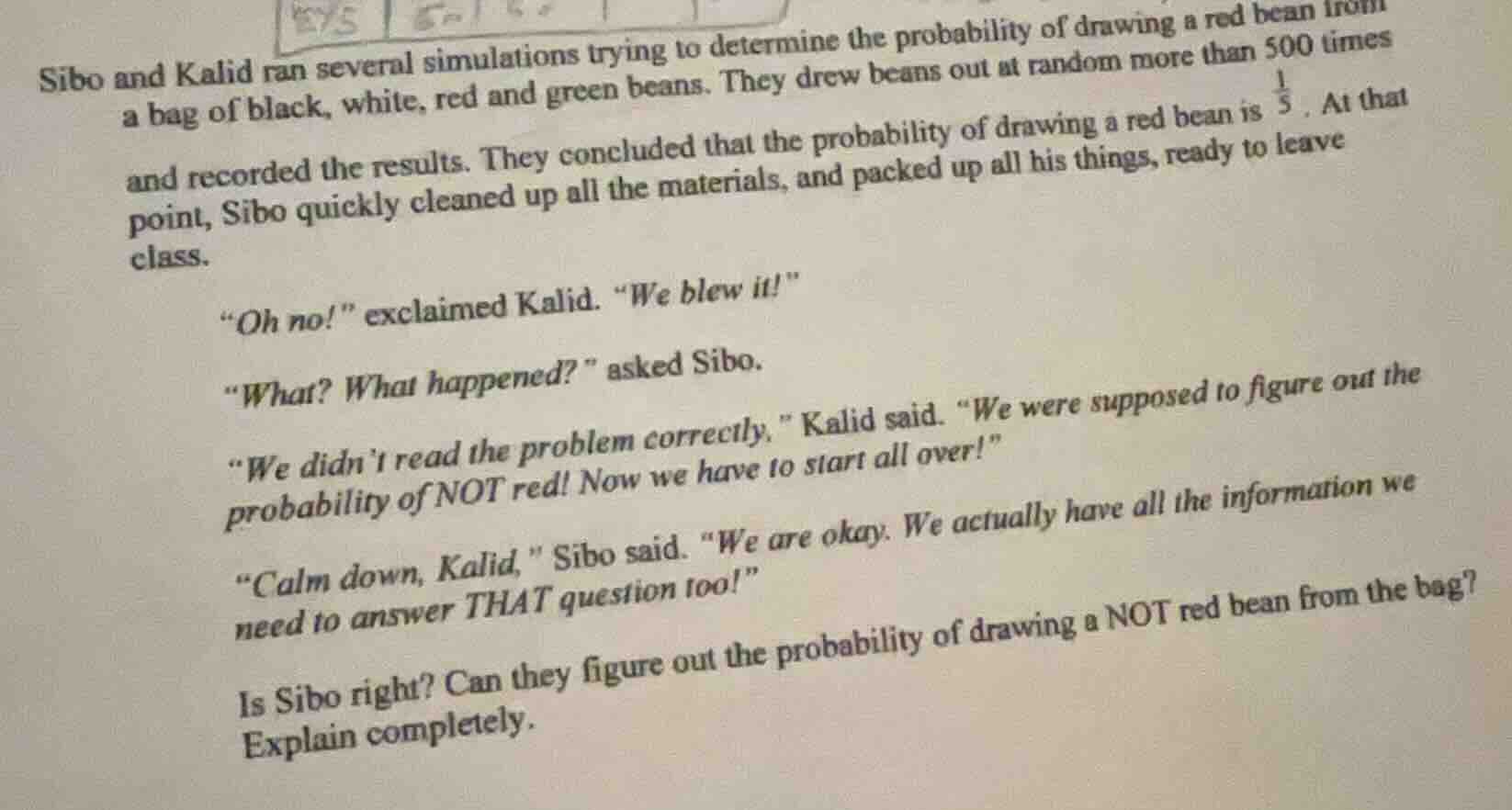
sibo and kalid ran several simulations trying to determine the probability of drawing a red bean from a bag of black, white, red and green beans. they drew beans out at random more than 500 times and recorded the results. they concluded that the probability of drawing a red bean is \\(\frac{1}{5}\\). at that point, sibo quickly cleaned up all the materials, and packed up all his things, ready to leave class.
\oh no!\ exclaimed kalid. \we blew it!\
\what? what happened?\ asked sibo.
\we didnt read the problem correctly,\ kalid said. \we were supposed to figure out the probability of not red! now we have to start all over!\
\calm down, kalid,\ sibo said. \we are okay. we actually have all the information we need to answer that question too!\
is sibo right? can they figure out the probability of drawing a not red bean from the bag?
explain completely.
Step1: Recall the complement rule
The complement rule in probability states that the probability of an event not occurring (denoted as \( P(\text{not } A) \)) is equal to \( 1 - P(A) \), where \( P(A) \) is the probability of the event \( A \) occurring. Here, event \( A \) is drawing a red bean.
Step2: Identify \( P(\text{red}) \)
We know from the problem that the probability of drawing a red bean, \( P(\text{red})=\frac{1}{5} \).
Step3: Calculate \( P(\text{not red}) \)
Using the complement rule, \( P(\text{not red}) = 1 - P(\text{red}) \). Substituting \( P(\text{red})=\frac{1}{5} \) into the formula, we get \( P(\text{not red}) = 1-\frac{1}{5} \).
To subtract, we rewrite 1 as \( \frac{5}{5} \), so \( \frac{5}{5}-\frac{1}{5}=\frac{5 - 1}{5}=\frac{4}{5} \).

Snap & solve any problem in the app
Get step-by-step solutions on Sovi AI
Photo-based solutions with guided steps
Explore more problems and detailed explanations
Yes, Sibo is right. The probability of drawing a NOT red bean is \(\frac{4}{5}\).