QUESTION IMAGE
Question
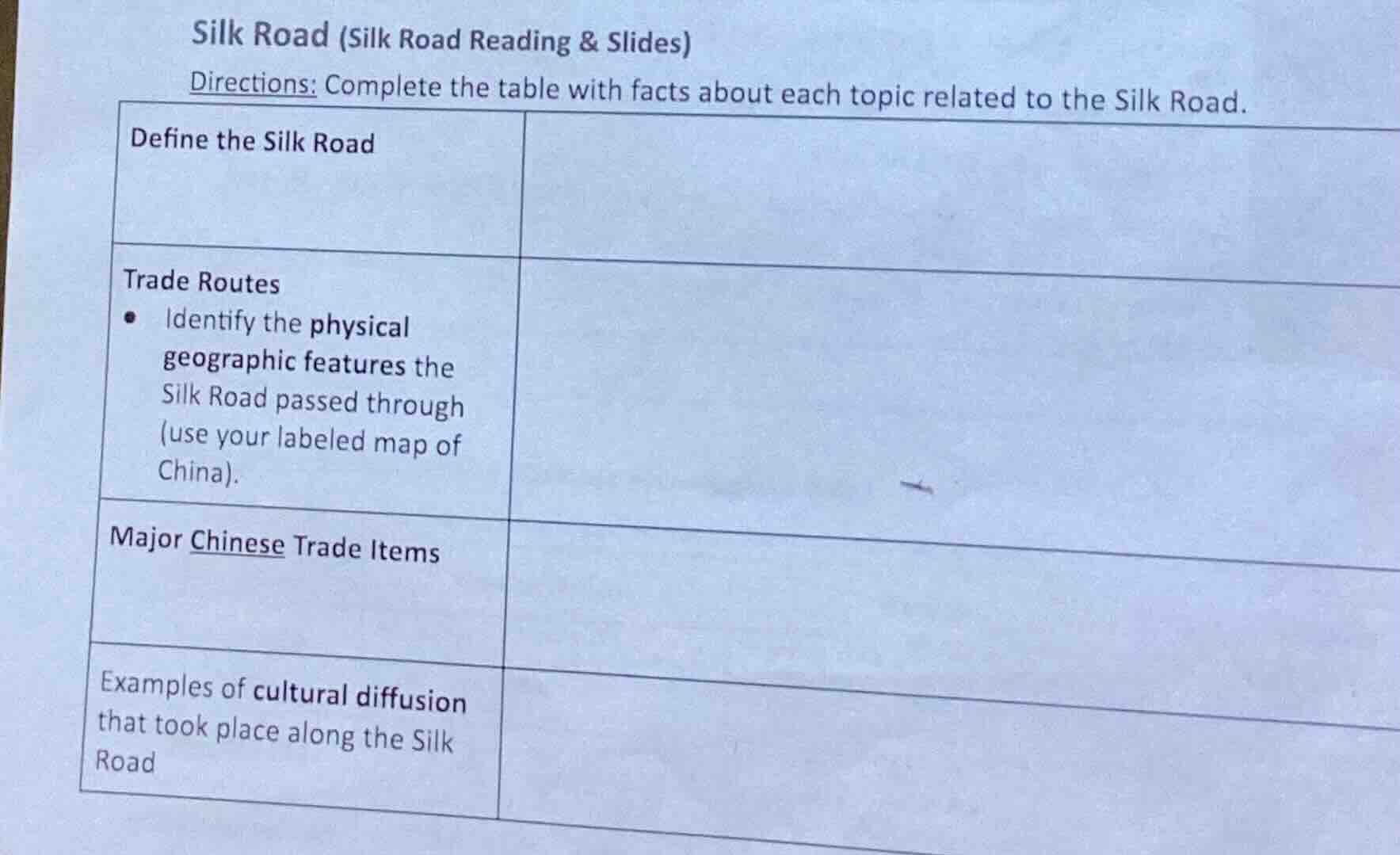
silk road (silk road reading & slides)
directions: complete the table with facts about each topic related to the silk road.
define the silk road
trade routes
- identify the physical geographic features the silk road passed through (use your labeled map of china).
major chinese trade items
examples of cultural diffusion that took place along the silk road
To complete the table about the Silk Road, we analyze each section:
1. Define the Silk Road
The Silk Road was a network of ancient trade routes (land and maritime) connecting East Asia (primarily China) to the Mediterranean, facilitating trade, cultural exchange, and technological diffusion between civilizations (e.g., China, India, Persia, Rome) from ~2nd century BCE to ~15th century CE.
2. Trade Routes - Physical Geographic Features
The Silk Road traversed:
- Mountains: Himalayas, Tian Shan, Pamirs.
- Deserts: Gobi, Taklamakan.
- Plains/Plateaus: Tarim Basin, Central Asian steppes, Iranian Plateau.
- Bodies of Water: Caspian Sea, Mediterranean Sea (maritime routes also connected to Indian Ocean and South China Sea).
3. Major Chinese Trade Items
China exported:
- Luxury goods: Silk (primary), porcelain, jade.
- Technology: Paper, gunpowder, compass, agricultural techniques (e.g., tea cultivation).
- Medicinal herbs: Ginseng, rhubarb.
4. Examples of Cultural Diffusion
- Religion: Buddhism spread from India to China (and beyond); Islam spread to Central Asia; Christianity (Nestorian) reached China.
- Language/Philosophy: Confucianism/Chinese philosophy influenced East Asia; Sanskrit/Indian texts influenced Central Asia.
- Technology/Art: Chinese papermaking spread west; Persian artistic styles (e.g., tilework) influenced Chinese ceramics; Indian mathematics (e.g., numerals) reached the West.
To present this in the table:
| Topic | Facts |
|---|---|
| Trade Routes <br> • Identify physical geographic features | Traversed Himalayas, Tian Shan, Pamirs (mountains); Gobi, Taklamakan (deserts); Tarim Basin, Central Asian steppes (plains); Caspian Sea, Mediterranean (water). |
| Major Chinese Trade Items | Silk, porcelain, jade, paper, gunpowder, compass, tea, medicinal herbs (ginseng, rhubarb). |
| Examples of cultural diffusion | Buddhism (India → China); Islam (Middle East → Central Asia); papermaking (China → West); Sanskrit texts (India → Central Asia); Persian art (→ Chinese ceramics). |

Snap & solve any problem in the app
Get step-by-step solutions on Sovi AI
Photo-based solutions with guided steps
Explore more problems and detailed explanations
To complete the table about the Silk Road, we analyze each section:
1. Define the Silk Road
The Silk Road was a network of ancient trade routes (land and maritime) connecting East Asia (primarily China) to the Mediterranean, facilitating trade, cultural exchange, and technological diffusion between civilizations (e.g., China, India, Persia, Rome) from ~2nd century BCE to ~15th century CE.
2. Trade Routes - Physical Geographic Features
The Silk Road traversed:
- Mountains: Himalayas, Tian Shan, Pamirs.
- Deserts: Gobi, Taklamakan.
- Plains/Plateaus: Tarim Basin, Central Asian steppes, Iranian Plateau.
- Bodies of Water: Caspian Sea, Mediterranean Sea (maritime routes also connected to Indian Ocean and South China Sea).
3. Major Chinese Trade Items
China exported:
- Luxury goods: Silk (primary), porcelain, jade.
- Technology: Paper, gunpowder, compass, agricultural techniques (e.g., tea cultivation).
- Medicinal herbs: Ginseng, rhubarb.
4. Examples of Cultural Diffusion
- Religion: Buddhism spread from India to China (and beyond); Islam spread to Central Asia; Christianity (Nestorian) reached China.
- Language/Philosophy: Confucianism/Chinese philosophy influenced East Asia; Sanskrit/Indian texts influenced Central Asia.
- Technology/Art: Chinese papermaking spread west; Persian artistic styles (e.g., tilework) influenced Chinese ceramics; Indian mathematics (e.g., numerals) reached the West.
To present this in the table:
| Topic | Facts |
|---|---|
| Trade Routes <br> • Identify physical geographic features | Traversed Himalayas, Tian Shan, Pamirs (mountains); Gobi, Taklamakan (deserts); Tarim Basin, Central Asian steppes (plains); Caspian Sea, Mediterranean (water). |
| Major Chinese Trade Items | Silk, porcelain, jade, paper, gunpowder, compass, tea, medicinal herbs (ginseng, rhubarb). |
| Examples of cultural diffusion | Buddhism (India → China); Islam (Middle East → Central Asia); papermaking (China → West); Sanskrit texts (India → Central Asia); Persian art (→ Chinese ceramics). |