QUESTION IMAGE
Question
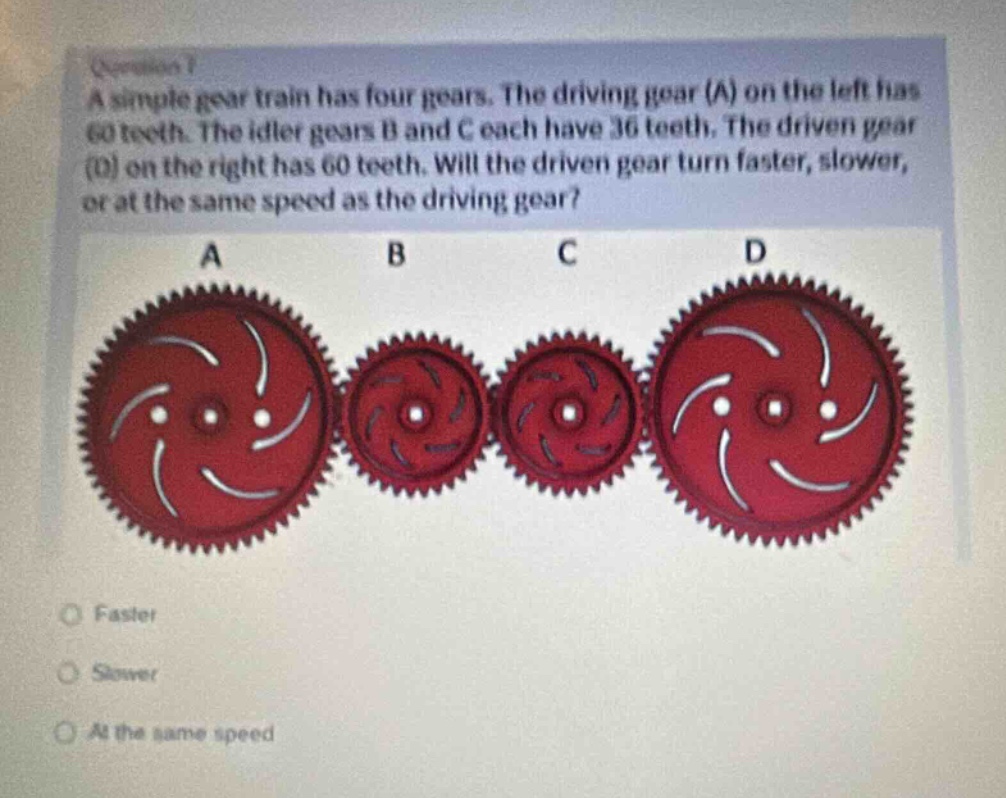
a simple gear train has four gears. the driving gear (a) on the left has 60 teeth. the idler gears b and c each have 36 teeth. the driven gear (d) on the right has 60 teeth. will the driven gear turn faster, slower, or at the same speed as the driving gear?
faster
slower
at the same speed
Step1: Recall gear speed formula
The speed ratio of two meshed gears is inverse to their tooth count ratio: $\frac{N_A}{N_D} = \frac{T_D}{T_A}$, where $N$ is rotational speed, $T$ is tooth count.
Step2: Account for idler gears
Idler gears only change direction, not the final speed ratio between driving (A) and driven (D) gears.
Step3: Plug in given values
$T_A=60$, $T_D=60$. Substitute into ratio: $\frac{N_A}{N_D} = \frac{60}{60}=1$
Step4: Interpret the ratio
A ratio of 1 means $N_A=N_D$.

Snap & solve any problem in the app
Get step-by-step solutions on Sovi AI
Photo-based solutions with guided steps
Explore more problems and detailed explanations
At the same speed