QUESTION IMAGE
Question
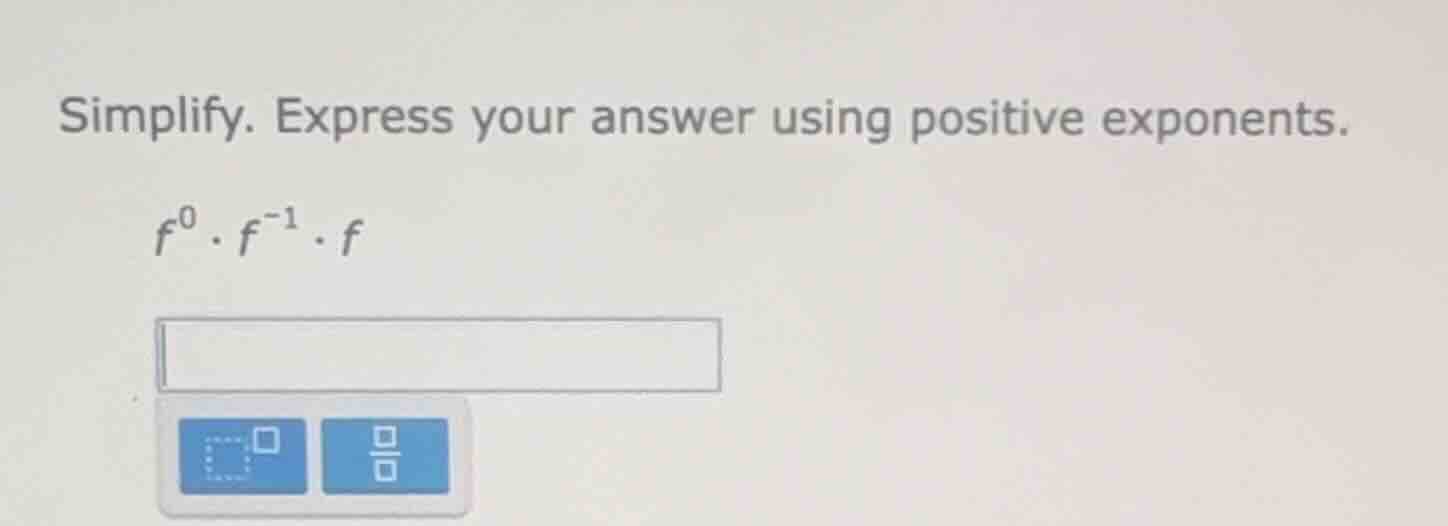
simplify. express your answer using positive exponents.\\( f^0 cdot f^{-1} cdot f \\)
Step1: Recall exponent rules
When multiplying terms with the same base, we use the rule \(a^m \cdot a^n = a^{m + n}\), and also \(a^0=1\) for any non - zero \(a\), and \(a^{-n}=\frac{1}{a^n}\) (but we want positive exponents, so we can use the addition of exponents first).
For the given expression \(f^{0}\cdot f^{-1}\cdot f\), first, note that \(f = f^{1}\) and \(f^{0}=1\) (assuming \(f
eq0\)).
Now, apply the rule \(a^m\cdot a^n=a^{m + n}\) to the exponents of \(f\).
The exponents are \(0\), \(- 1\), and \(1\). So we add them: \(0+( - 1)+1\).
Step2: Calculate the sum of exponents
Calculate \(0+( - 1)+1\): \(0-1 + 1=0\).
So the expression \(f^{0}\cdot f^{-1}\cdot f=f^{0+( - 1)+1}=f^{0}\). But \(f^{0} = 1\) (for \(f
eq0\)).
Alternatively, we can do it step by step:
First, \(f^{0}\cdot f^{-1}=f^{0+( - 1)}=f^{-1}\) (using \(a^m\cdot a^n=a^{m + n}\)).
Then, \(f^{-1}\cdot f=f^{-1 + 1}=f^{0}=1\).

Snap & solve any problem in the app
Get step-by-step solutions on Sovi AI
Photo-based solutions with guided steps
Explore more problems and detailed explanations
\(1\)