QUESTION IMAGE
Question
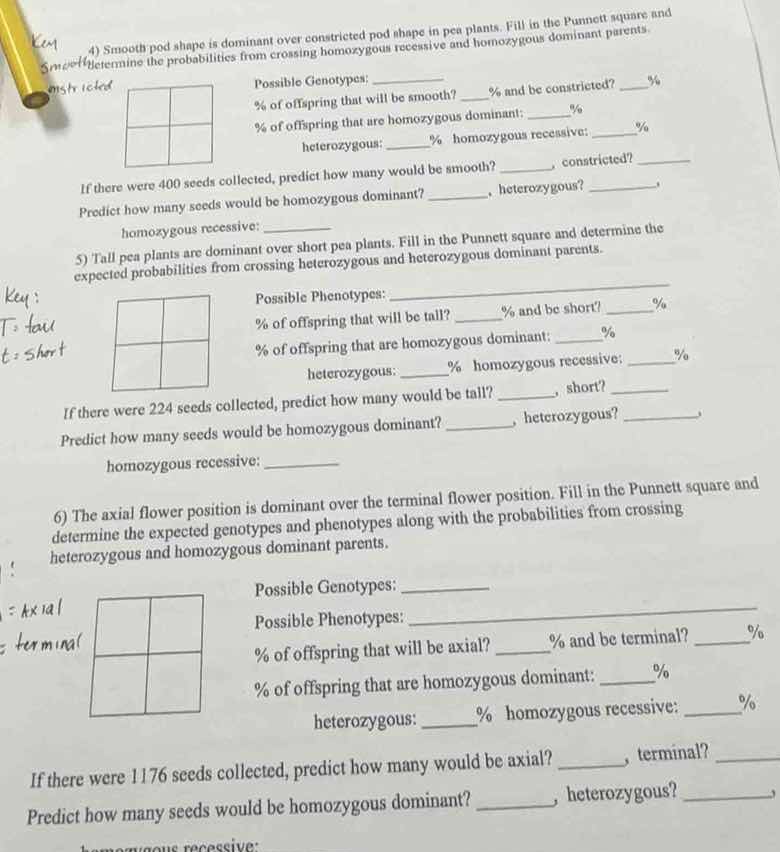
- smooth pod shape is dominant over constricted pod shape in pea plants. fill in the punnett square and determine the probabilities from crossing homozygous recessive and homozygous dominant parents. possible genotypes: ___ % of offspring that will be smooth? _ % and be constricted? _ % % of offspring that are homozygous dominant: _ % heterozygous: _ % homozygous recessive: _ % if there were 400 seeds collected, predict how many would be smooth? _, constricted? _ predict how many seeds would be homozygous dominant? _, heterozygous? _, homozygous recessive: _ 5) tall pea plants are dominant over short pea plants. fill in the punnett square and determine the expected probabilities from crossing heterozygous and heterozygous dominant parents. possible phenotypes: _ % of offspring that will be tall? _ % and be short? _ % % of offspring that are homozygous dominant: _ % heterozygous: _ % homozygous recessive: _ % if there were 224 seeds collected, predict how many would be tall? _, short? _ predict how many seeds would be homozygous dominant? _, heterozygous? _, homozygous recessive: _ 6) the axial flower position is dominant over the terminal flower position. fill in the punnett square and determine the expected genotypes and phenotypes along with the probabilities from crossing heterozygous and homozygous dominant parents. possible genotypes: _ possible phenotypes: _ % of offspring that will be axial? _ % and be terminal? _ % % of offspring that are homozygous dominant: _ % heterozygous: _ % homozygous recessive: _ % if there were 1176 seeds collected, predict how many would be axial? _, terminal? _ predict how many seeds would be homozygous dominant? _, heterozygous? _, homozygous recessive: ___
Problem 4: Smooth vs Constricted Pod Shape (Homozygous Recessive × Homozygous Dominant)
Step 1: Define Alleles
Let \( S \) = smooth (dominant), \( s \) = constricted (recessive).
Parent 1 (homozygous dominant): \( SS \) (gametes: \( S, S \))
Parent 2 (homozygous recessive): \( ss \) (gametes: \( s, s \))
Step 2: Punnett Square
| \( S \) | \( S \) | |
|---|---|---|
| \( s \) | \( Ss \) | \( Ss \) |
Step 3: Genotypes & Phenotypes
- Possible Genotypes: \( Ss \) (100%, since all offspring are \( Ss \)).
- Phenotypes: Smooth (100%, because \( S \) is dominant over \( s \); constricted: 0%).
- Homozygous dominant: 0% (no \( SS \) offspring).
- Heterozygous: 100% (all \( Ss \)).
- Homozygous recessive: 0% (no \( ss \) offspring).
Step 4: Seed Predictions (400 seeds)
- Smooth: \( 400 \times 100\% = 400 \)
- Constricted: \( 400 \times 0\% = 0 \)
- Homozygous dominant: \( 400 \times 0\% = 0 \)
- Heterozygous: \( 400 \times 100\% = 400 \)
- Homozygous recessive: \( 400 \times 0\% = 0 \)
Problem 5: Tall vs Short Pea Plants (Heterozygous × Heterozygous Dominant? Wait, correction: Likely "Heterozygous × Heterozygous" (since "heterozygous and heterozygous dominant" is unclear; standard is \( Tt \times Tt \), where \( T \)=tall, \( t \)=short).
Step 1: Alleles
\( T \) = tall (dominant), \( t \) = short (recessive). Parents: \( Tt \times Tt \) (gametes: \( T, t \) for each).
Step 2: Punnett Square
| \( T \) | \( t \) | |
|---|---|---|
| \( t \) | \( Tt \) | \( tt \) |
Step 3: Genotypes & Phenotypes
- Possible Phenotypes: Tall, Short.
- % Tall: \( \frac{3}{4} \times 100 = 75\% \) ( \( TT, Tt, Tt \) ), % Short: \( \frac{1}{4} \times 100 = 25\% \).
- Homozygous dominant (\( TT \)): \( \frac{1}{4} \times 100 = 25\% \).
- Heterozygous (\( Tt \)): \( \frac{2}{4} \times 100 = 50\% \).
- Homozygous recessive (\( tt \)): \( \frac{1}{4} \times 100 = 25\% \).
Step 4: Seed Predictions (224 seeds)
- Tall: \( 224 \times 75\% = 168 \)
- Short: \( 224 \times 25\% = 56 \)
- Homozygous dominant: \( 224 \times 25\% = 56 \)
- Heterozygous: \( 224 \times 50\% = 112 \)
- Homozygous recessive: \( 224 \times 25\% = 56 \)
Problem 6: Axial vs Terminal Flower Position (Heterozygous × Homozygous Dominant)
Step 1: Alleles
Let \( A \) = axial (dominant), \( a \) = terminal (recessive).
Parent 1 (homozygous dominant): \( AA \) (gametes: \( A, A \))
Parent 2 (heterozygous): \( Aa \) (gametes: \( A, a \))
Step 2: Punnett Square
| \( A \) | \( A \) | |
|---|---|---|
| \( a \) | \( Aa \) | \( Aa \) |
Step 3: Genotypes & Phenotypes
- Possible Genotypes: \( AA, Aa \) ( \( AA \): 2/4=50%, \( Aa \): 2/4=50% ).
- Possible Phenotypes: Axial (100%, since \( A \) is dominant; terminal: 0%).
- % Axial: 100%, % Terminal: 0%.
- Homozygous dominant (\( AA \)): \( \frac{2}{4} \times 100 = 50\% \).
- Heterozygous (\( Aa \)): \( \frac{2}{4} \times 100 = 50\% \).
- Homozygous recessive (\( aa \)): 0% (no \( aa \) offspring).
Step 4: Seed Predictions (1176 seeds)
- Axial: \( 1176 \times 100\% = 1176 \)
- Terminal: \( 1176 \times 0\% = 0 \)
- Homozygous dominant: \( 1176 \times 50\% = 588 \)
- Heterozygous: \( 1176 \times 50\% = 588 \)
- Homozygous recessive: \( 1176 \times 0\% = 0 \)
Final Answers (Summarized)
Problem 4
- Possible Genotypes: \( Ss \)
- % Smooth: 100%, % Con…

Snap & solve any problem in the app
Get step-by-step solutions on Sovi AI
Photo-based solutions with guided steps
Explore more problems and detailed explanations
Problem 4: Smooth vs Constricted Pod Shape (Homozygous Recessive × Homozygous Dominant)
Step 1: Define Alleles
Let \( S \) = smooth (dominant), \( s \) = constricted (recessive).
Parent 1 (homozygous dominant): \( SS \) (gametes: \( S, S \))
Parent 2 (homozygous recessive): \( ss \) (gametes: \( s, s \))
Step 2: Punnett Square
| \( S \) | \( S \) | |
|---|---|---|
| \( s \) | \( Ss \) | \( Ss \) |
Step 3: Genotypes & Phenotypes
- Possible Genotypes: \( Ss \) (100%, since all offspring are \( Ss \)).
- Phenotypes: Smooth (100%, because \( S \) is dominant over \( s \); constricted: 0%).
- Homozygous dominant: 0% (no \( SS \) offspring).
- Heterozygous: 100% (all \( Ss \)).
- Homozygous recessive: 0% (no \( ss \) offspring).
Step 4: Seed Predictions (400 seeds)
- Smooth: \( 400 \times 100\% = 400 \)
- Constricted: \( 400 \times 0\% = 0 \)
- Homozygous dominant: \( 400 \times 0\% = 0 \)
- Heterozygous: \( 400 \times 100\% = 400 \)
- Homozygous recessive: \( 400 \times 0\% = 0 \)
Problem 5: Tall vs Short Pea Plants (Heterozygous × Heterozygous Dominant? Wait, correction: Likely "Heterozygous × Heterozygous" (since "heterozygous and heterozygous dominant" is unclear; standard is \( Tt \times Tt \), where \( T \)=tall, \( t \)=short).
Step 1: Alleles
\( T \) = tall (dominant), \( t \) = short (recessive). Parents: \( Tt \times Tt \) (gametes: \( T, t \) for each).
Step 2: Punnett Square
| \( T \) | \( t \) | |
|---|---|---|
| \( t \) | \( Tt \) | \( tt \) |
Step 3: Genotypes & Phenotypes
- Possible Phenotypes: Tall, Short.
- % Tall: \( \frac{3}{4} \times 100 = 75\% \) ( \( TT, Tt, Tt \) ), % Short: \( \frac{1}{4} \times 100 = 25\% \).
- Homozygous dominant (\( TT \)): \( \frac{1}{4} \times 100 = 25\% \).
- Heterozygous (\( Tt \)): \( \frac{2}{4} \times 100 = 50\% \).
- Homozygous recessive (\( tt \)): \( \frac{1}{4} \times 100 = 25\% \).
Step 4: Seed Predictions (224 seeds)
- Tall: \( 224 \times 75\% = 168 \)
- Short: \( 224 \times 25\% = 56 \)
- Homozygous dominant: \( 224 \times 25\% = 56 \)
- Heterozygous: \( 224 \times 50\% = 112 \)
- Homozygous recessive: \( 224 \times 25\% = 56 \)
Problem 6: Axial vs Terminal Flower Position (Heterozygous × Homozygous Dominant)
Step 1: Alleles
Let \( A \) = axial (dominant), \( a \) = terminal (recessive).
Parent 1 (homozygous dominant): \( AA \) (gametes: \( A, A \))
Parent 2 (heterozygous): \( Aa \) (gametes: \( A, a \))
Step 2: Punnett Square
| \( A \) | \( A \) | |
|---|---|---|
| \( a \) | \( Aa \) | \( Aa \) |
Step 3: Genotypes & Phenotypes
- Possible Genotypes: \( AA, Aa \) ( \( AA \): 2/4=50%, \( Aa \): 2/4=50% ).
- Possible Phenotypes: Axial (100%, since \( A \) is dominant; terminal: 0%).
- % Axial: 100%, % Terminal: 0%.
- Homozygous dominant (\( AA \)): \( \frac{2}{4} \times 100 = 50\% \).
- Heterozygous (\( Aa \)): \( \frac{2}{4} \times 100 = 50\% \).
- Homozygous recessive (\( aa \)): 0% (no \( aa \) offspring).
Step 4: Seed Predictions (1176 seeds)
- Axial: \( 1176 \times 100\% = 1176 \)
- Terminal: \( 1176 \times 0\% = 0 \)
- Homozygous dominant: \( 1176 \times 50\% = 588 \)
- Heterozygous: \( 1176 \times 50\% = 588 \)
- Homozygous recessive: \( 1176 \times 0\% = 0 \)
Final Answers (Summarized)
Problem 4
- Possible Genotypes: \( Ss \)
- % Smooth: 100%, % Constricted: 0%
- % Homozygous dominant: 0%, Heterozygous: 100%, Homozygous recessive: 0%
- Smooth seeds: 400, Constricted: 0
- Homozygous dominant: 0, Heterozygous: 400, Homozygous recessive: 0
Problem 5 (Assuming \( Tt \times Tt \))
- Possible Phenotypes: Tall, Short
- % Tall: 75%, % Short: 25%
- % Homozygous dominant: 25%, Heterozygous: 50%, Homozygous recessive: 25%
- Tall seeds: 168, Short: 56
- Homozygous dominant: 56, Heterozygous: 112, Homozygous recessive: 56
Problem 6
- Possible Genotypes: \( AA, Aa \)
- Possible Phenotypes: Axial
- % Axial: 100%, % Terminal: 0%
- % Homozygous dominant: 50%, Heterozygous: 50%, Homozygous recessive: 0%
- Axial seeds: 1176, Terminal: 0
- Homozygous dominant: 588, Heterozygous: 588, Homozygous recessive: 0
(Note: For Problem 5, if the intended cross was "Heterozygous × Homozygous Dominant" (e.g., \( Tt \times TT \)), adjust accordingly. The above assumes the common \( Tt \times Tt \) cross for clarity.)