QUESTION IMAGE
Question
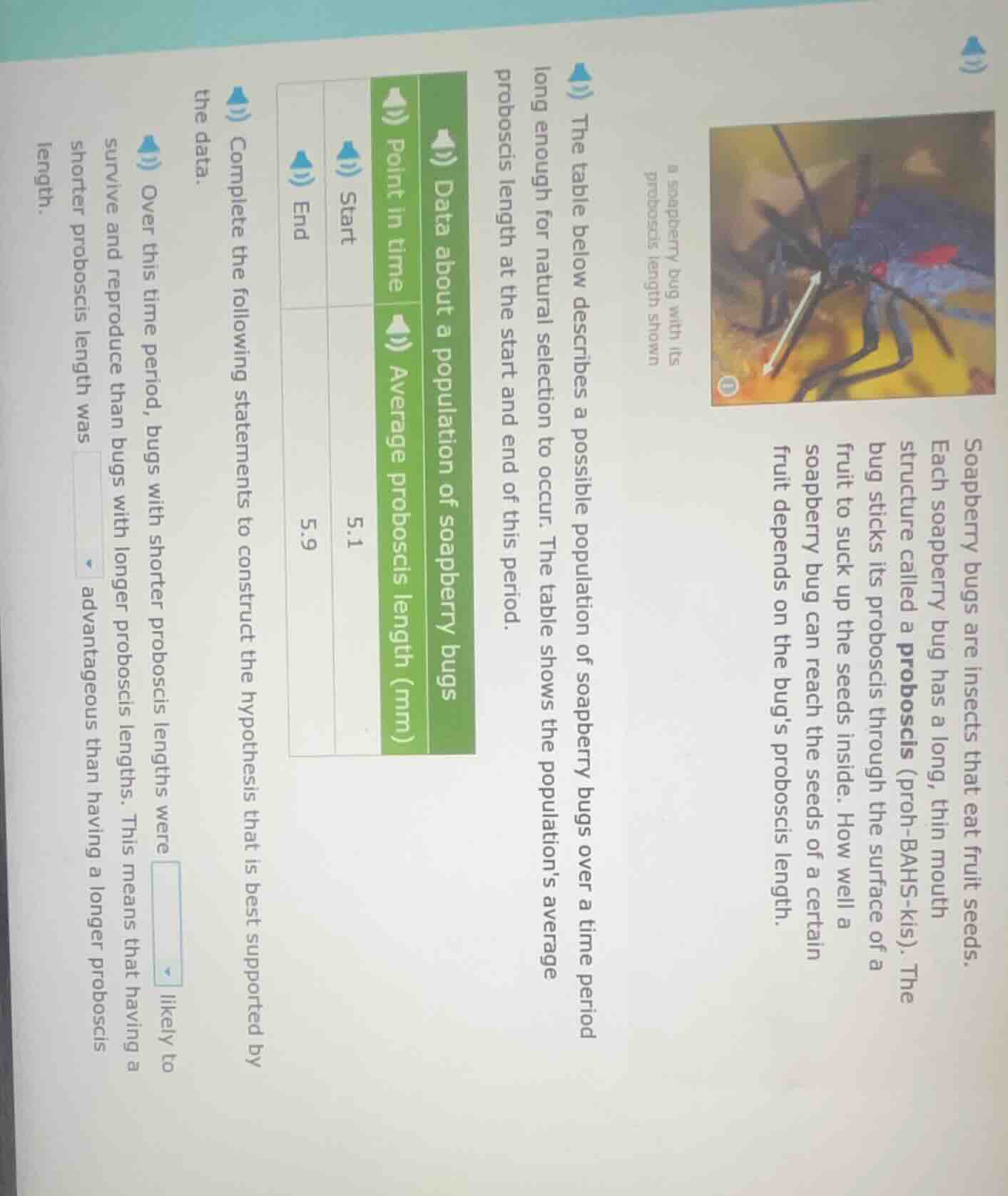
soapberry bugs are insects that eat fruit seeds. each soapberry bug has a long, thin mouth structure called a proboscis (proh-bahs-kis). the bug sticks its proboscis through the surface of a fruit to suck up the seeds inside. how well a soapberry bug can reach the seeds of a certain fruit depends on the bug’s proboscis length.
the table below describes a possible population of soapberry bugs over a time period long enough for natural selection to occur. the table shows the population’s average proboscis length at the start and end of this period.
data about a population of soapberry bugs
point in time | average proboscis length (mm)
--- | ---
start | 5.1
end | 5.9
complete the following statements to construct the hypothesis that is best supported by the data.
over this time period, bugs with shorter proboscis lengths were dropdown likely to survive and reproduce than bugs with longer proboscis lengths. this means that having a shorter proboscis length was dropdown advantageous than having a longer proboscis length.
- First, analyze the provided data: the average proboscis length increased from 5.1 mm (start) to 5.9 mm (end) over the time period.
- For natural selection, traits that improve survival/reproduction become more common. Since longer proboscises became average, shorter ones must have been less likely to survive/reproduce, meaning shorter length was less advantageous than longer length.

Snap & solve any problem in the app
Get step-by-step solutions on Sovi AI
Photo-based solutions with guided steps
Explore more problems and detailed explanations
- Over this time period, bugs with shorter proboscis lengths were less likely to survive and reproduce than bugs with longer proboscis lengths. This means that having a shorter proboscis length was less advantageous than having a longer proboscis length.