QUESTION IMAGE
Question
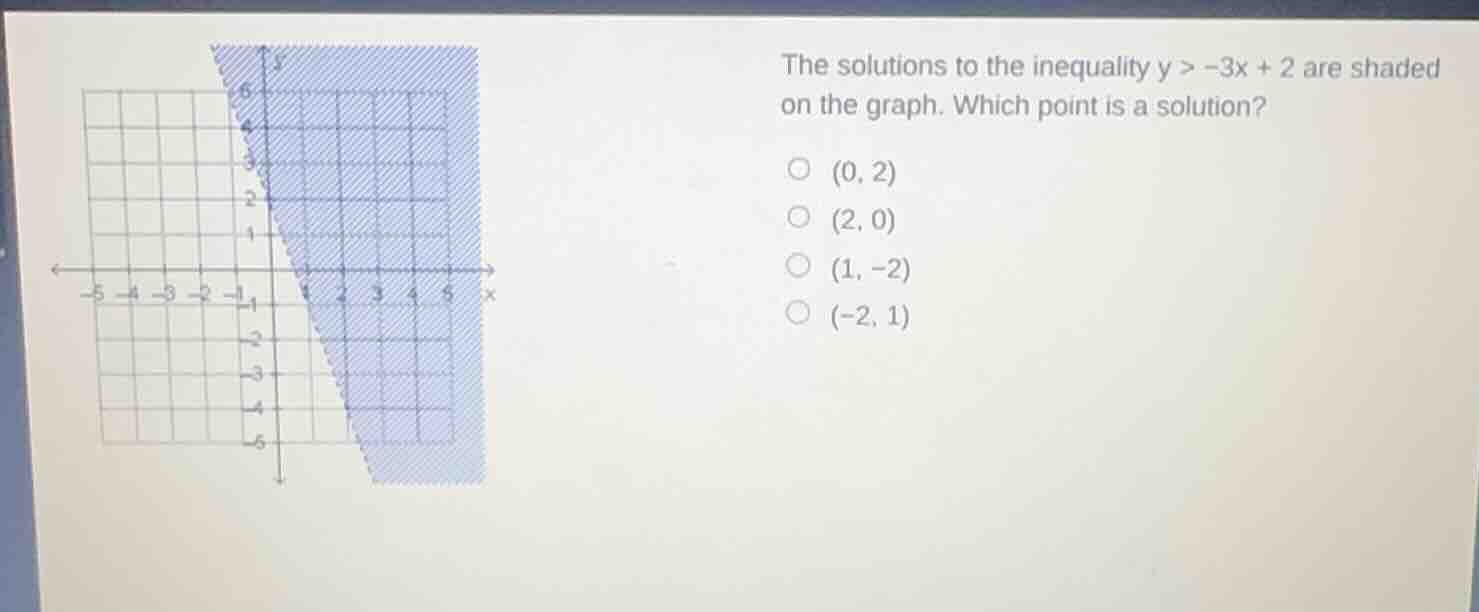
the solutions to the inequality $y > -3x + 2$ are shaded on the graph. which point is a solution?
$\bigcirc$ $(0, 2)$
$\bigcirc$ $(2, 0)$
$\bigcirc$ $(1, -2)$
$\bigcirc$ $(-2, 1)$
Step1: Check (0, 2)
Substitute \(x = 0\), \(y = 2\) into \(y > -3x + 2\):
\(2 > -3(0) + 2\)
\(2 > 0 + 2\)
\(2 > 2\) is false.
Step2: Check (2, 0)
Substitute \(x = 2\), \(y = 0\) into \(y > -3x + 2\):
\(0 > -3(2) + 2\)
\(0 > -6 + 2\)
\(0 > -4\) is true? Wait, wait, let's re - check the graph. The line is dashed (since the inequality is \(y > - 3x+2\), not \(y\geq - 3x + 2\)), and the shaded region. Wait, maybe I made a mistake. Wait, let's check the third point.
Wait, no, let's check the fourth point \((-2,1)\):
Step3: Check (1, -2)
Substitute \(x = 1\), \(y=-2\) into \(y > -3x + 2\):
\(-2 > -3(1)+2\)
\(-2 > -3 + 2\)
\(-2 > -1\) is false.
Step4: Check (-2, 1)
Substitute \(x=-2\), \(y = 1\) into \(y > -3x + 2\):
\(1 > -3(-2)+2\)
\(1 > 6 + 2\)
\(1 > 8\) is false. Wait, that can't be. Wait, maybe I messed up the sign. Wait, the inequality is \(y > -3x + 2\). Let's re - check (2,0):
\(y = 0\), \(-3x+2=-3\times2 + 2=-6 + 2=-4\). So \(0 > - 4\) is true. But wait, looking at the graph, the shaded region: when \(x = 2\), what's the \(y\) - value? The line is \(y=-3x + 2\), when \(x = 2\), \(y=-6 + 2=-4\). The shaded region is above the line? Wait, no, the inequality is \(y > -3x + 2\), so the region above the line \(y=-3x + 2\) (dashed line). Wait, but (2,0): \(y = 0\), and \(-3x+2=-4\), so \(0 > - 4\) is true. But let's check the first point \((0,2)\):
\(y = 2\), \(-3x+2=-3\times0 + 2 = 2\). So \(y > -3x + 2\) becomes \(2 > 2\), which is false (since the line is dashed, the points on the line are not included).
Wait, maybe I misread the graph. Let's look at the graph again. The line is \(y=-3x + 2\), when \(x = 0\), \(y = 2\) (the y - intercept), and when \(y = 0\), \(0=-3x + 2\), \(3x=2\), \(x=\frac{2}{3}\approx0.67\). The shaded region: on the right side of the line? Wait, no, the slope is - 3, so the line goes from (0,2) to \((\frac{2}{3},0)\). The shaded region: let's take a test point, say (0,3). Plug into \(y > -3x + 2\): \(3 > 0 + 2\), which is true. (0,3) is in the shaded region. Now, let's check the points:
- (0,2): on the line (dashed), so not a solution.
- (2,0): Let's see, when \(x = 2\), the line has \(y=-4\). So \(y = 0\) is above \(y=-4\), so \(0 > - 4\) (since \(y > -3x + 2\) when \(x = 2\), \(y > - 4\)), so (2,0) satisfies \(y > -3x + 2\).
- (1, - 2): \(y=-2\), \(-3x + 2=-3\times1+2=-1\), so \(-2 > - 1\) is false.
- (-2,1): \(y = 1\), \(-3x+2=-3\times(-2)+2=6 + 2=8\), so \(1 > 8\) is false.
Wait, but the answer should be (2,0)? But let's check again. Wait, maybe I made a mistake in the fourth point. Wait, \((-2,1)\): \(x=-2\), \(y = 1\). \(-3x+2=-3\times(-2)+2=6 + 2=8\). So \(1 > 8\) is false. (2,0): \(x = 2\), \(y = 0\). \(-3x+2=-6 + 2=-4\). So \(0 > - 4\) is true. So the solution is (2,0).

Snap & solve any problem in the app
Get step-by-step solutions on Sovi AI
Photo-based solutions with guided steps
Explore more problems and detailed explanations
B. (2, 0)