QUESTION IMAGE
Question
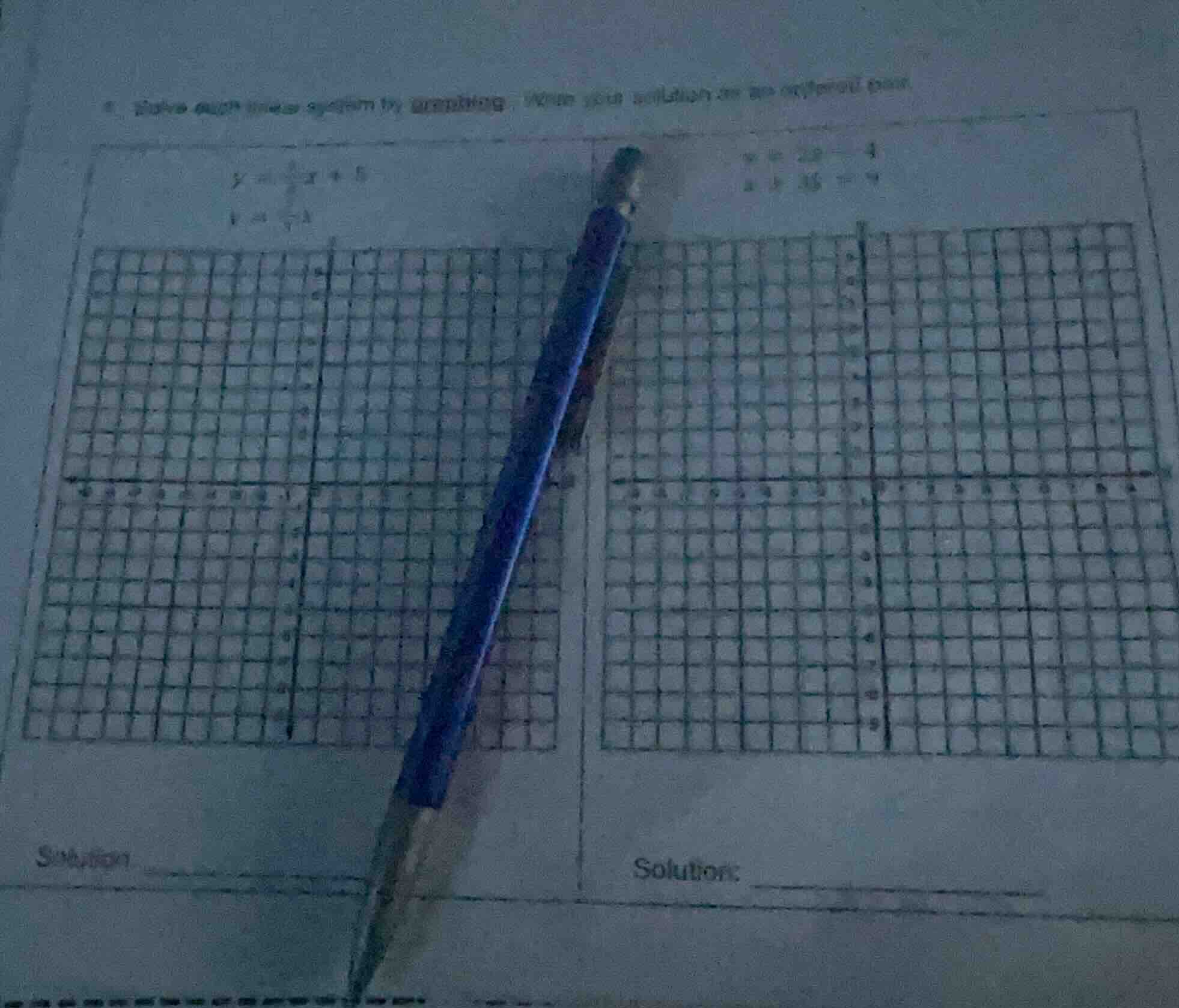
solve each linear system by graphing. write your solution as an ordered pair.
left system: ( y = \frac{1}{2}x + 5 ) and ( y = \frac{3}{2}x )
right system: ( x = 2y - 4 ) and ( x + 2y = 8 )
(graph grids are present with a pen on top, and solution lines at the bottom: \solution: ______\ for each system)
First System of Equations: \( y = \frac{1}{2}x + 5 \) and \( y = \frac{1}{2}x \) (assuming the second equation is \( y = \frac{1}{2}x \) from the image)
Step1: Analyze the slopes and y-intercepts
The first equation \( y = \frac{1}{2}x + 5 \) has a slope of \( \frac{1}{2} \) and a y-intercept of \( 5 \). The second equation \( y = \frac{1}{2}x \) has a slope of \( \frac{1}{2} \) and a y-intercept of \( 0 \). Since the slopes are equal and the y-intercepts are different, the lines are parallel.
Step2: Determine the solution
Parallel lines never intersect, so there is no solution for this system.
Second System of Equations: \( x = 2y - 4 \) and \( x + 2y = 4 \)
Step1: Rewrite the equations in slope-intercept form (\( y = mx + b \))
For \( x = 2y - 4 \), solve for \( y \):
\( 2y = x + 4 \)
\( y = \frac{1}{2}x + 2 \)
For \( x + 2y = 4 \), solve for \( y \):
\( 2y = -x + 4 \)
\( y = -\frac{1}{2}x + 2 \)
Step2: Find the intersection point
To find the solution, we can set the two equations equal to each other (or use substitution/elimination). Let's use substitution. From the first rewritten equation \( y = \frac{1}{2}x + 2 \), substitute into the second rewritten equation \( y = -\frac{1}{2}x + 2 \):
\( \frac{1}{2}x + 2 = -\frac{1}{2}x + 2 \)
Add \( \frac{1}{2}x \) to both sides:
\( x + 2 = 2 \)
Subtract 2 from both sides:
\( x = 0 \)
Now substitute \( x = 0 \) into \( y = \frac{1}{2}x + 2 \):
\( y = \frac{1}{2}(0) + 2 = 2 \)
So the solution is the ordered pair \( (0, 2) \).

Snap & solve any problem in the app
Get step-by-step solutions on Sovi AI
Photo-based solutions with guided steps
Explore more problems and detailed explanations
s:
- First system: No solution (parallel lines)
- Second system: \( (0, 2) \)