QUESTION IMAGE
Question
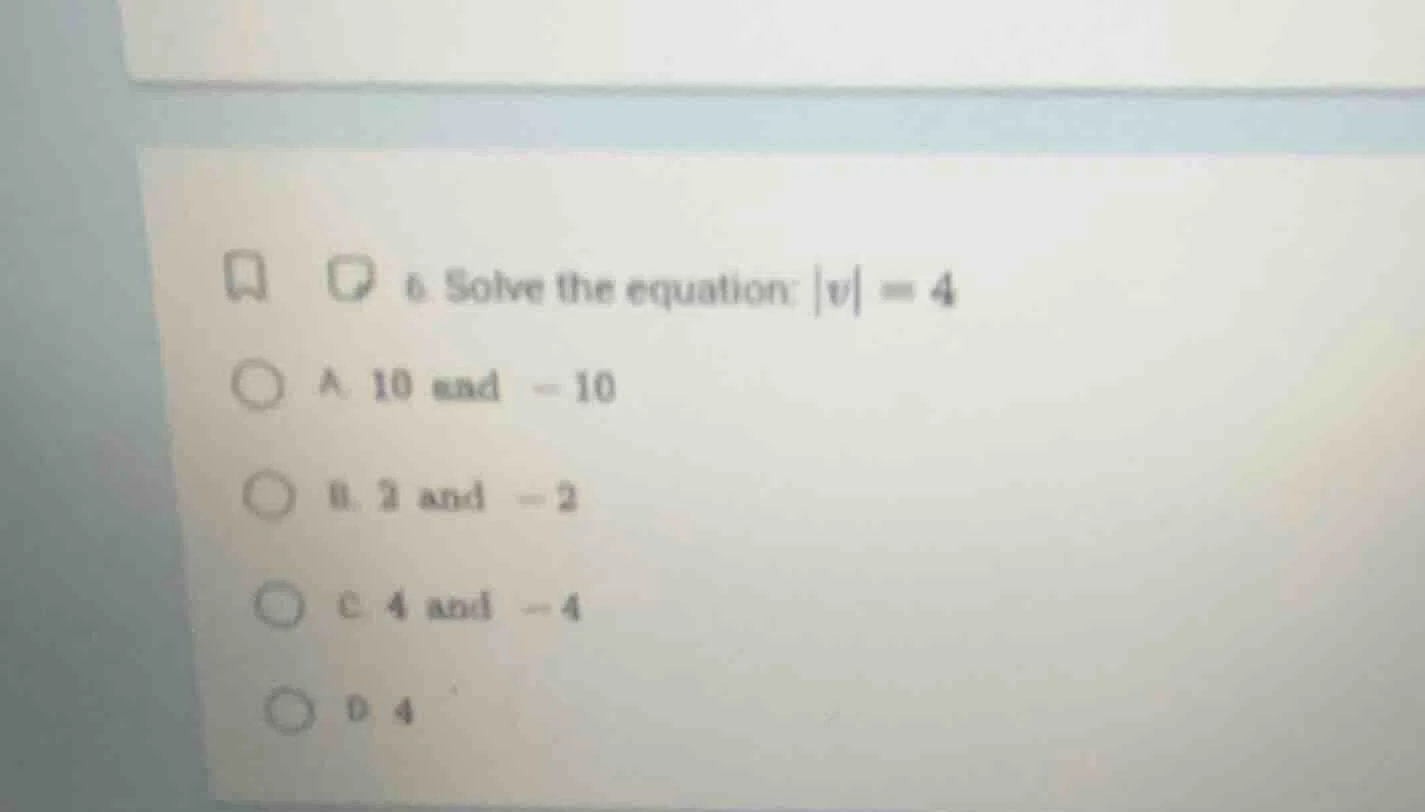
- solve the equation: |v| = 4
a. 10 and -10
b. 2 and -2
c. 4 and -4
d. 4
The absolute value of a number \( |x| \) is the distance of \( x \) from zero on the number line. By the definition of absolute value, if \( |v| = 4 \), this means that \( v \) is a number whose distance from zero is 4. The numbers that are 4 units away from zero on the number line are 4 (to the right of zero) and -4 (to the left of zero). So we set up two cases:
- Case 1: When \( v \) is non - negative, \( |v|=v \). So if \( |v| = 4 \) and \( v\geq0 \), then \( v = 4 \).
- Case 2: When \( v \) is negative, \( |v|=-v \). So if \( |v| = 4 \) and \( v<0 \), then \( -v=4 \), which implies \( v=- 4 \).

Snap & solve any problem in the app
Get step-by-step solutions on Sovi AI
Photo-based solutions with guided steps
Explore more problems and detailed explanations
C. 4 and - 4