QUESTION IMAGE
Question
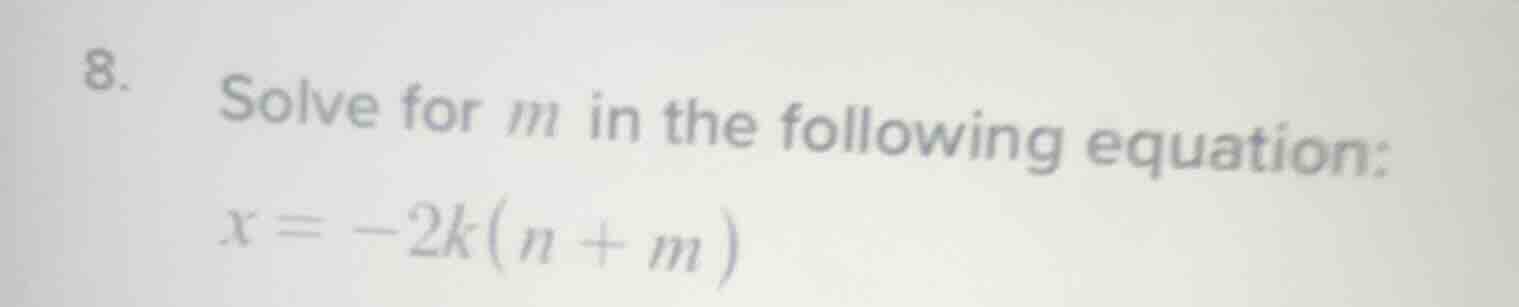
- solve for m in the following equation: x = -2k(n + m)
Step1: Divide both sides by -2k
To isolate the term containing \( m \), we divide both sides of the equation \( x = -2k(n + m) \) by \( -2k \) (assuming \( k
eq 0 \)). This gives us \(\frac{x}{-2k}=n + m\).
Step2: Subtract n from both sides
Now, to solve for \( m \), we subtract \( n \) from both sides of the equation \(\frac{x}{-2k}=n + m\). This results in \( m=\frac{x}{-2k}-n\), which can also be written as \( m = -\frac{x}{2k}-n \) or \( m=-\frac{x + 2kn}{2k}\) (by finding a common denominator).

Snap & solve any problem in the app
Get step-by-step solutions on Sovi AI
Photo-based solutions with guided steps
Explore more problems and detailed explanations
\( m = -\frac{x}{2k}-n \) (or equivalent forms like \( m=-\frac{x + 2kn}{2k} \))