QUESTION IMAGE
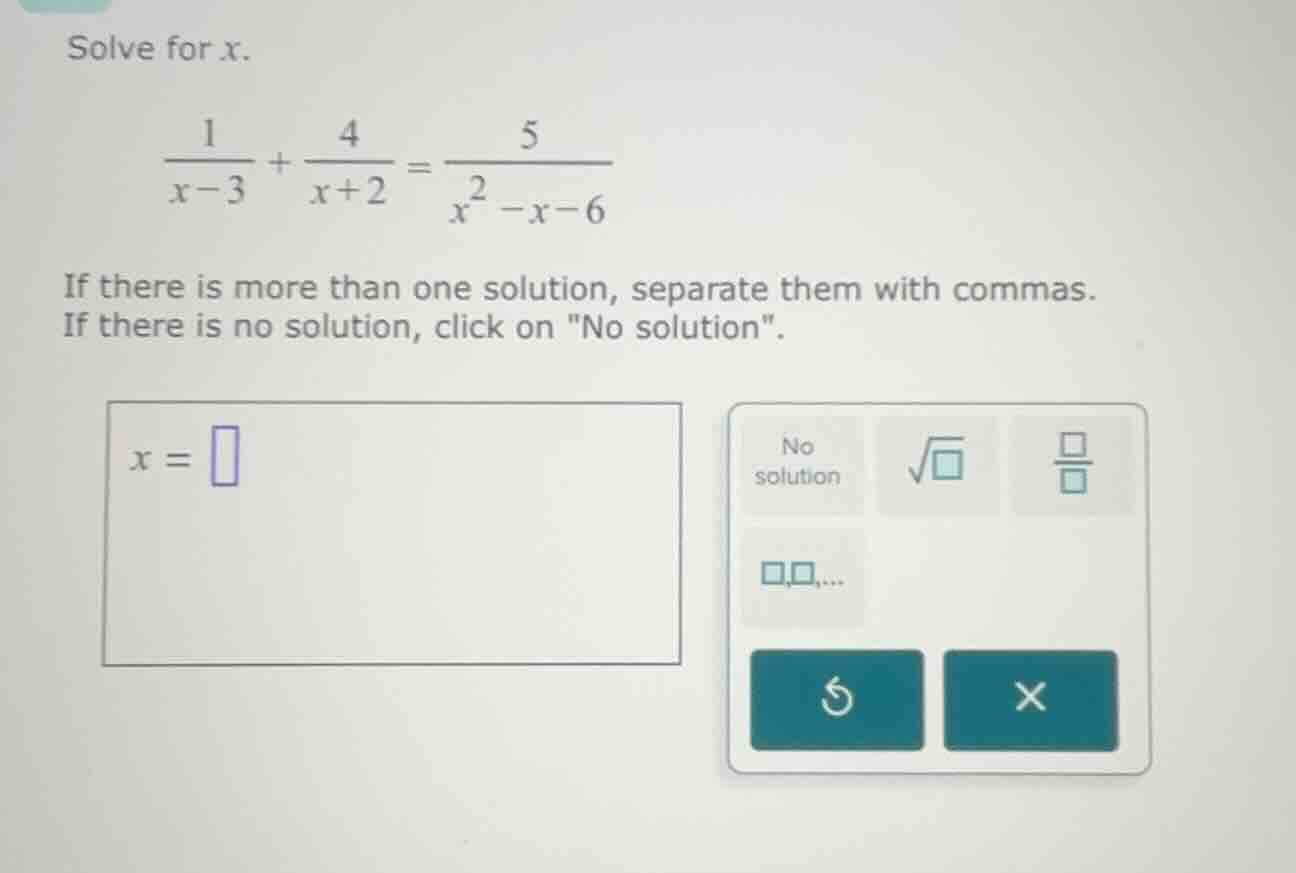
Question
solve for x.
\\(\frac{1}{x - 3} + \frac{4}{x + 2} = \frac{5}{x^2 - x - 6}\\)
if there is more than one solution, separate them with commas.
if there is no solution, click on
o solution\.
\\(x = \square\\)
Step1: Factor the denominator on the right
First, factor the quadratic in the denominator of the right - hand side. We know that \(x^{2}-x - 6=(x - 3)(x+2)\) (by using the formula \(ax^{2}+bx + c=a(x - x_1)(x - x_2)\) where \(x_1\) and \(x_2\) are the roots of the quadratic equation \(ax^{2}+bx + c = 0\). For \(x^{2}-x - 6\), we solve \(x^{2}-x - 6=0\), and by factoring, we get \((x - 3)(x + 2)=0\), so the roots are \(x = 3\) and \(x=-2\)). So the equation \(\frac{1}{x - 3}+\frac{4}{x + 2}=\frac{5}{x^{2}-x - 6}\) becomes \(\frac{1}{x - 3}+\frac{4}{x + 2}=\frac{5}{(x - 3)(x + 2)}\).
Step2: Find the domain
The domain of the original equation is all real numbers except \(x = 3\) and \(x=-2\) (because if \(x = 3\) or \(x=-2\), the denominators \(x - 3\), \(x + 2\) or \((x - 3)(x + 2)\) will be zero, and division by zero is undefined).
Step3: Multiply through by the common denominator
Multiply each term in the equation \(\frac{1}{x - 3}+\frac{4}{x + 2}=\frac{5}{(x - 3)(x + 2)}\) by \((x - 3)(x + 2)\) (the common denominator) to clear the fractions.
We get:
\((x + 2)\times1+(x - 3)\times4 = 5\)
Step4: Expand and simplify the left - hand side
Expand the left - hand side:
\(x+2 + 4x-12=5\)
Combine like terms:
\((x + 4x)+(2-12)=5\)
\(5x-10 = 5\)
Step5: Solve for x
Add 10 to both sides of the equation:
\(5x-10 + 10=5 + 10\)
\(5x=15\)
Divide both sides by 5:
\(x=\frac{15}{5}=3\)
Step6: Check the solution against the domain
But we know from the domain of the original equation that \(x
eq3\) (because when \(x = 3\), the denominator \(x - 3=0\) in the original equation). So the solution \(x = 3\) is extraneous.

Snap & solve any problem in the app
Get step-by-step solutions on Sovi AI
Photo-based solutions with guided steps
Explore more problems and detailed explanations
No solution