QUESTION IMAGE
Question
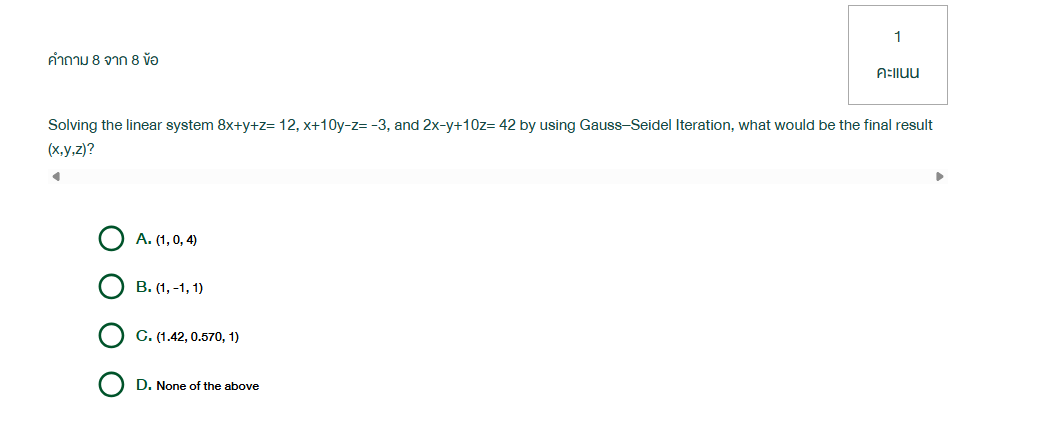
solving the linear system 8x + y + z = 12, x + 10y - z = -3, and 2x - y + 10z = 42 by using gauss - seidel iteration, what would be the final result (x, y, z)? a. (1, 0, 4) b. (1, -1, 1) c. (1.42, 0.570, 1) d. none of the above
Step1: Recall Gauss - Seidel Iteration for Linear Systems
The Gauss - Seidel iteration method is used to solve a system of linear equations of the form \(Ax = b\). For a system of linear equations:
\(a_{11}x + a_{12}y+a_{13}z=b_1\)
\(a_{21}x + a_{22}y+a_{23}z=b_2\)
\(a_{31}x + a_{32}y+a_{33}z=b_3\)
The iteration formulas are:
\(x^{(k + 1)}=\frac{1}{a_{11}}(b_1 - a_{12}y^{(k)}-a_{13}z^{(k)})\)
\(y^{(k + 1)}=\frac{1}{a_{22}}(b_2 - a_{21}x^{(k + 1)}-a_{23}z^{(k)})\)
\(z^{(k + 1)}=\frac{1}{a_{33}}(b_3 - a_{31}x^{(k + 1)}-a_{32}y^{(k + 1)})\)
First, we write the given system of equations in the form suitable for Gauss - Seidel iteration. The given system is:
\(8x + y+z = 12\) ---(1)
\(x + 10y - z=-3\) ---(2)
\(2x - y+10z = 42\) ---(3)
From equation (1), we can express \(x\) in terms of \(y\) and \(z\): \(x=\frac{12 - y - z}{8}\)
From equation (2), we can express \(y\) in terms of \(x\) and \(z\): \(y=\frac{- 3 - x+z}{10}\)
From equation (3), we can express \(z\) in terms of \(x\) and \(y\): \(z=\frac{42 - 2x + y}{10}\)
We start with an initial guess. Let's assume the initial guess \((x^{(0)},y^{(0)},z^{(0)})=(0,0,0)\)
Step2: First Iteration (k = 0)
For \(x^{(1)}\):
Using \(x=\frac{12 - y^{(0)}-z^{(0)}}{8}\), with \(y^{(0)} = 0\) and \(z^{(0)}=0\)
\(x^{(1)}=\frac{12-0 - 0}{8}=\frac{12}{8} = 1.5\)
For \(y^{(1)}\):
Using \(y=\frac{-3 - x^{(1)}+z^{(0)}}{10}\), with \(x^{(1)} = 1.5\) and \(z^{(0)} = 0\)
\(y^{(1)}=\frac{-3-1.5 + 0}{10}=\frac{-4.5}{10}=-0.45\)
For \(z^{(1)}\):
Using \(z=\frac{42 - 2x^{(1)}+y^{(1)}}{10}\), with \(x^{(1)} = 1.5\) and \(y^{(1)}=-0.45\)
\(z^{(1)}=\frac{42-2\times1.5+(- 0.45)}{10}=\frac{42 - 3-0.45}{10}=\frac{38.55}{10}=3.855\)
Step3: Second Iteration (k = 1)
For \(x^{(2)}\):
Using \(x=\frac{12 - y^{(1)}-z^{(1)}}{8}\), with \(y^{(1)}=-0.45\) and \(z^{(1)} = 3.855\)
\(x^{(2)}=\frac{12-(-0.45)-3.855}{8}=\frac{12 + 0.45-3.855}{8}=\frac{8.595}{8}\approx1.074\)
For \(y^{(2)}\):
Using \(y=\frac{-3 - x^{(2)}+z^{(1)}}{10}\), with \(x^{(2)}\approx1.074\) and \(z^{(1)} = 3.855\)
\(y^{(2)}=\frac{-3-1.074 + 3.855}{10}=\frac{-4.074 + 3.855}{10}=\frac{-0.219}{10}=-0.0219\)
For \(z^{(2)}\):
Using \(z=\frac{42 - 2x^{(2)}+y^{(2)}}{10}\), with \(x^{(2)}\approx1.074\) and \(y^{(2)}=-0.0219\)
\(z^{(2)}=\frac{42-2\times1.074+(-0.0219)}{10}=\frac{42-2.148 - 0.0219}{10}=\frac{39.8301}{10}=3.983\)
Step4: Third Iteration (k = 2)
For \(x^{(3)}\):
Using \(x=\frac{12 - y^{(2)}-z^{(2)}}{8}\), with \(y^{(2)}=-0.0219\) and \(z^{(2)} = 3.983\)
\(x^{(3)}=\frac{12-(-0.0219)-3.983}{8}=\frac{12 + 0.0219-3.983}{8}=\frac{8.0389}{8}\approx1.005\)
For \(y^{(3)}\):
Using \(y=\frac{-3 - x^{(3)}+z^{(2)}}{10}\), with \(x^{(3)}\approx1.005\) and \(z^{(2)} = 3.983\)
\(y^{(3)}=\frac{-3-1.005 + 3.983}{10}=\frac{-4.005 + 3.983}{10}=\frac{-0.022}{10}=-0.0022\)
For \(z^{(3)}\):
Using \(z=\frac{42 - 2x^{(3)}+y^{(3)}}{10}\), with \(x^{(3)}\approx1.005\) and \(y^{(3)}=-0.0022\)
\(z^{(3)}=\frac{42-2\times1.005+(-0.0022)}{10}=\frac{42-2.01 - 0.0022}{10}=\frac{39.9878}{10}=3.9988\)
We can see that as the iterations progress, \(x\approx1\), \(y\approx0\), \(z\approx4\) (since when we check the option A: \((1,0,4)\))
Let's verify the option A in the original equations:
For equation (1): \(8\times1+0 + 4=12\), \(8 + 4=12\), \(12 = 12\) (True)
For equation (2): \(1+10\times0-4=-3\), \(1 - 4=-3\), \(-3=-3\) (True)
For equation (3): \(2\times1-0 + 10\times4=42\), \(2+40 = 42\), \(42=42\) (True)

Snap & solve any problem in the app
Get step-by-step solutions on Sovi AI
Photo-based solutions with guided steps
Explore more problems and detailed explanations
A. (1, 0, 4)