QUESTION IMAGE
Question
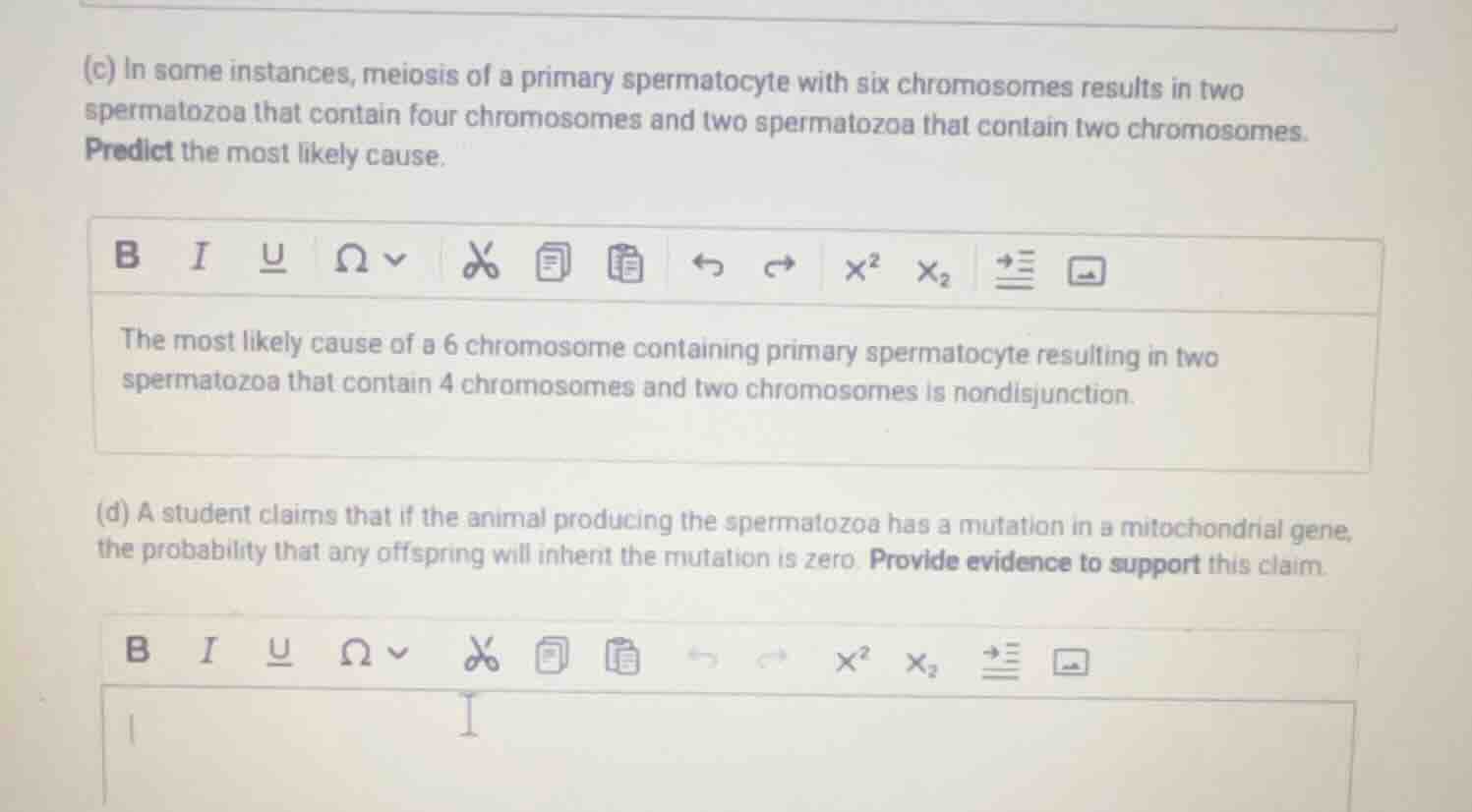
(c) in some instances, meiosis of a primary spermatocyte with six chromosomes results in two spermatozoa that contain four chromosomes and two spermatozoa that contain two chromosomes. predict the most likely cause.
the most likely cause of a 6 chromosome containing primary spermatocyte resulting in two spermatozoa that contain 4 chromosomes and two chromosomes is nondisjunction.
(d) a student claims that if the animal producing the spermatozoa has a mutation in a mitochondrial gene, the probability that any offspring will inherit the mutation is zero. provide evidence to support this claim.
Part (c)
During meiosis, normal chromosome segregation ensures each gamete (spermatozoa here) gets half the parent cell's chromosomes. A primary spermatocyte with 6 chromosomes should produce sperm with 3 each. Nondisjunction (failure of chromosomes to separate properly in meiosis I or II) causes some gametes to have extra (4) and others to have fewer (2) chromosomes.
In animals, mitochondrial DNA (mtDNA) is inherited maternally. Sperm contribute little to no mitochondria to the zygote (fertilized egg); the zygote’s mitochondria come from the mother’s egg. So, a mutation in a male’s (animal producing sperm) mitochondrial gene won’t be passed to offspring, as sperm’s mitochondria (and thus mtDNA) are not inherited by the embryo.

Snap & solve any problem in the app
Get step-by-step solutions on Sovi AI
Photo-based solutions with guided steps
Explore more problems and detailed explanations
The most likely cause is nondisjunction (failure of chromosome pairs or sister chromatids to separate during meiosis), leading to unequal distribution of chromosomes in the resulting spermatozoa.